




Why Is Intel (INTC) Stock Volatile After Earnings? Revenue Beat Overshadowed by $11 Billion Loss
TradingKey - Even though the chipmaker's second-quarter revenue surpassed Wall Street estimates, along with an increase in gross margins and a more upbeat third-quarter forecast, the stock was unable to keep pace with its initial gain after reports.
Trading nearly 10% higher in after-hours trading initially, shares of Intel (NASDAQ: INTC) retreated following investors weighing in on its $11 billion net loss in relation to restructuring costs. It remains to be seen if the stronger demand, increasing 18A ramp-up progress, and better profitability will make up for the losses associated with restructuring the company's business.
Revenue Beat Expectations, But Losses Grew
Intel generated revenues of $16.1 billion in Q2, 25% higher than one year ago and above Wall Street's estimate of about $14.4 billion. Gross margin also jumped dramatically to 40.4% on a GAAP basis, and adjusted earnings placed at $0.42 per share, contrasting with a loss of $0.10 in the previous year's period.
However, the biggest talking point was the bottom line. Intel, meanwhile, reported a net loss of about $11 billion, or $2.16 per share, compared with a $2.9 billion loss a year ago. The stock's early rally was driven in part by that huge loss, which blunted the rest of the stock's operating performance.
Q3 Outlook Suggests Recovery Is Continuing
For the future, Intel is projecting revenue of $15.8 billion to $16.8 billion and reported EPS of $0.31 and adjusted EPS of $0.38 for the third quarter.
Management's guidance implies demand will be sustained, especially for its server processors, over the next couple months. Investors will be waiting to gauge if this quarter is a harbinger of a sustained recovery, or just a good quarter.
Prior to the earnings report, options traders were anticipating a swing of around 12% to 15% on Thursday, and it was clear how split the market was, as it swung wildly in the after-hours session.
Intel's 18A Manufacturing Progress Is Driving Optimism
In addition to the financial performance, much of Wall Street is still focused on Intel's manufacturing turnaround.
The company's 18A process technology is also a key component of the company's foundry approach and was reportedly able to upgrade manufacturing yields to approximately 85% from around 65% 3 months ago.
Intel has also begun high-volume production of the selected Core Ultra Series 3 processors with ASML's High-NA EUV technology, while the improved 18A-P process is in risk production. In the quarter, Intel unveiled its first server processor using 18A nodes, Xeon 6+, and announced new partnerships for AI infrastructure with SambaNova and Foxconn.
However, over 130 customers are reportedly testing Intel's new Core Ultra and Core Series 3 chips for use in edge AI and robotics applications, indicating that the company's manufacturing approach is starting to show signs of commercial traction.
Analysts Became More Bullish Before Earnings
The overall analyst consensus is Hold but Wall Street had begun to increase price targets in advance of the report.
KeyBanc raised its target to $155, UBS its target to $121, and TD Cowen and Susquehanna both upped theirs to $115. Citi has kept its Buy rating and set a $130 price goal for Intel, projecting that the company could gain almost half of the CPU market by 2030.
HSBC is still one of the most bullish names with a price target of $200, while Rosenblatt's team is the most bearish, stuck with a Sell rating and a price target of $65, given manufacturing concerns that could continue to hamper Intel's recovery.
The wide spread of price targets reflects the uncertainty among analysts about the company's future.
AMD Still Poses the Biggest Competitive Threat
While progress has been made, Intel is still facing competition from AMD, especially in the data center market, which Intel had long ruled.
Some analysts also have raised concerns that the memory shortage will hinder PC sales in the second half of 2026, adding further pressure on margins even as Intel's foundry operation improves.
Key Levels to Watch
The average analyst price target is now approximately $113.72, which suggests some downside from current prices. The stock is rated a consensus 8 buys, 20 holds, and 2 sells among 30 analysts.
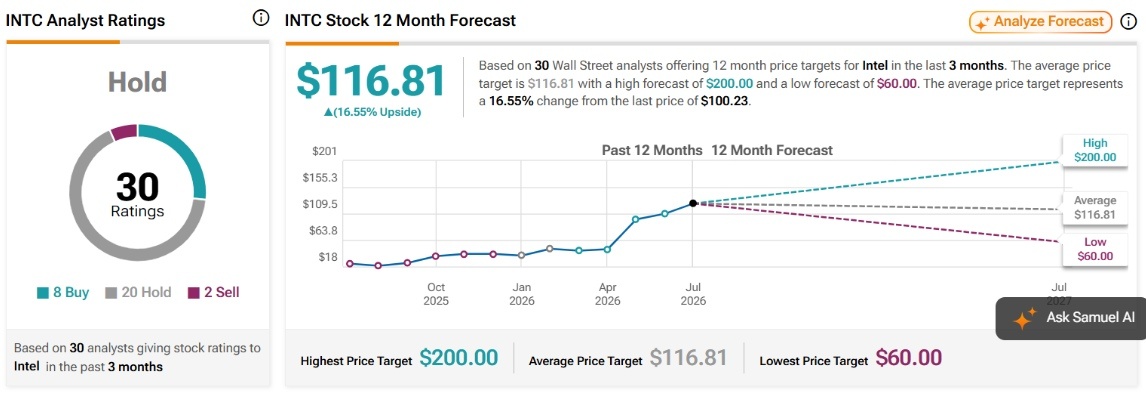
Image Source: tipranks
From a technical perspective, $109 has become an important resistance level, while $100 continues to act as key psychological support. Any move above $109 could help sustain the bulls' momentum while a pullback below $100 could bring the shares back to the $82-$89 range.
The results delivered by Intel were above expectations and helped drive up margins, while the progress around its 18A manufacturing roadmap continued as well. But the drastic $11 billion loss, which caught investors' eyes, reminds them that the restructuring is far from over.
The third quarter results will be the next big catalyst. Intel would have to keep improving manufacturing yields, and still have robust demand for servers to build confidence in the recovery. In the meantime, investors will keep weighing Intel's exciting progress at the office with the heavy price tag of its transition.
Intel (NASDAQ: INTC) Technical Analysis: Descending Channel Caps Recovery as Resistance Holds
Intel (NASDAQ: INTC), currently trading near $103.30, appears to be contained inside a clearly visible descending channel that continues to favor the bears. The rally from the recent lows is facing resistance near the channel top, just under the 50-period EMA at $105.68 and the 200-period EMA at $108.03, confirming that these levels have become a key resistance.

Intel (INTC) Stock Price Chart - Source: Tradingview
The lower trend, characterized by lower highs and lower lows, still dominates the stock. Nevertheless, RSI has moved higher towards 50.9, which indicates that the selling momentum has decreased and we are currently in a neutral range, not an oversold one.
A break of $105.68 and the descending trendline would be the first bullish sign, paving the way towards $106.72 and $108.03. Until that occurs, the price may go lower. A failure to stay above $96.74 will result in a drop down towards $89.45 as the longer-term downtrend persists.
In the meantime, Intel is at a technical turning point. Though the RSI has moved up, a break and close above the channel top is still required for sustained buying in the coming period.
Conclusion
Intel's second quarter offered evidence of tangible operational improvement. Revenue came in above forecast, margins came back, and management issued a forward-looking 3Q outlook that suggests demand for data-centre processors and AI products is still good. The $11 billion net loss, however, reminded investors that Intel's turnaround is costly and has a long way to go.
To maintain confidence in the recovery from here, 18A progress, foundry execution, enterprise AI, and evidence of sustainable profitability will matter as much as beat rates. Reclaiming $105.68, and more importantly $108.03, is bullish; $96.74 is the key level of support to hold. The next few quarters will decide whether Intel can deliver sustainable growth in earnings, or whether restructuring will continue to mask better operational results.
Recommended Articles


