




JPMorgan CEO Jamie Dimon Just Sent an Ominous Warning to Wall Street: "Close to as Good as It Gets"
Key Points
JPMorgan Chase just posted incredibly strong earnings.
JPMorgan Chase CEO Jamie Dimon said he has concerns about a range of issues affecting the market and economy.
Dimon is concerned about elevated valuations.
- 10 stocks we like better than JPMorgan Chase ›
There aren't too many people in the financial world more respected than JPMorgan Chase Chief Executive Officer Jamie Dimon. JPMorgan Chase is the largest bank in the U.S. by assets, and Dimon has successfully steered the company through the Great Recession and the pandemic, all while making some very smart strategic moves along the way.
Notably, JPMorgan acquired First Republic as it was on the brink of failure during the 2023 Silicon Valley Bank crisis. Needless to say, investors and stakeholders across Wall Street are closely listening to Dimon's comments on the economy and markets.
Where to invest $1,000 right now? Our analyst team just revealed what they believe are the 10 best stocks to buy right now, when you join Stock Advisor. See the stocks »
Recently, Dimon just sent an ominous warning to Wall Street, telling analysts during JPMorgan's second-quarter earnings conference call, "It's getting close to as good as it gets."
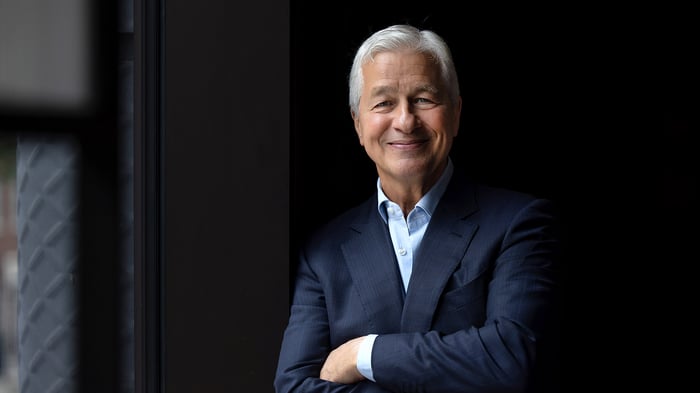
JPMorgan Chase CEO Jamie Dimon. Image source: JPMorgan Chase.
Despite all the concerns, things have gone pretty well
When Dimon said that, he was referring to the bank's splendid second-quarter earnings, in which every business line achieved record revenue, and the company generated a 23% core return on tangible common equity (ROTCE).
The bank has issued a long-term target of 17% ROTCE yet exceeded it in each of the past five quarters. A bank like JPMorgan is highly reflective of the U.S. economy, so a blowout quarter like the one JPMorgan just had at least partially reflects this.
Still, Dimon has long had concerns about many of the issues affecting markets during the past few years.
"I do think those risks are probably bigger than other people think," he said in a July 20 CNBC interview, referring to geopolitical risks and rising government deficits that the current administration is seemingly ignoring as it ramps up military spending using borrowed money.
But in another podcast, Dimon also acknowledged that the global economy has become more resilient due to its reduced dependence on energy, so even a renewed escalation between the U.S. and Iran may not derail the U.S. economy and stock market.
Dimon also said he would not personally buy long-maturity U.S. Treasury bonds because he believes a group of bond investors, known as the bond vigilantes, will demand higher yields to compensate for the risk associated with the U.S. government's growing debt.
Additionally, Dimon expressed caution about the broader market's elevated valuation and the artificial intelligence (AI) boom, at least in the near term.
Dimon said, alluding to the fact that the big winners of the internet were not the dominant early pioneers:
The amount of money being spent is huge. Will it, in total, pay off? Probably, just like the internet did. Will it pay off the way you expect and the timetable you expect? Definitely not.
What can investors take away from Dimon's comments?
Dimon is extremely savvy and widely viewed as the best CEO in banking, but he often strikes a note of cautious. It's a tone he's frequently had since the pandemic, and it has served the him well throughout his career.
Nonetheless, Dimon is issuing Wall Street an ominous warning, particularly about market froth and the state of the U.S. government's finances. The U.S. continues to rack up significant debt, which takes a big bite out of its budget through annual interest payments.
How long can this continue without any consequences? It's hard to say, but investors should not be complacent.
I think the high debt has already had significant consequences, given that the money being printed has likely inflated asset prices and contributed to affordability issues and the wealth gap in the U.S.
Investors should also heed Dimon's advice on AI. Just because companies like OpenAI and Anthropic dominate the landscape right now, that doesn't guarantee their success. They may be the forerunners of the real winners down the road.
Should you buy stock in JPMorgan Chase right now?
Before you buy stock in JPMorgan Chase, consider this:
The Motley Fool Stock Advisor analyst team just identified what they believe are the 10 best stocks for investors to buy now… and JPMorgan Chase wasn’t one of them. The 10 stocks that made the cut could produce monster returns in the coming years.
Consider when Netflix made this list on December 17, 2004... if you invested $1,000 at the time of our recommendation, you’d have $371,519!* Or when Nvidia made this list on April 15, 2005... if you invested $1,000 at the time of our recommendation, you’d have $1,281,302!*
Now, it’s worth noting Stock Advisor’s total average return is 892% — a market-crushing outperformance compared to 206% for the S&P 500. Don't miss the latest top 10 list, available with Stock Advisor, and join an investing community built by individual investors for individual investors.
See the 10 stocks »
*Stock Advisor returns as of July 25, 2026.
JPMorgan Chase is an advertising partner of Motley Fool Money. Bram Berkowitz has no position in any of the stocks mentioned. The Motley Fool has positions in and recommends JPMorgan Chase. The Motley Fool has a disclosure policy.
Recommended Articles


