




A $5,000 Investment in SpaceX at Its Nasdaq-100 Debut Would Be Worth This Much Today
Key Points
Less than one month after SpaceX went public, it was fast-tracked into the Nasdaq-100.
In the weeks since it was added to the index, SpaceX stock has witnessed meaningful selling pressure.
- 10 stocks we like better than Space Exploration Technologies ›
On June 12, Elon Musk's Space Exploration Technologies (NASDAQ: SPCX) completed the largest initial public offering (IPO) in history. SpaceX stock initially opened on the Nasdaq at $150, valuing the company at north of $2 trillion. Just weeks later -- on July 7 -- the company was fast-tracked into the Nasdaq-100 index.
Let's analyze how SpaceX stock has held up since joining the Nasdaq-100 and assess what a $5,000 investment made at that time is worth today.
Missed Nvidia in 2009? This Rare Signal Is Flashing Again. In 2009, a "Double Down" signal flashed for a little-known chipmaker called Nvidia. For the first time in years, that same "Total Conviction" signal is flashing for a company 1/100th the size of Nvidia. Continue »
What is the Nasdaq-100 index?
The Nasdaq-100 is an index that includes around 100 of the largest nonfinancial companies listed on the Nasdaq Exchange, using a modified market capitalization weighting system. Investors can track the index through exchange-traded funds (ETFs) such as Invesco QQQ, making inclusion an event that triggers automatic buying from passive funds.
How has SpaceX stock performed since joining the Nasdaq-100?
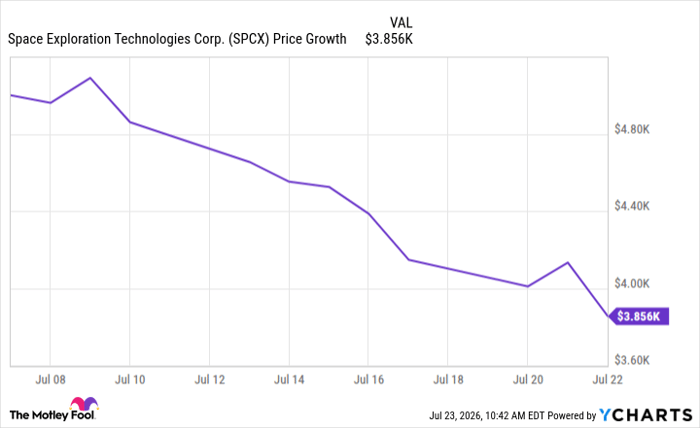
SpaceX stock closed at $149.47 after its first trading day as a member of the Nasdaq-100. By the closing bell on July 22, shares had dropped to $115.26 -- a decline of 23%.
Several factors have put pressure on SpaceX stock recently. These include profit-taking after the initial IPO hype faded, questions about the company's lofty valuation, and scrutiny over its aggressive capital expenditures and their impact on its operating losses.
Image source: Getty Images.
Breaking down the implications of an investment in SpaceX
A $5,000 investment in SpaceX stock made at its closing price on July 7 would now be worth about $3,856. This loss illustrates the types of sharp swings that volatile growth stocks can undergo, even after hitting positive milestones.
SPCX data by YCharts.
Some SpaceX shareholders might consider cutting their losses if the stock's decline exceeds their comfort level. However, investors with a long-term mindset may employ a buy-and-hold approach or selectively add to their SpaceX positions on further dips to lower their cost basis.
While no single strategy fits every situation, smart investors understand that disciplined risk management remains essential, particularly when it comes to companies with lofty valuations, high expectations, and the inherent uncertainties that come with those attributes.
Should you buy stock in Space Exploration Technologies right now?
Before you buy stock in Space Exploration Technologies, consider this:
The Motley Fool Stock Advisor analyst team just identified what they believe are the 10 best stocks for investors to buy now… and Space Exploration Technologies wasn’t one of them. The 10 stocks that made the cut could produce monster returns in the coming years.
Consider when Netflix made this list on December 17, 2004... if you invested $1,000 at the time of our recommendation, you’d have $371,519!* Or when Nvidia made this list on April 15, 2005... if you invested $1,000 at the time of our recommendation, you’d have $1,281,302!*
Now, it’s worth noting Stock Advisor’s total average return is 892% — a market-crushing outperformance compared to 206% for the S&P 500. Don't miss the latest top 10 list, available with Stock Advisor, and join an investing community built by individual investors for individual investors.
See the 10 stocks »
*Stock Advisor returns as of July 24, 2026.
Adam Spatacco has no position in any of the stocks mentioned. The Motley Fool has no position in any of the stocks mentioned. The Motley Fool has a disclosure policy.
Recommended Articles


