




Fox Buys Roku, and Now Comcast Is Spinning Off NBCUniversal. Does Netflix Need to Make a Big Move This Summer?
Key Points
Netflix bid $82.7 billion for Warner Bros. Discovery but walked away when Paramount Skydance offered $111 billion.
The company also passed on bidding for Roku, its former hardware division.
Recent SEC filings show a new $1 billion debt deal, but it's just some routine refinancing and not preparation for a huge buyout.
- 10 stocks we like better than Netflix ›
On July 20, Netflix (NASDAQ: NFLX) filed a couple of Securities and Exchange Commission (SEC) documents with "prospectus" in their names. My heart rate ticked up a bit. In a summer where every media company seems to be buying, selling, or spinning off something, my first move was to hunt for the "use of proceeds" section of Netflix's filings. Was the company loading up for another acquisition run?
Luckily, my blood pressure has returned to normal. Netflix is just refinancing $1 billion in debt that was about to mature. Old notes out, new notes in. The interest rate is higher (5.250% versus 4.375%), reflecting recent inflation trends, but this is the financial equivalent of rolling over a CD at your local bank.
Missed Nvidia in 2009? This Rare Signal Is Flashing Again. In 2009, a "Double Down" signal flashed for a little-known chipmaker called Nvidia. For the first time in years, that same "Total Conviction" signal is flashing for a company 1/100th the size of Nvidia. Continue »
Boring. Routine. Totally fine. The new debt is just replacing the old one, two days before the expiration date. That's a relief, frankly.
Meanwhile, in Hollywood...
The media industry has been reshuffling at a dizzying pace this year. Fox is buying Roku. Comcast decided NBCUniversal would be happier living on its own and announced a spin-off. Lionsgate (NYSE: LION) is standing on the corner holding a "will sell studio to good home" sign since spinning off from Starz Entertainment last year. And the Warner Bros. Discovery (NASDAQ: WBD) situation has more plot twists than an Agatha Christie whodunnit.
Netflix, of course, was part of the Warner story. The company bid $82.7 billion for Warner's studios and streaming assets back in December. For a brief moment, it looked like Netflix might finally get its hands on a legacy content library; the one thing every major competitor has that Netflix doesn't.
Then, Paramount Skydance showed up with $111 billion and a willingness to take on approximately all the debt in Hollywood. Netflix took one look at the new price tag, said "thanks, but no thanks," and walked away.
Insider reports say that Netflix also considered buying back Roku, its own former media-streaming hardware division. It didn't make financial sense and management walked away without making an official bid.
Lucky breaks or missed opportunities?
Honestly? Probably the former. Warner's library is incredible. Beyond classic films like Casablanca, The Matrix, and Sinners, the company runs HBO, DC Comics, and The Food Network. But $111 billion is a lot of money, and even Oracle founder Larry Ellison's financial backing might not be enough. Paramount Skydance's deal is currently stuck in legal limbo after a dozen state attorneys general decided they had opinions about media consolidation.
Netflix, meanwhile, is doing just fine without a legacy studio in its pocket. Revenue is up 47% over three years. Net income more than tripled over the same period. Subscriber growth is continuing despite a streaming market that's supposedly saturated. The self-made content strategy that skeptics questioned for years appears to be working.
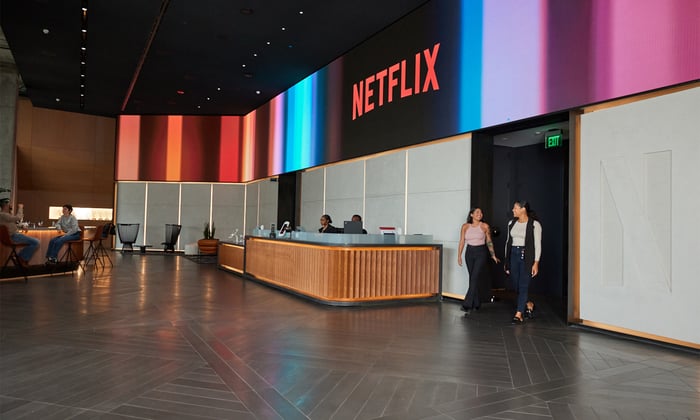
Image source: Netflix.
Building something different
Here's what I find interesting about Netflix's current trajectory: The company seems less interested in forming another traditional media conglomerate and more interested in becoming something else entirely.
Video games are a growing part of the business. Netflix House is bringing the brand into physical entertainment spaces. There's a future here that looks less like "streaming service with a studio" and more like a diversified entertainment empire.
Some of the trappings should look similar to the existing Comcast/Universal and Walt Disney powerhouses. I imagine theme parks, hotels, gaming, live experiences... the works. Disney built that model over decades through acquisitions and clever land deals. Netflix might try to build it from scratch.
The movie and TV business is enormous, especially on a global scale. However, it might not be enormous enough for where Netflix wants to go. Why fight over Warner Bros. when you could be building Netflix World, starting far behind the scenes?
For now, the company is keeping its powder dry, refinancing debt, and letting everyone else write the dramatic headlines. In a summer of Hollywood chaos, that's not the worst strategy.
Should you buy stock in Netflix right now?
Before you buy stock in Netflix, consider this:
The Motley Fool Stock Advisor analyst team just identified what they believe are the 10 best stocks for investors to buy now… and Netflix wasn’t one of them. The 10 stocks that made the cut could produce monster returns in the coming years.
Consider when Netflix made this list on December 17, 2004... if you invested $1,000 at the time of our recommendation, you’d have $370,332!* Or when Nvidia made this list on April 15, 2005... if you invested $1,000 at the time of our recommendation, you’d have $1,272,280!*
Now, it’s worth noting Stock Advisor’s total average return is 904% — a market-crushing outperformance compared to 208% for the S&P 500. Don't miss the latest top 10 list, available with Stock Advisor, and join an investing community built by individual investors for individual investors.
See the 10 stocks »
*Stock Advisor returns as of July 22, 2026.
Anders Bylund has positions in Netflix and Walt Disney. The Motley Fool has positions in and recommends Netflix, Oracle, Roku, Walt Disney, and Warner Bros. Discovery. The Motley Fool has a disclosure policy.
Recommended Articles


