




Can Nvidia Become a $10 Trillion Stock by 2030?
Key Points
There are positive signals that AI development will continue, and Nvidia products underpin AI infrastructure.
Revenue has been accelerating.
Nvidia stock is expensive at 20 times sales.
- 10 stocks we like better than Nvidia ›
Nvidia (NASDAQ: NVDA) stock hasn't been an incredible performer this year, but it is slightly edging out the S&P 500 (SNPINDEX: ^GSPC), with both up around 11% year to date.
It's still the most valuable company in the world with a $5 trillion valuation, so reaching $10 trillion by 2030 would imply doubling. It looks like a distinct possibility. Here's why.
Where to invest $1,000 right now? Our analyst team just revealed what they believe are the 10 best stocks to buy right now, when you join Stock Advisor. See the stocks »
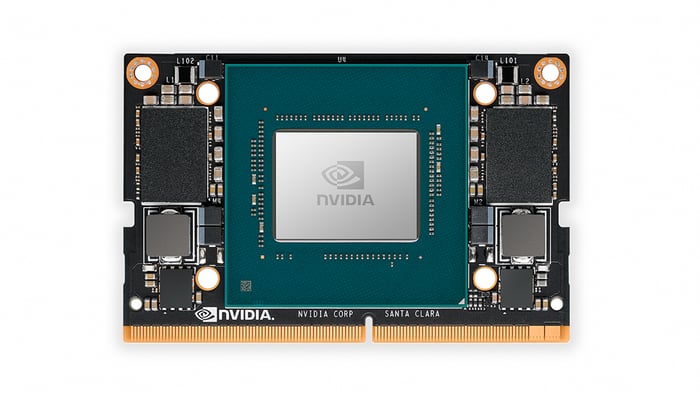
Image source: Nvidia.
Nvidia isn't slowing down
Sales growth has been accelerating. Revenue increased 85% year over year in the 2027 fiscal first quarter (ended April 26), and Wall Street is looking for even higher growth in the second quarter: a whopping 96%, with a forecast of 82% for the full year. That's quite a feat for a company as big as Nvidia.
The positive signs abound. On Tuesday, JPMorgan Chase CEO Jamie Dimon said he thinks artificial intelligence (AI) spending will reach $1 trillion in 2027, and Taiwan Semiconductor Manufacturing, which makes Nvidia's chips, is investing $100 billion in its new Arizona facility.
The chip market is heating up
The AI chip races are only getting faster. Nvidia accounts for 80% to 90% of the market, according to Silicon Analysts, a level of absolute dominance. That lead is projected to decline to 75% as competitors like Advanced Micro Devices gain traction and many top AI players compete with other chip types, such as Broadcom's Application-Specific Integrated Circuits (ASICs) and Alphabet's Tensor Processing Units (TPUs). However, even a 75% lead is fortress-level.
Nvidia's CEO Jensen Huang doesn't seem fussed by the competition; he sees more AI development as a good thing for the company, which underpins much of the AI infrastructure. Whether or not the competition advances, Nvidia should keep growing and remain the leader.
More concerning, from an investing standpoint, might be whether Nvidia can continue to demonstrate accelerating growth or even maintain current growth rates. As the base gets bigger, that isn't likely to last much longer. For example, if it were to grow at a compound annual growth rate of 80% over the next four years, it would have $2.7 trillion in sales, easily becoming the largest company in the world.
It's more likely that growth will slow over the next four years, and as it does, the stock will reflect that. It trades at a premium price-to-sales ratio of 20 right now, but that would likely decline as growth decelerates.
To see how it could play out, a CAGR of 40% to 50% would result in somewhere around $1 trillion in sales in 2030, or about four times today's trailing-12-month revenue. At the current price-to-sales ratio, the stock would quadruple. But at half the ratio, or 10 times trailing-12-month sales, the stock would double and reach $10 trillion.
That's just one possibility, but it's rooted in reality and is a potential scenario for where Nvidia stock could be by 2030.
Should you buy stock in Nvidia right now?
Before you buy stock in Nvidia, consider this:
The Motley Fool Stock Advisor analyst team just identified what they believe are the 10 best stocks for investors to buy now… and Nvidia wasn’t one of them. The 10 stocks that made the cut could produce monster returns in the coming years.
Consider when Netflix made this list on December 17, 2004... if you invested $1,000 at the time of our recommendation, you’d have $371,842!* Or when Nvidia made this list on April 15, 2005... if you invested $1,000 at the time of our recommendation, you’d have $1,244,783!*
Now, it’s worth noting Stock Advisor’s total average return is 900% — a market-crushing outperformance compared to 207% for the S&P 500. Don't miss the latest top 10 list, available with Stock Advisor, and join an investing community built by individual investors for individual investors.
See the 10 stocks »
*Stock Advisor returns as of July 19, 2026.
JPMorgan Chase is an advertising partner of Motley Fool Money. Jennifer Saibil has positions in Taiwan Semiconductor Manufacturing. The Motley Fool has positions in and recommends Advanced Micro Devices, Alphabet, Broadcom, JPMorgan Chase, Nvidia, and Taiwan Semiconductor Manufacturing. The Motley Fool has a disclosure policy.
Recommended Articles


