




Micron Stock Price Prediction: MU Breaks $898 Support as Memory Boom Faces Capacity Risk
TradingKey - On July 16, Micron Technology (NASDAQ: MU) was trading around $853.20, marking a drop of roughly 5.6% amid a wider sell-off in the semiconductor space. Despite the dip, Micron’s market capitalization still sat at nearly $977 billion, a level that captures the stock’s significant run-up in 2026, as well as investors’ growing conviction on AI demand and pricing power for memory chips.
The pullback in price, however, comes on the back of a strong fiscal period for Micron, as shortages of high-bandwidth memory, DRAM and data-center storage products have given the company notable pricing power as cloud providers ramp up AI infrastructure investments. Now the big question is whether the environment that Micron finds itself in can sustain as Micron, Samsung Electronics and SK Hynix put money toward expanding capacity.
Micron Reports Record Fiscal Third Quarter
In its fiscal third quarter, Micron announced total revenue of $41.46 billion, up from $23.86 billion in the previous quarter and $9.30 billion a year earlier. Earnings per share, excluding non-GAAP items, came in at $25.11, which beat analyst expectations, while adjusted net income rose to $28.86 billion.
GAAP (generally accepted accounting principle) earnings, including non-GAAP items, were $28.24 billion, or $24.67 per diluted share. Gross margins reached 84.6%, compared with 74.4% in the prior quarter and 37.7% in the prior year’s period.
In other words, the results underscore the operating leverage in the memory business. As manufacturing plants operate at higher utilization levels, combined with selling prices moving above costs, an increasing portion of the incremental revenues flows directly into profits.
That same leverage also creates downside risk. Margins can deteriorate rapidly should customers cut back, producers start expanding supply or memory prices begin to slide.
Micron 4Q Guidance Jumps Bar for Earnings
Micron is calling for approximately $50 billion, plus or minus $1 billion in fiscal fourth-quarter revenue. The business is also predicting adjusted gross margins of 86%, as well as adjusted earnings of $31 per share, plus or minus $1.
For capital expenditures in the fourth quarter, the company is looking at $10 billion, with funds earmarked for advanced DRAM, NAND, high-bandwidth memory and manufacturing infrastructure. The guidance exceeded consensus estimates and confirms that pricing power remains a priority for Micron.
On the other hand, the higher spending is a key component in the bearish story. Micron’s earnings explosion is at least partially a product of tight supply conditions. As the industry brings more capacity online, customers may find themselves better positioned and premium memory prices could stabilize.
High-Bandwidth Memory Is Micron’s Primary AI Story
High-bandwidth memory (HBM), is a primary AI product for Micron. It is technology which stacks multiple memory chips in a three-dimensional configuration to provide the memory bandwidth needed for advanced compute processors used for AI training and inference.
Micron has said that it has completely sold the company’s supply of HBM for calendar-year 2026. In addition, the company has commenced mass shipment of its HBM4 memory to a leading customer and is developing its HBM4E using its next-generation DRAM manufacturing process.
NVIDIA and other accelerator chip designers are the key sources of HBM demand. However, competitive dynamics are challenging for Micron, which battles mostly with SK Hynix and Samsung, both of which are expanding their next-generation HBM supply.
Micron also happens to be the only major U.S. HBM manufacturer, an aspect of its business that holds strategic value. Nonetheless, that doesn’t prevent potential industry output increases from constraining pricing power.
Longer-Term Agreements Give Micron Earnings a Smoother Ride
Micron also said it has closed out 16 strategic customer arrangements that represent around $22 billion of memory supply between data center, consumer electronic and automotive markets. Some of these agreements will carry multi-year purchase obligations, price floors and customer deposits.
Customers under take-or-pay agreements will need to honor purchase commitments made between Micron and them, even if their needs evolve in the short term. That should make the company’s cycle of boom and bust a bit less severe. But they won’t be a silver bullet. The take-or-pay contracts depend on continued AI spending as well as customers’ financial capacity to pay over time.
Automotive Agreements Expand Micron's AI Exposure
On July 16, Micron announced long-term supply agreements with Qualcomm, Harman, Visteon, DENSO, JOYNEXT, Astemo, Hyundai Mobis and other automotive-technology suppliers.
These deals encompass memory and storage products utilized in advanced driver-assistance features, digital cockpits and software-defined automobiles. Their function is to ensure consistent supply and pricing and assist customers in planning for upcoming vehicle platforms.
Automotive needs are desirable for a variety of strategic reasons, primarily because of their multi-year lifecycle and the necessity of reliable components. It also helps diversify Micron's AI-driven expansion from data centers to automobiles, mobile devices, PCs and robots.
US Investment Boosts Capacity But Increases Expenditures
Micron will now allocate more than $250 billion in the US through 2035, which will increase from the previously stated $200 billion. That includes manufacturing projects in New York, Idaho and Virginia that will create over 90,000 jobs.
In addition, Micron will spend $3 billion in its domestic semiconductor supply chain, including $500 million in connection with GlobalWafers' Texas silicon-wafer plant. The two firms have signed a 10-year supply contract.
While it might facilitate increased access to government incentives and supply security, these projects may require significant outlays of money and cost more than Micron's current manufacturing facilities in Asia.
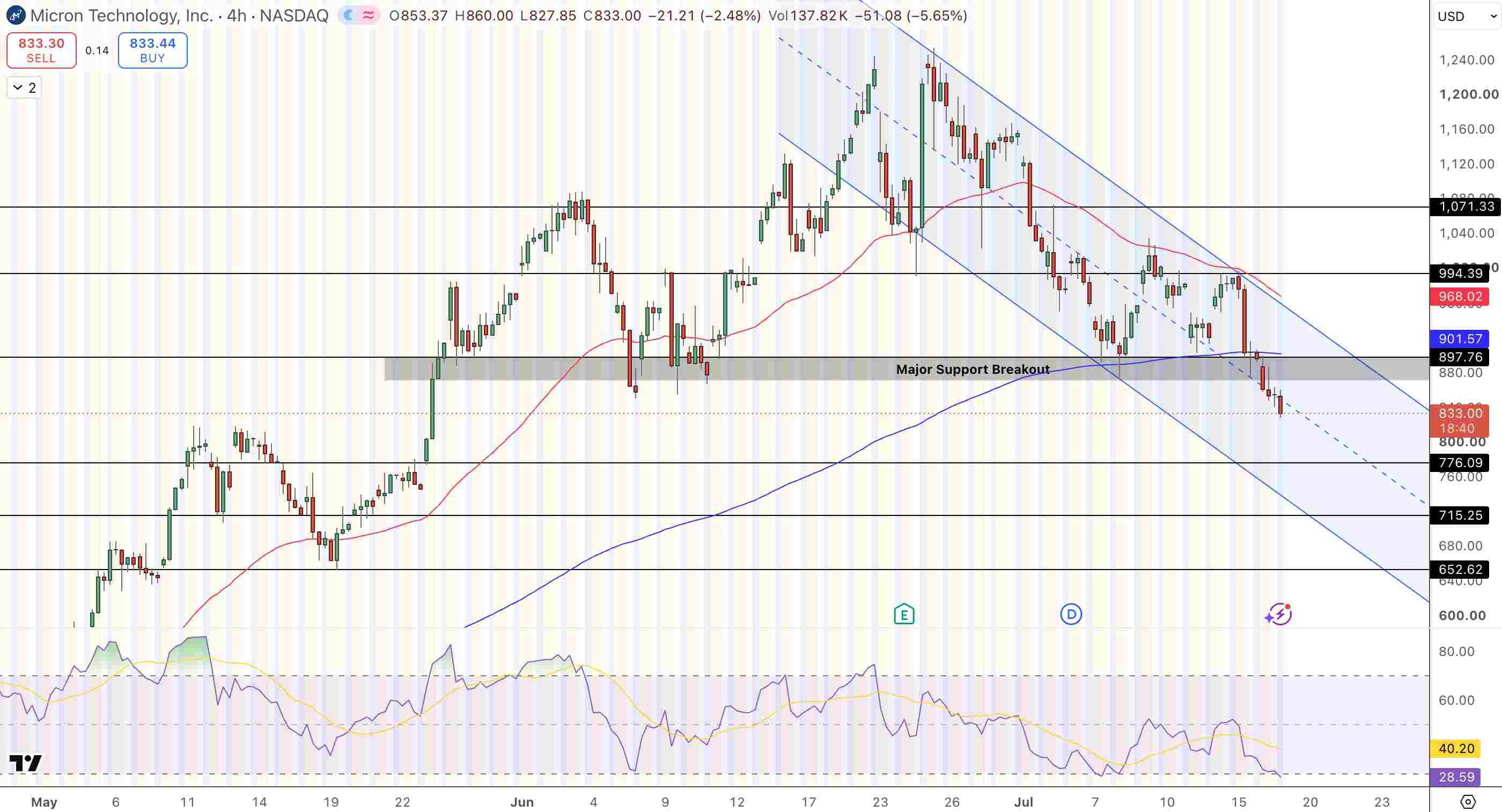
Micron Price Chart - Source: Tradingview
Micron stock is currently trending lower, breaking below the significant $897.80 support on the four-hour time frame, a sign of a bearish outlook. From that level, the price declined to about $833, with strong lower-stick candlesticks trading beneath the 50-period exponential moving average (EMA) at $968 and the 200-period EMA at $901.60.
Consequently, that former support area has been transformed into resistance, which could potentially stall upside momentum. Micron could continue to fall in the short term, perhaps reaching $776.10 and then $715.30 if the buying pressure fails to reclaim the breached support level. A correction lower, with more selling pressure, may see Micron fall as far as $652.60.
The strength of the selling pressure may be relieved somewhat with the Relative Strength Index (RSI) having fallen to about 29. This puts the RSI into oversold territory, which may encourage a temporary bounce. However, an oversold condition does not necessarily indicate a reversal.
If a rebound develops in Micron stock, it may face renewed resistance at $897.80 and below, as the 50 EMA has also fallen sharply. Until Micron breaks above its falling channel and regains some of its major moving averages, the technical picture is still predominantly bearish.
FAQs
Why is Micron stock falling, despite record results? Market participants have begun questioning the longevity of the record memory pricing and margins with companies increasing capacity in response. In addition, Micron stock had a strong rally in 2026, making the shares vulnerable to selling.
What was Micron's guidance for the fourth quarter fiscal 2026? Micron guided the fourth quarter for revenue of approximately $50 billion, adjusted earnings of about $31 a share and adjusted gross margin of approximately 86%.
Where is Micron stock's primary support? Micron stock had a major technical support point of $897.80, but that level has been breached. The next downside targets are approximately $776.10 and $715.30.
Conclusion
Micron fundamentals remain strong across all major metrics. Micron posted record revenue, earnings, margins and free cash flow. Its supply of high-bandwidth memory (HBM) is booked solid, and longer-term agreements with customers give it more visibility into the future than many memory cycles previously saw.
The key risk to investors is that the current environment might be peaking. They will have to keep an eye on capital spending, the level of industry capacity, the competitive landscape for HBM and whether Micron will be able to reach its goal of $50 billion in fourth-quarter revenue.
On a technical level, a breach of $897.80 means that selling pressure continues to be dominant. Should Micron rally back above that area, selling pressure would subside and any sustained weakness would likely drive the shares down toward $776.10 as a new target.
Recommended Articles


