




Visa: A Smart Way to Invest in the Cashless Economy (NYSE:V)
Key Points
Visa's dominant position in the payments landscape results in trillions of dollars in quarterly volume.
A globally entrenched network effect makes it almost impossible for challengers to disrupt the business.
Analysts expect Visa to post double-digit revenue growth for the sixth straight year in fiscal 2026.
- 10 stocks we like better than Visa ›
The artificial intelligence data center build-out is grabbing all the attention. However, investors shouldn't ignore durable secular trends that have stood the test of time. The ongoing decline in cash usage has been a powerful story.
Visa (NYSE: V) sits atop this movement. This financial stock provides investors with an excellent way to bet on the cashless economy.
Where to invest $1,000 right now? Our analyst team just revealed what they believe are the 10 best stocks to buy right now, when you join Stock Advisor. See the stocks »
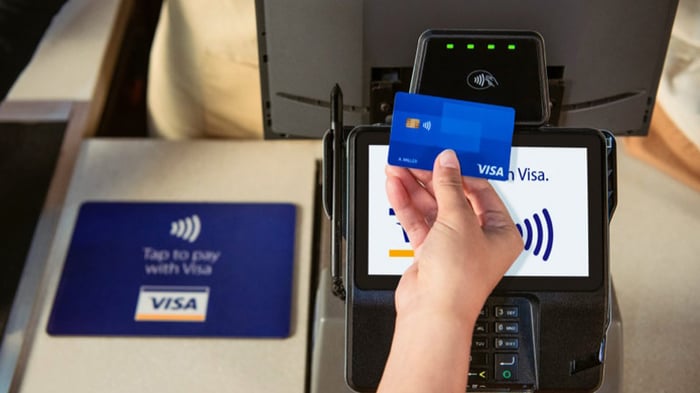
Image source: Visa.
Scale is unmatched
Visa dominates the digital payments landscape. Investors can look at one key data point to understand exactly why.
During its fiscal 2026 second quarter (ended March 31), the business processed $4.4 trillion in total payment volume (TPV). That figure increased by 142% in the past decade. For comparison, on an annualized basis, this represents about 15% of the entire world's gross domestic product (GDP).
This company quite literally enables commerce to happen on a global stage. Visa is used in more than 200 countries and territories, showcasing its broad reach. Its TPV reveals just how much influence it has on the declining usage of cash and paper-based transaction methods.
A network effect supports the competitive position
There are 5 billion Visa cards in use around the world, and 175 million merchant locations accept them as a form of payment. At a high level, this creates an incredible network effect. Because Visa has such wide acceptance, people need to have these cards in their wallets. Because there are so many of these cardholders, merchants almost have no choice but to accept Visa in an effort to avoid losing sales.
This network effect supports the company's powerful competitive position. It's almost impossible to disrupt Visa, given its entrenched position with merchants, consumers, and banks. Businesses trying to threaten this setup not only need to introduce payment solutions that are significantly better. They also need to figure out how to achieve adoption.
Growth is sustainable
Visa isn't going to impress investors with outsize revenue gains, but growth has proven to be extremely durable and resilient.
In the past decade, revenue rose at a compound annual rate of 211%. Besides a 5% decline in fiscal 2020 (due to the pandemic's negative effect), the company's slowest pace of growth was an 8.7% increase in fiscal 2016. Based on consensus analyst estimates, fiscal 2026 will be Visa's sixth straight year posting a double-digit sales jump.
Greater spending activity over time directly supports Visa's financial success, as the business is essentially a tax on global commerce. Moreover, rising penetration of the cashless economy further aids the growth story.
Investors can confidently consider buying Visa shares today and holding for the next five years.
Should you buy stock in Visa right now?
Before you buy stock in Visa, consider this:
The Motley Fool Stock Advisor analyst team just identified what they believe are the 10 best stocks for investors to buy now… and Visa wasn’t one of them. The 10 stocks that made the cut could produce monster returns in the coming years.
Consider when Netflix made this list on December 17, 2004... if you invested $1,000 at the time of our recommendation, you’d have $397,351!* Or when Nvidia made this list on April 15, 2005... if you invested $1,000 at the time of our recommendation, you’d have $1,304,257!*
Now, it’s worth noting Stock Advisor’s total average return is 937% — a market-crushing outperformance compared to 211% for the S&P 500. Don't miss the latest top 10 list, available with Stock Advisor, and join an investing community built by individual investors for individual investors.
See the 10 stocks »
*Stock Advisor returns as of July 16, 2026.
Neil Patel has no position in any of the stocks mentioned. The Motley Fool has positions in and recommends Visa. The Motley Fool has a disclosure policy.
Recommended Articles


