




Today’s Market Recap: Micron’s U.S. Investment Expansion Ignites Chip Stocks, as SanDisk, AMD, and Broadcom Gain Collectively
Track Market Trends
TradingKey - On July 9, Eastern Time, the three major US stock indexes closed higher collectively, with technology and semiconductor sectors serving as the main drivers. As oil prices fell back from the highs of the previous session, market concerns that the escalation of the US-Iran conflict would drive up inflation eased, and funds flowed back into the main AI and chip themes.
As of the close, the Dow Jones Industrial Average rose 0.27% to 52,492.26 points; the S&P 500 Index rose 0.81% to 7,543.64 points; and the Nasdaq Composite Index rose 1.30% to 26,206.89 points.
In terms of individual stocks and sectors, the semiconductor sector performed the strongest. The Philadelphia Semiconductor Index rose 3.06%, climbing for the second consecutive trading day. Micron Technology ( MU) rose 4.42%, briefly rising to near $1,035 during intraday trading; SanDisk ( SNDK) rose 7.57%, AMD ( AMD) rose 5.67%, Broadcom ( AVGO) rose 3.2%. Meta ( META) rose 4.70%, as the market focused on news that the company is about to push forward with its self-developed AI chip production.
In commodities, oil prices fell back from their highs. Brent crude fell 4.5% to close at $75.91; WTI ( USOIL) crude fell 3.97% to close at $71.80. Oil prices surged in the previous session due to the US-Iran conflict and risks in the Strait of Hormuz, but in the latest trading, investors refocused on the possibility that high oil prices could suppress demand, alongside renewed diplomatic efforts to cool tensions.
In precious metals, spot gold ( XAUUSD) rose 1.13% to $4,123.55. The rise in gold was mainly driven by bargain hunting after the previous day's decline, while uncertainty regarding the situation in the Middle East persisted. However, the Federal Reserve minutes showed that inflation concerns remain, and the market still needs to watch the impact of next week's inflation data and Fed Chairman Warsh's congressional hearing on interest rate expectations.
Market News
US official: US and Iran hold technical talks on nuclear issues. The official stated that despite President Trump ordering a new round of strikes against Iran this week, the US and Iran continue to conduct technical negotiations on nuclear issues and seek a diplomatic solution, but Iran can never possess nuclear weapons. Meanwhile, Vance remarked that the US is willing to "fundamentally" alter US-Iran bilateral relations if Iran is willing to abandon its pursuit of nuclear weapons.
Micron expands its US investment plan to over $250 billion. Micron Technology announced plans to invest more than $250 billion in the US by 2035 to meet the demand for memory chips in the AI era and to align with US policies aimed at strengthening domestic chip manufacturing capabilities. This plan is an upward revision from the company's previously announced $2000 billion investment scale. The news drove a sharp rise in Micron's stock price, which also triggered a collective rebound in memory chip and semiconductor equipment stocks.
Meta reportedly to push forward with production of self-developed AI chips in September. Reports indicate that Meta plans to start producing its self-developed AI chip, code-named "Iris," in September, with the goal of enhancing the company's AI training and inference capabilities and reducing its reliance on external GPU suppliers. Meta also plans to increase its computing capacity to 14 gigawatts by 2027. This news reinforced market expectations for long-term investment in AI infrastructure, keeping capital focused on the AI chip, memory, and data center supply chains.
PepsiCo ( PEP) and Costco ( COST) stock prices decline, focusing attention on consumer resilience. PepsiCo's second-quarter revenue exceeded market expectations, but weak North American consumer demand, more cautious consumers, and cost pressures still weighed on its stock price. Costco's stock price fell to a six-month low due to a slowdown in same-store sales growth in June. The weakness in both companies' stock prices suggests that while tech stocks are strengthening again, the market remains cautious about the divergence in US consumer spending and the growth sustainability of high-valuation retail stocks.
US initial jobless claims fall, demonstrating continued resilience in the labor market. The latest data shows that US initial jobless claims fell last week, indicating that despite a slowdown in job growth in June, there are no signs of rapid deterioration in the labor market yet. For US equities, a stable labor market helps support corporate earnings expectations; however, if employment remains resilient while inflationary pressures do not subside, it could also limit the Federal Reserve's room to pivot toward monetary easing.
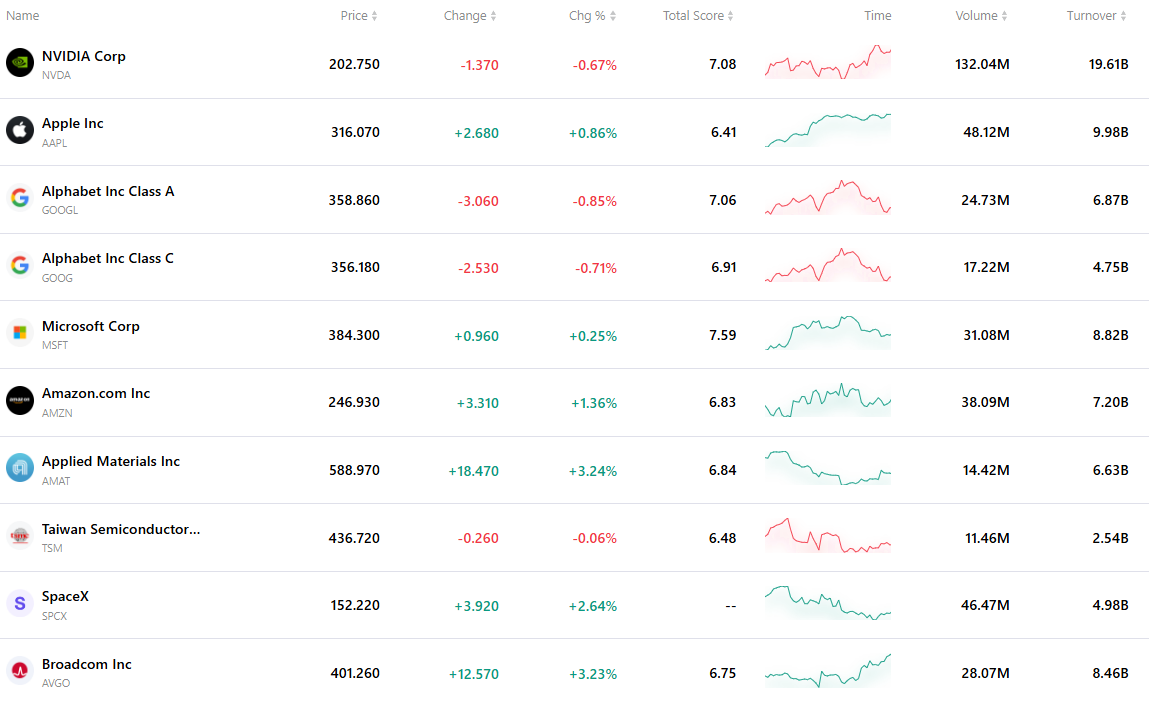
Top 10 Most Active Stocks
The table below lists the ten most actively traded stocks in the latest market. Supported by massive trading volumes and excellent liquidity, these assets have become key benchmarks for tracking global market dynamics.
Recommended Articles


