




Oil Price Forecast: WTI Jumps Above $73, Brent Surges 5%—Will Crude Oil Rally Continue?

Crude oil prices staged a powerful comeback on July 8, posting their strongest one-day gains in weeks as renewed geopolitical concerns and tightening supply expectations reignited bullish sentiment across the energy market.
By the close of trading, West Texas Intermediate (WTI) for August delivery had climbed 4.37% to $73.52 per barrel, while Brent crude for September delivery surged 5.20% to $78.02 per barrel. The sharp rebound erased much of the previous week's losses and pushed both benchmarks back above important technical resistance levels.
The rally comes after several weeks of volatile trading, with investors weighing the impact of global economic uncertainty against persistent supply risks. As traders reassess the outlook for crude demand and geopolitical tensions remain elevated, many are now asking a critical question:
Is this the beginning of a new uptrend, or simply a short-term rebound before another correction?
Why Did Oil Prices Jump on July 8?
Brent Crude Oil Price Today
Renewed US-Iran tensions rattled energy markets
The biggest catalyst was a sharp deterioration in US-Iran relations. Fresh U.S. military strikes on Iranian targets, combined with renewed attacks near the Strait of Hormuz, prompted investors to reassess the risk of disruptions to one of the world's most important oil shipping routes. The Strait of Hormuz carries roughly one-fifth of global oil supplies, making any threat to shipping a major bullish factor for crude prices.
Although no prolonged supply outage has been confirmed, traders quickly priced in a higher geopolitical risk premium, pushing both Brent and WTI sharply higher.
Iran oil sanctions added fresh supply concerns
Market sentiment also strengthened after the United States moved to tighten pressure on Iranian crude exports by revoking previously granted sanctions relief. Investors interpreted the move as a potential reduction in global oil supply at a time when inventories remain relatively tight.
Unlike previous geopolitical flare-ups that faded quickly, this latest escalation directly affects expectations for future export volumes, giving the rally stronger fundamental support.
Technical buying accelerated the move
The fundamental news triggered an aggressive technical breakout.
After trading near multi-week lows following OPEC+'s decision to increase August production quotas, WTI climbed back above the psychologically important $73 level while Brent reclaimed $78. Once these resistance levels were breached, algorithmic traders and short sellers rushed to cover bearish positions, adding further momentum to the rally.
“Trade Crude Oil with an ASIC-regulated broker. Fast AUD funding via PayID. ”
What's Driving WTI and Brent Higher?
While geopolitical headlines sparked the initial rally, several broader market forces will determine whether oil prices can continue moving higher in the coming weeks.
1. Geopolitical risk premium has returned
For much of the past two weeks, markets had assumed tensions in the Middle East were easing. However, the latest military developments have reversed that sentiment.
As long as uncertainty remains around the Strait of Hormuz and Iranian exports, traders are likely to maintain a higher risk premium in crude oil prices. Even if physical supply remains uninterrupted, the possibility of future disruptions tends to support both Brent and WTI futures.
2. Supply risks are outweighing OPEC+ production increases
Earlier this month, OPEC+ agreed to raise production targets beginning in August, a move that initially pushed oil prices lower on expectations of increased supply. However, geopolitical concerns have largely overshadowed that bearish development.
Investors now believe that any additional OPEC+ output could be offset if Iranian exports decline or if shipping through the Gulf becomes more constrained. As a result, supply risks have once again become the dominant market driver.
3. Market positioning has shifted back to bullish
The sharp rebound also reflects changing investor positioning.
Following several sessions of declines, speculative traders had accumulated significant short positions in crude oil. July 8's breakout forced many of those traders to buy back contracts, creating a classic short-covering rally that amplified the price move.
If geopolitical risks remain elevated, institutional investors may continue rebuilding long positions, providing additional support for oil prices.
4. Traders are watching key technical resistance levels
From a technical perspective, momentum has improved considerably.
WTI has reclaimed $73, while Brent has recovered above $78, shifting near-term sentiment back in favor of the bulls. If buyers can maintain these levels, the next upside targets are around WTI $75–76 and Brent $80, where stronger resistance is expected.
However, if geopolitical tensions begin to ease or concerns over global demand re-emerge, profit-taking could quickly send prices back toward recent support levels. In other words, the sustainability of this rally will depend on whether geopolitical supply risks continue to outweigh concerns about slower economic growth.
Technical Analysis: Can WTI Break $75?
WTI Price Today
After surging 4.37% on July 8, WTI crude has regained strong bullish momentum, closing at $73.52 per barrel—its highest settlement since late June. The sharp recovery has shifted the short-term technical outlook from neutral to cautiously bullish, although a decisive breakout above $75 remains the next major test.
Key levels to watch
Resistance
$74.50–75.00: Immediate resistance and the first major hurdle for buyers.
$76.50: Previous swing high and the next upside target if bullish momentum continues.
$78.00: Strong psychological resistance that could attract profit-taking.
Support
$73.00: Former resistance now acting as initial support.
$71.80–72.00: Short-term support zone where buyers recently returned.
$70.00: Major psychological support. A break below this level would weaken the current bullish outlook.
The latest rally was accompanied by a sharp increase in trading volume as geopolitical tensions pushed investors back into energy markets. In addition, short-covering by bearish traders accelerated the upward move once WTI reclaimed the $73 level.
From a momentum perspective, buyers remain in control as long as WTI holds above $73. A sustained move above $75 could trigger another wave of technical buying, opening the door toward $76.50–78.00. However, failure to break through resistance may lead to short-term consolidation after such a strong single-day rally.
“Trade Crude Oil with an ASIC-regulated broker. Fast AUD funding via PayID. ”
Oil Price Forecast for This Week
Oil prices are expected to remain highly volatile this week as traders continue to monitor geopolitical developments in the Middle East alongside evolving supply expectations.
The market's primary focus remains the renewed confrontation between the United States and Iran. Any further military escalation, sanctions, or disruption to shipping through the Strait of Hormuz could keep a substantial geopolitical risk premium embedded in crude prices. Conversely, signs of de-escalation could quickly erase part of this week's gains.
Meanwhile, investors are also assessing the impact of OPEC+ production increases announced earlier this month. While additional output should gradually improve global supply, the market currently believes geopolitical risks are outweighing concerns about oversupply. The U.S. Energy Information Administration also expects global inventories to tighten less than previously forecast as production recovers later this year, suggesting that supply conditions may gradually improve if geopolitical risks ease.
Short-term outlook
Bullish scenario
WTI holds above $73 and breaks $75
Brent moves toward $80
Escalating geopolitical tensions continue supporting the risk premium
Neutral scenario
WTI trades between $72 and $75
Traders await fresh geopolitical headlines and inventory data before taking larger positions
Bearish scenario
Diplomatic progress reduces supply concerns
OPEC+ output increases become the dominant market driver
WTI falls back toward $70–71
Overall, the near-term bias remains moderately bullish, but traders should expect elevated volatility as headlines continue to drive price action.
How Australian Investors Can Trade Oil CFDs
For Australian investors, trading Oil CFDs offers a flexible way to speculate on crude oil price movements without owning physical barrels of oil or trading futures contracts.
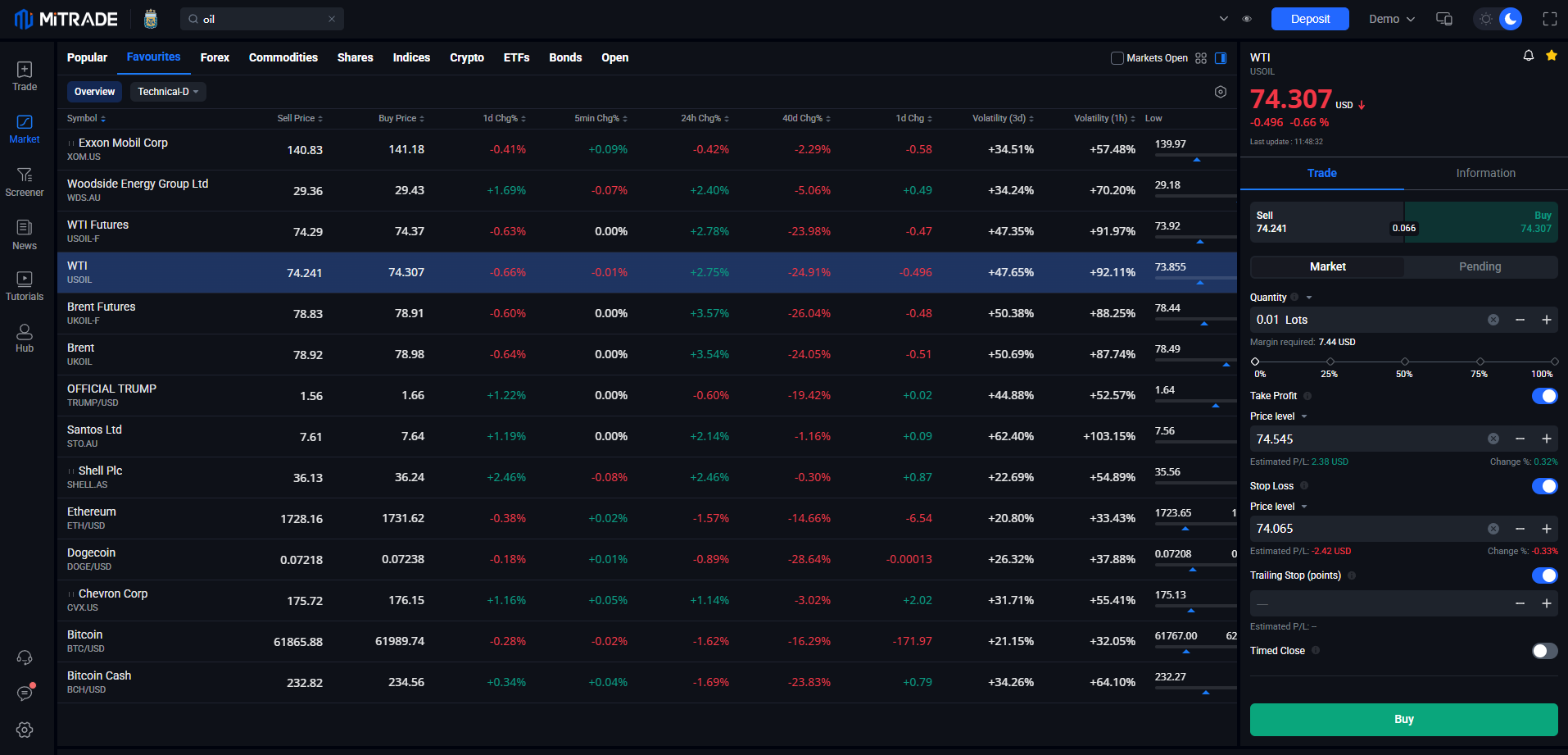
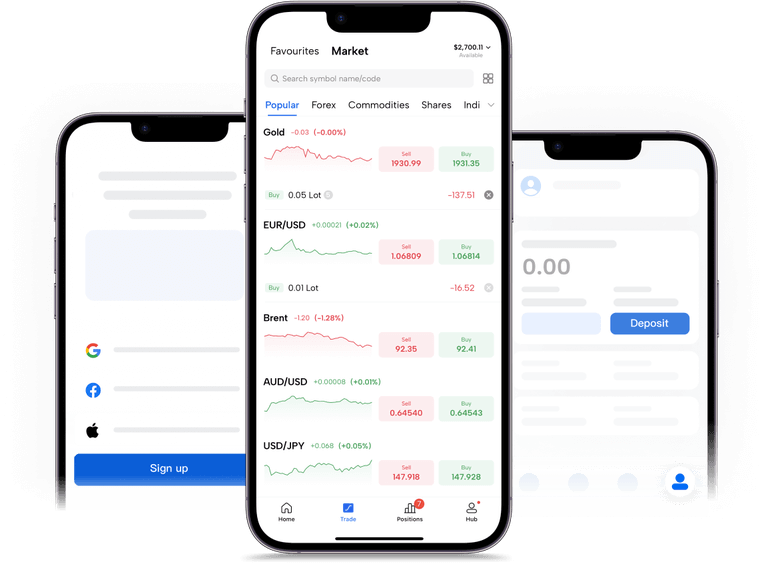
One popular platform is Mitrade, an ASIC-regulated CFD broker that provides access to both WTI and Brent crude through an intuitive trading platform.
Why trade oil CFDs with Mitrade?
Trade rising and falling markets by going long or short.
No commission on CFD trades, with competitive spreads.
Leverage allows traders to gain greater market exposure with less capital (subject to ASIC regulations).
Fast execution during periods of high market volatility.
Access to multiple markets—including oil, gold, forex, indices, stocks, and cryptocurrencies—from a single account.
Free demo account for practicing trading strategies before risking real money.
How to start trading oil CFDs
Open a Mitrade trading account.
Complete identity verification.
Deposit funds into your trading account.
Search for WTI Crude or Brent Crude.
Analyze the latest market trend using technical and fundamental analysis.
Decide whether to Buy (if expecting prices to rise) or Sell (if expecting prices to fall).
Use stop-loss and take-profit orders to manage risk.
Oil prices can react within minutes to geopolitical developments, inventory reports, and OPEC+ announcements. For active traders, CFDs provide a convenient way to capitalize on both upward and downward price swings while maintaining flexible risk management.


1. Why did oil prices rise more than 5% on July 8?
Oil prices surged after renewed geopolitical tensions between the United States and Iran increased fears of supply disruptions through the Strait of Hormuz. The rally was further supported by technical buying and short covering.
2. Will WTI crude oil break above $75?
WTI has regained bullish momentum after reclaiming $73. If geopolitical risks remain elevated and buying interest continues, a move above $75 is possible. However, resistance around $75–76 could trigger short-term profit-taking.
3. What's the difference between WTI and Brent crude?
WTI is the primary U.S. crude oil benchmark, while Brent is the international benchmark used to price most global oil exports. Brent generally trades at a premium due to its broader global relevance and transportation dynamics.
4. Is now a good time to trade oil CFDs?
Oil remains one of the most volatile commodities, creating opportunities for short-term traders. However, volatility also increases risk, so it's important to use stop-loss orders and proper position sizing when trading CFDs.
5. Can Australians trade WTI and Brent oil?
Yes. Australian investors can trade both WTI and Brent crude through ASIC-regulated CFD brokers such as Mitrade, allowing them to speculate on oil price movements without owning physical oil.
Disclaimer: The content presented above, whether from a third party or not, is considered as general advice only. CFD trading involves significant risk of loss. Past performance does not guarantee future results. This article serves informational purposes only and does not constitute financial advice. Consider your risk tolerance before trading.


