




11 Words From Nvidia CFO Colette Kress That Should Have AMD and Intel Investors Worried
Key Points
Throughout the artificial intelligence (AI) revolution, Nvidia's primary tailwinds have come from demand for its GPUs.
Competition in the GPU space and the rise of custom silicon have inspired Nvidia to enter new hardware markets.
Nvidia management estimates that its new Vera CPU platform is competing for a piece of a $200 billion total addressable market.
- 10 stocks we like better than Nvidia ›
Nvidia (NASDAQ: NVDA) has dominated the artificial intelligence (AI) revolution through its industry-leading suite of graphics processing units (GPUs) -- powerful parallel processors that were ideal for handling the computational complex workloads of training AI models. But the recent unveiling of the company's Vera central processing unit (CPU) platform signals a strategic broadening of its ambitions within AI chip stacks.
The Vera CPU platform is purpose-built for the demands of an emerging new technology: agentic AI. Nvidia CFO Colette Kress says that the platform unlocks a brand new $200 billion market for the company. This development propels Nvidia beyond its role as a supplier of accelerator hardware for data centers, positioning it to supply more of the foundational compute layer of next-generation AI infrastructure.
Where to invest $1,000 right now? Our analyst team just revealed what they believe are the 10 best stocks to buy right now, when you join Stock Advisor. See the stocks »
Image source: Nvidia.
Why is the Vera CPU important for Nvidia?
In AI data centers, GPUs excel at the heavy number-crunching required to train AI models and deploy inference applications. This is why hyperscalers have been buying Nvidia's Blackwell and Rubin units as fast as they could be produced.
However, the types of computations that are best handled with parallel processors like GPUs are only part of the puzzle. Developers also require CPUs to manage coordinating tasks such as running experiments safely, processing data workloads, analyzing results, and connecting AI workflows to other tools and systems. The Vera CPU fills that important gap in Nvidia's chip lineup.
Vera leverages Nvidia's custom processor cores with fast memory access. This architecture allows the Vera platform to complete sophisticated tasks more efficiently than the chips from Intel or Advanced Micro Devices, the established CPU market leaders. With the introduction of the Vera CPU, Nvidia now sells a complete package that includes CPUs, GPUs, networking, and CUDA software. This comprehensive ecosystem allows Nvidia to capture incremental value from each new AI deployment. Far from cannibalizing GPU sales, the Vera CPU is marketed to complement GPU demand by enabling larger and more capable AI build-outs.
During Nvidia's first-quarter earnings call, CFO Colette Kress said that "Vera CPU opens a brand new $200 billion TAM [total addressable market] for Nvidia, a market we have never addressed before, and every major hyperscale and system maker is partnering with us to get it deployed. We have visibility to nearly $20 billion in total CPU revenue this year."
These comments make it clear that the Vera CPU is already being viewed as a strong alternative for AI infrastructure build-outs. By offering exceptional performance on agentic workloads and seamless integration with its GPUs, Nvidia is making it easy for hyperscalers to purchase a full-stack solution from one company instead of mixing vendors. This strategy positions Nvidia to take market share away from the CPU incumbents.
Why is no one talking about the Vera CPU?
Despite the scale of the opportunity, Vera hasn't captured widespread attention. A big reason why is that Wall Street's discourse continues to index heavily on GPU orders from big tech and the competitive threats custom silicon -- called application-specific integrated circuits (ASICs) -- pose to Nvidia's core chip business.
Moreover, CPUs are generally perceived as a lower-margin, more commoditized segment of the chip value chain. For this reason, it's not surprising that a new product in that niche that's focused on specialized AI workloads is receiving less immediate scrutiny.
As a result, the $200 billion TAM for Nvidia's CPUs that Kress highlighted has not yet translated into market excitement -- despite the obvious fact that Vera represents genuine diversification into a new market for the chipmaker.
How Vera can transform Nvidia's business throughout the AI infrastructure era
Vera is a big step in Nvidia's evolution from a GPU supplier into a full-stack AI infrastructure provider. By offering both the CPU and GPU layers, Nvidia gains a unique ability to co-optimize hardware, interconnects, and software across an entire AI data center. This tight integration will reduce friction for customers building sophisticated agentic systems, but that unified platform will ultimately create higher switching costs should customers want to consider a rival hardware provider later.
As agentic AI services move from experimentation to production and deployment at scale, the Vera CPU will enable Nvidia to capture a greater share of total AI build-out capex than it would if it remained primarily an accelerator vendor. This strategically improves Nvidia's business model, so it can shift toward higher customer attachment rates and greater resilience across GPU cycles.
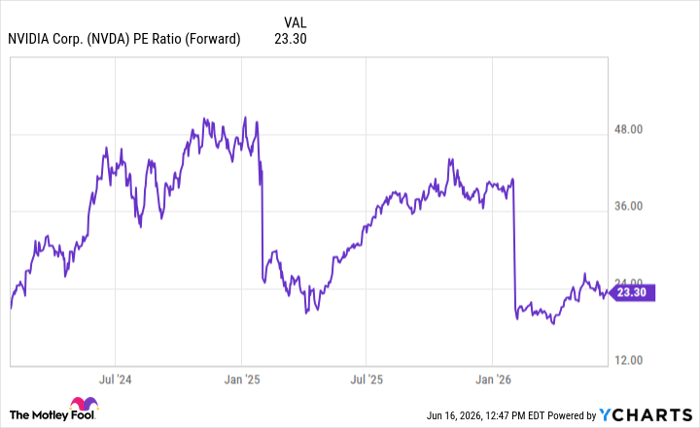
Nvidia's forward price-to-earnings (P/E) ratio currently sits around 23 -- near its lowest level in about five years. I think these trends suggest that Nvidia's valuation largely prices in its continued leadership in data center GPUs, but does not account for much else related to the broader AI infrastructure build-out.
NVDA PE Ratio (Forward) data by YCharts.
The Vera CPU introduces an entirely new, high-growth vector that appears to be unaccounted for in the market's current expectations for the company. As AI deployments accelerate and agentic workloads mature, incremental earnings power from CPUs could meaningfully exceed analysts' near-term models. For this reason, I think Nvidia stock carries further upside and potential valuation expansion as the market comes to recognize this additional growth engine.
Should you buy stock in Nvidia right now?
Before you buy stock in Nvidia, consider this:
The Motley Fool Stock Advisor analyst team just identified what they believe are the 10 best stocks for investors to buy now… and Nvidia wasn’t one of them. The 10 stocks that made the cut could produce monster returns in the coming years.
Consider when Netflix made this list on December 17, 2004... if you invested $1,000 at the time of our recommendation, you’d have $415,040!* Or when Nvidia made this list on April 15, 2005... if you invested $1,000 at the time of our recommendation, you’d have $1,256,076!*
Now, it’s worth noting Stock Advisor’s total average return is 923% — a market-crushing outperformance compared to 207% for the S&P 500. Don't miss the latest top 10 list, available with Stock Advisor, and join an investing community built by individual investors for individual investors.
See the 10 stocks »
*Stock Advisor returns as of June 18, 2026.
Adam Spatacco has positions in Nvidia. The Motley Fool has positions in and recommends Advanced Micro Devices, Intel, and Nvidia. The Motley Fool has a disclosure policy.
Recommended Articles


