




Today’s Market Recap: Fed's Hawkish Dot Plot Pressures U.S. Stocks; SpaceX Slides 5% , Allbirds Soars 39%
Tracking the Market Trend
TradingKey - On June 17, Eastern Time, the Federal Reserve’s dot plot sent a strongly hawkish signal. Renewed expectations of interest rate hikes weighed on the market, causing all three major indices to decline, with the Nasdaq falling for the second consecutive day.
At the close, the Dow Jones Industrial Average fell 0.98% to 51,492.55; the Nasdaq Composite dropped 1.34% to 26,021.66; and the S&P 500 declined 1.21% to 74,201.10.
Sector performance was mixed, with semiconductors bucking the trend to post gains, while tech giants led the broader market lower. The Philadelphia Semiconductor Index closed up 1.38%, serving as a highlight of the session; Meta Platforms (META) plummeted more than 5%, leading the decline among the “Big Seven” tech companies; SpaceX (SPCX) closed lower for the first time since its IPO, falling nearly 5%; while Allbirds (BIRD) soared 39%.
In the commodities market, a stronger U.S. dollar weighed on gold, while crude oil remained largely unchanged after fluctuating. The U.S. Dollar Index surged 0.86%, hitting a two-month high; spot gold (XAU/USD) came under pressure and retreated, falling more than 2.5% at one point during the session, completely erasing the gains accumulated this week on expectations of peace talks; WTI crude oil futures closed flat after sharp volatility, with prices holding steady around $76 per barrel.
Market Headline
The Federal Reserve’s June policy meeting sent a strongly hawkish signal, significantly dampening expectations for interest rate cuts this year. The Fed decided to hold rates steady, keeping the federal funds rate in the 3.50%–3.75% range, but the median rate projection in the dot plot was raised sharply from 3.4% in March to 3.8%. Nine officials voted in favor of further rate hikes this year, and the overall stance indicates that the number of rate cuts in 2026 will be significantly reduced, while the duration of high interest rates will be substantially extended.
A Memorandum of Understanding (MoU) between the U.S. and Iran was formally signed, ending the war and reopening the Strait of Hormuz. U.S. officials confirmed that both sides had signed the agreement remotely and that it took effect immediately; the Iranian Foreign Ministry also confirmed that the text had been finalized. According to the published text, the U.S. will completely lift the naval blockade within 30 days, release Iran’s frozen funds, and, together with regional partners, commit to investing at least $300 billion in Iran’s reconstruction and economic development.
The “Fable 5 takedown” incident has sparked concerns about the “weaponization” of AI regulation, with Silicon Valley wary of damage to talent and innovation. The U.S. Department of Commerce’s restriction on Anthropic’s access to models such as “Fable” for foreign nationals directly led to the product’s removal from the market, prompting concerns in Silicon Valley that this move will deal a severe blow to the AI R&D ecosystem, which relies heavily on foreign talent. While OpenAI has publicly expressed support for foreign talent, it has deliberately distanced itself from Anthropic. Legal experts warn that this action could set a precedent for the government to establish an AI licensing system, and policy unpredictability is becoming a new risk for the industry.
Apple (AAPL) is making major adjustments to its product pricing and release schedule, with the second-generation iPhone Air expected to launch next spring. Cook stated that due to rising prices for memory and flash storage, it has become difficult to fully absorb the costs, and future price increases for products are “inevitable.” According to reports, Apple will only release the iPhone 18 Pro, Pro Max, and its first foldable model this fall, while the standard iPhone 18 and the second-generation iPhone Air will be delayed until next spring.
Cost pressures are forcing Microsoft (MSFT) to shift toward more affordable AI models, with DeepSeek expected to replace OpenAI and Anthropic. Microsoft is considering integrating DeepSeek V4 into its enterprise AI tool, Copilot Cowork, to replace existing expensive models, and is expected to make a final decision within weeks.
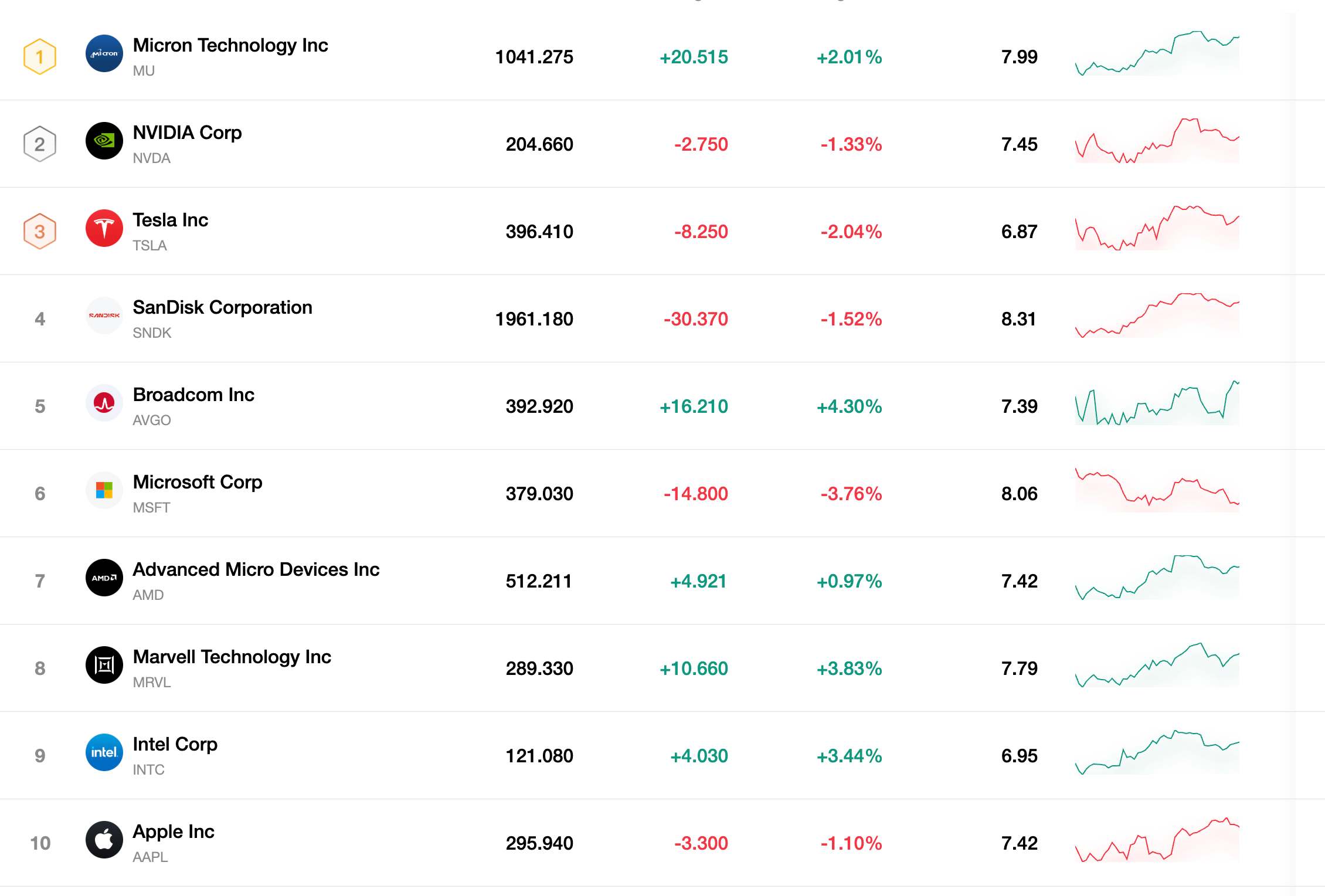
Top 10 Most Traded Stocks
The table below lists the ten most actively traded stocks on Wednesday. With their high trading volume and excellent liquidity, these securities have become key indicators for tracking global market trends.
Recommended Articles


