




Build First, Talk Later: Decoding Trump's Portfolio Logic
February 10, 2026. Trump's investment account purchased between $1 million and $5 million worth of Dell Technologies stock at approximately $126 per share. Nobody knew. He quietly added three more positions in March. The public wouldn't find out until May.
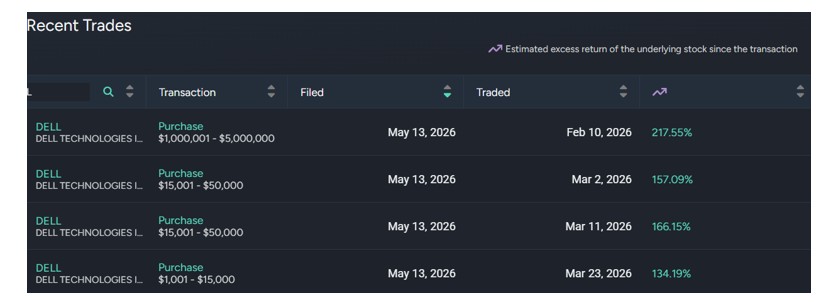
Source: Quiver Quantitative Donald Trump Stock Trade Tracker
Fast-forward to May 8th. The White House hosted an event attended by Dell founder Michael Dell in person. Near the end, Trump went off-script: "Go out and buy a Dell! They're great."
DELL surged as much as 14.6% intraday, closing up approximately 12%, setting a new all-time high that day. Three weeks later, Dell reported earnings that stunned Wall Street: Q1 revenue of $43.8 billion, crushing estimates, with its full-year AI server revenue target raised from $50 billion to $60 billion. The next day, the Pentagon announced a $9.7 billion procurement contract with Dell.
From the entry price of $126, DELL has gained more than 200%, hitting an all-time high of $469. It currently trades near $410.
Build position. Talk it up. Earnings beat and government contract follow. That sequence doesn't look like coincidence.
On May 14, 2026, the U.S. Office of Government Ethics (OGE) published two disclosure documents totaling 113 pages. The primary filing covers Trump's Q1 2026 equity trades: 3,642 transactions spanning 1,026 companies and funds — 2,346 buys and 1,296 sells — with a total value ranging from $220 million to as much as $750 million, averaging roughly 60 transactions per trading day. A separate document lists 69 additional transactions, primarily bonds. Trump personally signed the primary filing on May 8th — the same day he publicly talked up Dell at the White House.
On June 15, CBS News launched a publicly accessible interactive tracking database dedicated to this dataset. This is no longer just a finance story. It's a subject of public oversight.
Dell is just the opening act. What's inside this portfolio is far more complex than a single stock.
The Big Picture: A Rare Asset Allocation Overhaul
To understand Trump's Q1 2026 holdings, you need the backstory: his account barely touched stocks in 2025.
According to Investopedia's in-depth analysis, Trump's trust spent most of 2025 trading municipal bonds — Alabama gas prepayment bonds, Indiana school district bonds, investment-grade corporate bonds from Boeing and Netflix. About five trades per day on average, mostly fixed income.
In the first week of January 2026, everything changed. The trust executed nearly 500 trades in a single week — almost entirely individual equities. Q1 2026 trading volume accounted for 75% of all transactions during Trump's entire second term, with more than half concentrated in March alone.
This wasn't a gradual style shift. It was a full stop, full reversal asset reallocation.
The direction was equally clear. While trimming large-cap tech positions — Meta, Amazon, and Microsoft all saw $5–25 million in large-scale sales — the account concentrated new capital into three categories:
Category 1: AI Hardware & Chip Infrastructure Nvidia, Broadcom, Intel, AMD, Texas Instruments, Synopsys, Cadence, Dell, Jabil.
Category 2: Enterprise Software & Cloud Platforms Oracle, ServiceNow, Adobe, Workday, PTC.
Category 3: Policy-Driven Beneficiaries Palantir, Axon Enterprise, Intuitive Machines, Lockheed Martin, General Dynamics, Northrop Grumman.
Plus broad index exposure: VOO (S&P 500 ETF), IWB (Russell 1000 ETF), RSP (equal-weight S&P 500 ETF).
The portfolio style is institutional, not retail. Active management, concentrated bets, market timing, sector rotation — every characteristic points to a professionally resourced, actively managed account. That assessment sits in notable tension with the Trump family's claim that all trades are "fully managed by third-party automated systems" — but we'll come back to that.
The Two Biggest Winners
The highest returns came from two names: Penguin Solutions (PENG) and SanDisk (SNDK).
Penguin Solutions is a name that draws a blank for most people. The company rebranded from SMART Global Holdings in 2024 and operates AI factory platforms — helping enterprises and emerging cloud providers deploy large-scale AI compute infrastructure. Its core technology is CXL (Computer Express Link) memory expansion. In March 2026, it released the MemoryAI KV Cache Server: a CXL-based enterprise memory appliance delivering up to 11TB of single-node memory capacity, purpose-built for large model inference. Trump's account bought exactly once, at the low. The stock has since approximately tripled.
SanDisk (SNDK) delivered a different kind of explosion. In early 2026, it reported Q2 adjusted EPS of $6.20 against a Wall Street consensus of $3.50 — nearly double the estimate. Data center revenue surged 64% quarter-over-quarter. It then announced a $42 billion multi-year AI storage contract, shifting its business from cyclical NAND spot sales to locked-in long-term agreements with major AI customers. Morgan Stanley raised its price target to $690. Raymond James said "there's still room even after a 16x move." Trump's account bought six times; from the initial position, the stock has more than doubled. Since the start of 2026, SNDK's total gain exceeds 5x.
The thesis behind both stocks has nothing to do with political endorsements — they represent real supply-demand mismatches being resolved along the AI compute expansion chain. The next set of positions is a different story.
Where Every Buy Overlaps With a Policy Timeline
Intel (INTC): One of the world's oldest semiconductor companies, struggling through a painful transition after falling behind TSMC in advanced nodes. Trump's account began buying aggressively in March 2026 — six purchases, several flagged as "broker acting as agent." The backdrop: in August 2025, the U.S. government announced a 9.9% equity stake in Intel at $20.47 per share, a total commitment of $8.9 billion — the government entered first; the president's personal account began building its position roughly six months later. Since the government's announcement, Intel's stock has risen 5x. Intel has now become the second-largest holding among Republican members of Congress.
Nvidia (NVDA): The undisputed AI chip leader, with over 80% share of the data center GPU market. Q1 saw 15 total transactions, including million-dollar-plus buys on both January 6 and February 10. Key context: in August 2025, the Trump administration struck a deal with Nvidia and AMD to permit AI chip sales to China; in January 2026, the administration further approved H200 exports to China with a 25% surcharge; in March 2026, China formally approved H200 imports. Trump's account's major purchases were concentrated in the window during which H200 was receiving regulatory clearance on both sides.
AMD (AMD): Nvidia's most direct competitor in high-end GPUs, and an equally direct beneficiary of the U.S.-China chip agreement. Bought 12 times throughout Q1. As the China market reopened, AMD's data center business gained important new incremental demand.
Dell (DELL): The world's largest AI server integrator. The timeline was covered at the top. One additional fundamental note: Dell's ISG division is the core AI server supplier, with the CFO explicitly stating on the earnings call that AI server backlog had exceeded its all-time high. Michael and Susan Dell donated $6.25 billion to Trump's "American Savings Accounts" initiative. The Pentagon's $9.7 billion contract didn't emerge from nowhere.
The Supply Chain and Tooling Layer: Every Link Covered
Texas Instruments (TXN): The world's largest analog chip company. In June 2025, Commerce Secretary Howard Lutnick announced TI would invest $60 billion in the U.S. to build seven chip factories. Six months later, Trump's account began buying aggressively — 13 purchases total, second only to Oracle and Nvidia in frequency.
Marvell Technology (MRVL): Designs custom AI chips (ASICs/XPUs) for Google, Amazon, and Microsoft — the preferred supplier for cloud providers seeking to reduce Nvidia dependency. In May 2025, Marvell and Nvidia announced a partnership via NVLink Fusion technology, enabling Marvell chips to interface directly with Nvidia's interconnect architecture. Marvell thus became simultaneously a beneficiary of the Nvidia ecosystem and an independent growth story. Trump's account bought twice in February.
Cadence (CDNS) and Synopsys (SNPS): EDA software companies — virtually every new chip in the world passes through their tools from design to tape-out. The most invisible, most structurally durable infrastructure in the entire stack.
Oracle (ORCL): Enterprise database software's long-dominant player, rapidly transitioning to cloud and AI infrastructure. The single most frequently traded stock in the entire portfolio — 17 purchases. Oracle has also captured a large volume of federal government cloud contracts.
Datadog (DDOG): The observability platform for cloud infrastructure. The bigger the AI infrastructure build-out, the higher the probability of failure, and the stronger the demand for monitoring tools. First purchased in March.
Jabil (JBL): One of the world's largest EMS companies; Apple and Nvidia both rely heavily on Jabil for hardware production. Headquartered in Florida. Bought February 10, with three additional purchases in March.
Fortinet (FTNT): Leading network security vendor. AI infrastructure expansion simultaneously creates a larger attack surface. The account first sold a batch, then bought back more in March.
Government Contracts and the Most Contested Positions
Palantir (PLTR) represents the most direct conflict of interest in this portfolio. In February 2026, DHS awarded Palantir a blanket purchase agreement with a ceiling value of $1 billion. Trump's account began building a position in January, made a large sale on February 10 (up to $5 million), then bought multiple times in March with some partial sales, resulting in a Q1 net purchase of approximately $247,000 to $630,000. The entity signing the contract was the administration Trump leads. The account holding the stock belongs to Trump himself. In April, Trump posted on Truth Social praising Palantir for its "great war fighting capabilities and equipment."
Axon Enterprise (AXON): Same logic. Axon makes Tasers and law enforcement AI platforms. The Trump administration's large-scale immigration enforcement operations directly expanded procurement demand across law enforcement agencies. The account purchased $1–5 million on February 10.
Lockheed Martin, General Dynamics, Northrop Grumman all appear in the OGE source documents. In early January, when Trump posted on Truth Social attacking defense contractors and the sector sold off sharply, the account had already quietly begun building positions. After the U.S.-Israel military strike on Iran on February 28, defense stocks rallied broadly — Trump entered at the sector's low and captured the entire move higher.
The Three Questions That Matter
Is this insider trading? Under the current legal framework, the trades in this filing do not constitute insider trading in the criminal law sense. The STOCK Act (signed 2012) prohibits officials from trading on material nonpublic information, but "material nonpublic information" is extraordinarily difficult to define and prove. The Trump family's defense — third-party independent management — provides a legal layer of protection.
Is the presidential account a blind trust? No. A blind trust requires assets to be managed by a trustee completely independent from the beneficiary, with the beneficiary having no knowledge of holdings. Trump personally signed the OGE disclosure and certified its accuracy — meaning he was aware of his holdings at the time of filing. A NOTUS investigation directly concludes this is not, in substance, a "blind" trust.
Were these trades automated? Unverifiable. "Broker Acted As Agent" and "Discretion Exercised" notations indicate only that execution was handled by the broker — they say nothing about whether the strategic direction was set by a human. The Trump Organization's statement that the president is "neither informed nor consulted" cannot be independently verified.
The real central question isn't about legality. It's this: when a single person is simultaneously the most powerful source of policy information in the market and an active participant in that market, is the game starting on a level playing field?
The March Bottom: Precise Entry at Maximum Fear
Euronews noted that Trump's account made substantial purchases during March's market selloff — when the S&P 500 was down nearly 9%, as the Iran war broke out and fear spiked. That bottom call proved strikingly accurate: the S&P 500 bottomed at the end of March, then rallied approximately 17% to new all-time highs.
Buying the dip is not illegal. But a BBC investigation in April provided broader context — across the entirety of Trump's second term, researchers identified a recurring pattern of "abnormal volume spikes in specific assets hours before major announcements." That's no longer an isolated coincidence. It's a consistently observable phenomenon.
A person in possession of war intelligence, policy intelligence, and negotiation intelligence chose to buy aggressively at a moment of extreme market uncertainty. The information sources behind that decision remain a black box.
What This Portfolio Actually Tells Us
Trump's holdings are not an ordinary investment portfolio. They read more like a concrete visualization of America's core strategic priorities for 2026 — with four legible themes.
The AI Arms Race. Nvidia, Broadcom, AMD, Intel, Texas Instruments — the hardware foundation of America's AI chip strategy, directly tied to export control policy, CHIPS Act disbursement, and data center construction pace.
Storage and Inference Infrastructure. SanDisk, Marvell, Penguin Solutions — the underreported layer of the AI stack. Large model inference demands enormous memory and high-speed storage. This chain's breakout is a physical inevitability of AI compute expansion. SanDisk's 5x gain since January 2026 is underwritten by $42 billion in locked AI storage contracts.
The Government Contract Ecosystem. Palantir, Axon — growth through federal procurement, not market competition. The Trump administration's immigration enforcement, homeland security, and intelligent policing agenda are the direct growth drivers. The president holds equity in these companies while his administration signs contracts with them.
Geopolitical Beneficiaries. Lockheed, Northrop, General Dynamics — directly linked to war. In January, Trump's account built positions at the sector low; after the February 28 Iran strike, defense stocks rallied, THAAD production expanded, and Ukraine reconstruction contracts materialized — Trump entered at the bottom and captured the full move.
This portfolio has also triggered an unexpected cascade: Republican members of Congress are replicating these holdings at scale, and Intel has become the second-largest position among GOP lawmakers. According to Autopilot's tracking, Trump's "White House Asset Management" portfolio has substantially outperformed Nancy Pelosi's year-to-date.
A Final Note
No publicly available evidence proves that Trump himself or his family directly participated in any specific trading decision. But one thing is certain: in this portfolio, the highest-returning positions consistently correspond to the most consequential policy decisions made by the Trump administration — the Intel equity stake, the Nvidia China access deal, the Palantir DHS contract, the Dell Pentagon award.
This may not be insider trading. But the existence of this portfolio is itself a profound metaphor for the relationship between power and capital:
In this market, the most valuable research report is never on any broker's subscription list.
Disclaimer: U.S. Office of Government Ethics (OGE) public financial disclosure filings, CBS News interactive database, Forbes, Reuters, and other public reporting. Does not represent realized returns. Not investment advice.
Recommended Articles


