




Fed Chair Kevin Warsh Is in a No-Win Scenario -- and So Is Wall Street
Key Points
Jerome Powell's successor, Kevin Warsh, officially took the reins as Fed chair on May 22.
A historic energy supply shock is wreaking havoc on prices, sending the U.S. inflation rate to a three-year high.
Regardless of whether Warsh and the Federal Open Market Committee (FOMC) raise or lower interest rates, a historically expensive stock market ends up the loser.
- 10 stocks we like better than S&P 500 Index ›
It's been an eventful past month for Wall Street and investors. Earlier this month, the iconic Dow Jones Industrial Average (DJINDICES: ^DJI), widely followed S&P 500 (SNPINDEX: ^GSPC), and growth-stock-inspired Nasdaq Composite (NASDAQINDEX: ^IXIC) rocketed to all-time highs.
Meanwhile, Jerome Powell's tenure as Fed chair came to a close on May 15. President Donald Trump's nominee, Kevin Warsh, officially became only the 17th head of the central bank on May 22.
Will AI create the world's first trillionaire? Our team just released a report on the one little-known company, called an "Indispensable Monopoly" providing the critical technology Nvidia and Intel both need. Continue »
While change is a given on Wall Street, not all shifts are necessarily good news for the stock market or investors. Warsh's ascent to Fed Chair comes at a particularly challenging time for the Federal Open Market Committee (FOMC) -- the 12-person body responsible for setting the nation's monetary policy -- and Wall Street. It appears that no matter what action Warsh oversees next, neither he nor Wall Street can come out as winners.
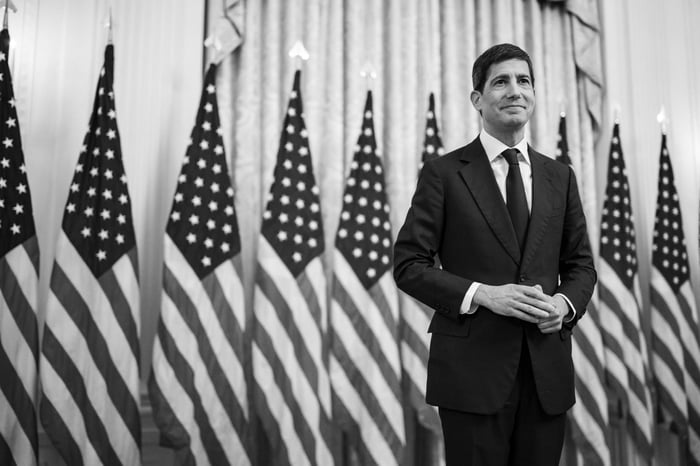
Kevin Warsh became Fed chair at an incredibly challenging time. Image source: Official White House Photo by Daniel Torok.
A historic energy supply shock is wreaking havoc on prices
Although former Fed Chair Jerome Powell frequently pointed to the price stickiness of Trump's tariffs in the goods sector as a reason for elevated inflation, the primary factor making things challenging for the new Fed chair and FOMC is the Iran war.
On Feb. 28, the president gave the OK for U.S. military forces to attack Iran. Not long after Operation Epic Fury commenced, Iran virtually shut down the Strait of Hormuz to commercial vessels. This decision effectively halted the flow of 20 million barrels of petroleum liquids each day. As of this writing on June 6, the Strait of Hormuz remains closed to most commercial traffic.
As you can imagine, removing approximately 20% of the world's crude oil demand in the blink of an eye has had a meaningful impact on energy prices. Gas and diesel prices have soared in the wake of the Iran war, with some inflationary spillover beginning to be seen in the broader economy.
In February, U.S. trailing 12-month (TTM) inflation was just 2.4% and appeared to be trending toward the Fed's long-term target of 2%. By April, TTM inflation had surged to a three-year high of 3.8%.
US inflation is red hot.
-- The Kobeissi Letter (@KobeissiLetter) May 28, 2026
1. CPI Inflation: 3.8%, highest since May 2023
2. PCE Inflation: 3.8%, highest since May 2023
3. PPI Inflation: 6%, highest since March 2023
4. Services Inflation: 3.4%, highest since Sept 2025
5. Shelter Inflation: 3.3%, highest since Sept 2025
6.... pic.twitter.com/u8kaSN54G3
Even if Donald Trump and his administration negotiate a peace deal with Iran in the coming days, the inflationary effects of this historic energy supply shock should persist for several quarters.
Furthermore, the inflationary effects of energy supply shocks on businesses are typically delayed. As the impacts of higher transportation and production costs are felt, core inflation (i.e., inflation excluding volatile food and energy costs) can rise further.
All the while, President Trump has been publicly lobbying the Fed to slash interest rates to 1% or lower. Reducing the cost of borrowing can increase hiring, fuel the artificial intelligence (AI) revolution, lower mortgage rates to make housing more affordable, and decrease the cost of servicing the nation's more than $39 trillion in national debt.
The new Fed chair is about to learn that not only is it impossible to please all the people all the time on Wall Street, but sometimes there flat-out isn't a winning solution.

Image source: Getty Images.
Kevin Warsh and Wall Street are in a no-win scenario
With inflation climbing to a three-year high, the logical expectation is that Warsh and the FOMC will eventually raise interest rates to stabilize prices. Warsh's voting record as a previous member of the FOMC (Feb. 24, 2006 – March 31, 2011) shows he was a monetary hawk who often favored higher interest rates as an inflation-suppression tool.
However, raising interest rates would put Warsh squarely in the crosshairs of President Trump and Wall Street.
Although the Fed is independent of political persuasion within the federal government, drawing the public ire of Trump can unsettle a historically pricey stock market.
Perhaps the more worrisome issue for Wall Street is that higher interest rates could grind a historic AI-driven rally to a halt. Corporate borrowing is helping to finance the AI data center build-out. If Warsh and the FOMC make it costlier to borrow capital, the second-priciest stock market in history would likely find itself vulnerable to substantial downside.
STRONG US JOBS DATA LIFTS FED HIKE ODDS
-- *Walter Bloomberg (@DeItaone) June 5, 2026
Rate futures now price a 63% chance of a December Fed hike, up from 48% pre-data. Kalshi traders also see a 64% chance of a Fed hike before July 2027, with probabilities trending higher. Markets now price a more resilient economy and fewer... pic.twitter.com/47v2Jp0Di2
But continuing the Fed's rate-easing cycle isn't an obvious win for Warsh and Wall Street, either.
If the FOMC were to cut interest rates amid a surge of inflation, it would be viewed as Warsh effectively capitulating to President Trump's demands. While lower interest rates would make borrowing cheaper, this move would threaten the central bank's credibility.
While there's no tangible value to the Fed's credibility, a perceived loss of independence would be devastating to the stock market. The central bank has long been viewed as a financial pillar of Wall Street. If the predictability and trustworthiness that the Fed has built up over decades are lost, the Dow Jones Industrial Average, S&P 500, and Nasdaq Composite could plummet.
No matter what choice Kevin Warsh oversees at the Fed, it's a no-win scenario for him and Wall Street.
Should you buy stock in S&P 500 Index right now?
Before you buy stock in S&P 500 Index, consider this:
The Motley Fool Stock Advisor analyst team just identified what they believe are the 10 best stocks for investors to buy now… and S&P 500 Index wasn’t one of them. The 10 stocks that made the cut could produce monster returns in the coming years.
Consider when Netflix made this list on December 17, 2004... if you invested $1,000 at the time of our recommendation, you’d have $438,283!* Or when Nvidia made this list on April 15, 2005... if you invested $1,000 at the time of our recommendation, you’d have $1,257,427!*
Now, it’s worth noting Stock Advisor’s total average return is 938% — a market-crushing outperformance compared to 206% for the S&P 500. Don't miss the latest top 10 list, available with Stock Advisor, and join an investing community built by individual investors for individual investors.
See the 10 stocks »
*Stock Advisor returns as of June 13, 2026.
Sean Williams has no position in any of the stocks mentioned. The Motley Fool has no position in any of the stocks mentioned. The Motley Fool has a disclosure policy.
Recommended Articles


