




SpaceX: Why This $1.6 Trillion Opportunity Is Critical for the Upcoming IPO
Key Points
AI and rockets garner a lot of attention.
Another business segment may have even more near-term influence for SpaceX.
- These 10 stocks could mint the next wave of millionaires ›
SpaceX expects to go public on June 12. The company hopes to raise $75 billion or more with a target valuation of $1.77 trillion. That would value the company well above Elon Musk's other company, Tesla (NASDAQ: TSLA), which has significantly higher revenue and is already profitable.
Experts are split on whether such a gargantuan valuation is justified. A recent report from Morningstar, for example, calls the IPO stock "significantly overvalued." The firm estimates that SpaceX's true value is currently around $780 billion -- less than half the company's intended valuation.
Will AI create the world's first trillionaire? Our team just released a report on the one little-known company, called an "Indispensable Monopoly" providing the critical technology Nvidia and Intel both need. Continue »
Still, Morningstar sees SpaceX's share price possibly rising once shares hit the public market. "With a small initial float boosted by almost every investment bank on the planet, buoyant investor appetite for AI infrastructure bids, and an unprecedented path to inclusion in the Nasdaq 100 Index just 15 trading days after the IPO, we expect SpaceX's share price will likely survive separation and may even ascend, at least for a time," the firm concludes.
Whatever happens to SpaceX's stock price out of the gate, a single business segment will have a disproportionate impact on the company's bottom line over the next 12 months. And this business has nothing to do with artificial intelligence (AI) or rockets -- at least not directly.
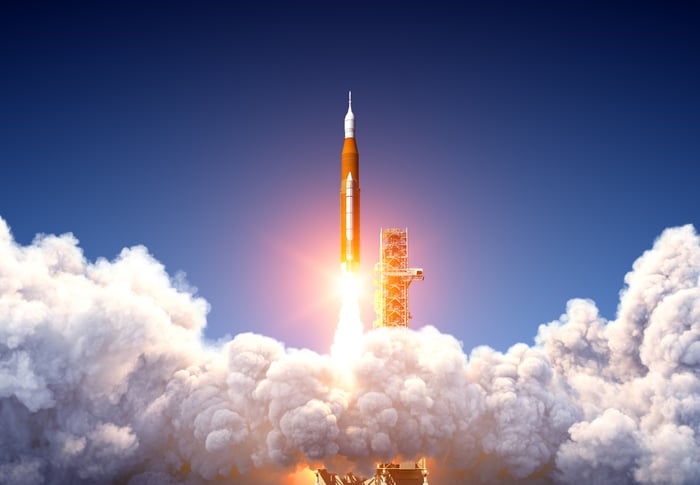
Image source: Getty Images.
SpaceX needs to execute on this $1.6 trillion growth opportunity
A significant amount of detail was revealed in SpaceX's recent IPO prospectus. The most eye-popping revelations related to the value of the company's claimed total addressable market.
"We believe we have identified the largest actionable total addressable market in human history," SpaceX boasts. "We estimate that our quantifiable TAM is $28.5 trillion."
Surprisingly, $26.5 trillion of this $28.5 trillion total opportunity deals with a single business segment: artificial intelligence. But even SpaceX admits that this business segment is "early stage." AI is still a money-losing segment for SpaceX, even though revenue growth is expected to be strong in the coming years.
Rockets -- what SpaceX deems "space-enabled solutions" -- only have a $370 billion total addressable market, even though it's widely considered a core business by the public.
Both AI and rockets will be critical to SpaceX's long-term growth prospects. And successes or failures on these fronts will have an impact on the stock price over the next 12 months. But I think it will be SpaceX's third segment -- what it simply calls "connectivity" -- that will have the greatest near-term influence.
This segment mostly includes SpaceX's Starlink satellite network. SpaceX estimates that this is a $1.6 trillion opportunity, with $870 billion of value attributed to Starlink Broadband, its satellite internet service, and $740 billion tied up in Starlink Mobile, its satellite-to-mobile connectivity business.
Unlike AI and rockets, Starlink is already profitable. And its growth runway is clear: launch more satellites, scale additional broadband customers, partner with more terrestrial cellular networks, and eventually launch a stand-alone mobile service. The segment added more than 4 million new customers last year alone, expanding to 35 additional countries.
When it comes to near-term growth, Starlink will arguably lead the pack, especially when it comes to profit growth. If shares fall in value over the next 12 months -- adding dilutive pressure should SpaceX continue to sell stock to offset its financial losses and fund its heavy capital expenditure plan -- Starlink's profitability will rise in relative value.
Near-term, the financial metrics of this segment could be the tail that wags the dog. Yet the importance of Starlink to SpaceX's financials alone doesn't necessarily warrant an investment at the company's $1.77 trillion targeted valuation. After all, even SpaceX forecasts the total Starlink opportunity to be worth $1.6 trillion. Even capturing the entire addressable market would leave the company short of its intended IPO valuation.
Don’t miss this second chance at a potentially lucrative opportunity
Ever feel like you missed the boat in buying the most successful stocks? Then you’ll want to hear this.
On rare occasions, our expert team of analysts issues a “Double Down” stock recommendation for companies that they think are about to pop. If you’re worried you’ve already missed your chance to invest, now is the best time to buy before it’s too late. And the numbers speak for themselves:
- Nvidia: if you invested $1,000 when we doubled down in 2009, you’d have $540,646!*
- Apple: if you invested $1,000 when we doubled down in 2008, you’d have $55,377!*
- Netflix: if you invested $1,000 when we doubled down in 2004, you’d have $439,038!*
Right now, we’re issuing “Double Down” alerts for three incredible companies, available when you join Stock Advisor, and there may not be another chance like this anytime soon.
See the 3 stocks »
*Stock Advisor returns as of June 10, 2026.
Ryan Vanzo has no position in any of the stocks mentioned. The Motley Fool has positions in and recommends Tesla. The Motley Fool has a disclosure policy.
Recommended Articles


