




Even in a Volatile Market, These 3 Warren Buffett Stocks Are No-Brainers
Key Points
Visa is doing well despite headwinds because consumers now use payment cards the way they used to use cash.
Web domain registry outfit VeriSign is uniquely positioned as a gatekeeper of a business that’s never going away.
Beverage behemoth Coca-Cola remains a Berkshire Hathaway favorite with its long history of dividend growth.
- 10 stocks we like better than VeriSign ›
It's been a wild past few weeks for the stock market. Although S&P 500 soared more than 10% in April, that was mostly just a bounce from the nearly 6% setback it suffered in March following a more muted loss in February. It's the sort of volatility that prompts knee-jerk reactions, for better and for worse.
As veteran investors can attest, however, the things that have always mattered most in the long run are still the things that matter the most now. That's quality. And there's still no better arbiter of quality than the Oracle of Omaha, Warren Buffett, who led Berkshire Hathaway (NYSE: BRKA) (NYSE: BRKB) to a market-beating performance while serving as its chief stock picker since taking the helm as CEO back in 1970.
Will AI create the world's first trillionaire? Our team just released a report on the one little-known company, called an "Indispensable Monopoly" providing the critical technology Nvidia and Intel both need. Continue »
Buffett stepped down from both roles at the end of last year. But the vast majority of Berkshire's equity holdings right now are still his selections. You'd do well to borrow some of these picks for yourself, particularly in this environment where the market's all over the map.
To this end, here's a rundown of three of your best and most stable Buffett bets from Berkshire's current stock portfolio.
Visa
There was a time when credit card middlemen would have felt the impact of consumers' belt-tightening stemming from the sort of economic headwinds that seem to be blowing now. But that's no longer the case.
Last quarter's retail spending within the United States was up 3.7% despite rising prices, according to the U.S. Census Bureau, while consumers continue using cards to pay for things like groceries, gas, and restaurant visits that they used to pay for with cash or a check. The Federal Reserve reports that 31% of all domestic purchases are now made with plastic versus only 7% with cash, dramatically reversing cash's usage of 14% for all transactions as recently as 2016 when credit cards were only used 8% of the time.
Given this, it comes as no surprise that Berkshire holding Visa (NYSE: V) reported a 9% increase in total payments volume last quarter, driving a 17% year-over-year increase in total revenue. What may be surprising is the fact that -- with the exception of the earliest part of the COVID-19 pandemic -- Visa hasn't failed to report year-over-year revenue growth in any quarter for nearly 20 years. Income growth has been nearly as reliable for the same time frame, shrugging off economic weakness like what we saw in 2022.
Berkshire Hathaway doesn't own a huge stake in Visa -- just 8.3 million shares worth a little less than $2.7 billion. What it owns has performed very well though, gaining more than 300% over the course of just the past 10 turbulent years.
VeriSign
VeriSign (NASDAQ: VRSN) may be one of Berkshire's least-talked-about positions, mostly because there's just so little to say about it. But don't confuse being boring with being unrewarding. This name proves there's something to be said for slow and steady,
So what is it? Do you ever wonder who manages all the world's web addresses to prevent more than one person or organization from trying to use the same one? That's what VeriSign does. While you might use a registrar like GoDaddy to request a particular domain, if it ends in a ".com" or ".net," that registrar is ultimately coming to VeriSign to make sure that website name is available, and claim it.
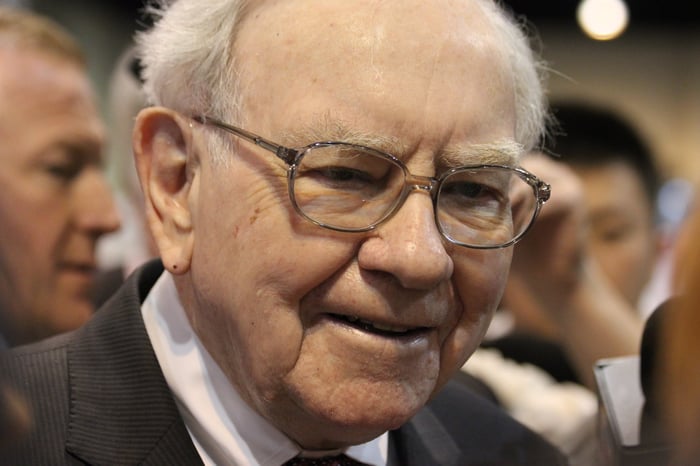
Image source: Getty Images.
And yes, VeriSign collects a modest annual fee for each web address it approves and holds for a user. It's not much, but with over a billion websites in the world today, a lot of small annual fees can go a long way. That's not all VeriSign does though. The company also offers related cybersecurity solutions to ensure websites are reliably accessible. All told, the company did $1.66 billion worth of business last year, up 6.4%, turning $826 million of that into net income (or $8.81 per share).
It's clearly not a high-growth business and probably never will be. It's not difficult to see why Buffett and his acolytes still like it though. VeriSign's competitive position is practically a monopoly on a business that will never cease to exist and will likely never shrink even in a weak economy. The internet is here to stay. So are most of its websites.
Coca-Cola
Finally, an oldie but a goodie, as well as one of Buffett's favorites. That's Coca-Cola (NYSE: KO), which is currently Berkshire's third-biggest position with a value of more than $30 billion.
It doesn't really need an introduction. Coca-Cola is of course the company behind the world's most popular carbonated beverage of the same name but also parent to brands like Gold Peak tea, Minute Maid juice, Powerade sports drink, Dasani water, and more. It's got something for consumers' ever-changing preferences.
That's not quite the reason Buffett's stuck with it for so long, however, and why new Berkshire CEO Greg Abel and his team seem to be just as committed. Their interest is the underlying dividend supported by a perpetually marketable portfolio of products regardless of the economic backdrop. Not only has Coca-Cola paid a quarterly dividend like clockwork for decades now but has upped its per-share payout every year for the past 64 consecutive years. Only a small handful of other Dividend Kings boast a longer track record of uninterrupted dividend growth.
Even if you don't need income at this stage of your life, you can -- as Berkshire does -- use this reliable cash flow to purchase other investments if you don't want to expand your position in Coca-Cola by reinvesting these dividend payments.
Should you buy stock in VeriSign right now?
Before you buy stock in VeriSign, consider this:
The Motley Fool Stock Advisor analyst team just identified what they believe are the 10 best stocks for investors to buy now… and VeriSign wasn’t one of them. The 10 stocks that made the cut could produce monster returns in the coming years.
Consider when Netflix made this list on December 17, 2004... if you invested $1,000 at the time of our recommendation, you’d have $476,034!* Or when Nvidia made this list on April 15, 2005... if you invested $1,000 at the time of our recommendation, you’d have $1,274,109!*
Now, it’s worth noting Stock Advisor’s total average return is 974% — a market-crushing outperformance compared to 206% for the S&P 500. Don't miss the latest top 10 list, available with Stock Advisor, and join an investing community built by individual investors for individual investors.
See the 10 stocks »
*Stock Advisor returns as of May 8, 2026.
James Brumley has positions in Coca-Cola. The Motley Fool has positions in and recommends Berkshire Hathaway, VeriSign, and Visa. The Motley Fool recommends GoDaddy. The Motley Fool has a disclosure policy.
Recommended Articles


