




Meta AI Capex (Up 7%) Is a Bad Surprise -- Could This Be the Next Metaverse?
Key Points
Meta Platforms shares fell 8.6% the day after last Wednesday’s earnings report.
The company is spending at least 7% more than expected on AI capex in 2026.
- 10 stocks we like better than Meta Platforms ›
Meta Platforms (NASDAQ: META) reported earnings on Wednesday, and the news didn't go over well with investors. The company reported some positive results, like a 33% year-over-year increase in quarterly revenue and a 12% year-over-year increase in average price per ad.
But there was bad news about costs. The company's ambitions to be a leader in artificial intelligence (AI) are getting more expensive. Meta stock dropped 8.6% on Thursday, the day after the earnings report. The company's shares are down 7% year to date and have underperformed the tech-heavy Nasdaq-100 index and the S&P 500 index for the past year. Investors aren't buying this company's AI story.
Will AI create the world's first trillionaire? Our team just released a report on the one little-known company, called an "Indispensable Monopoly" providing the critical technology Nvidia and Intel both need. Continue »
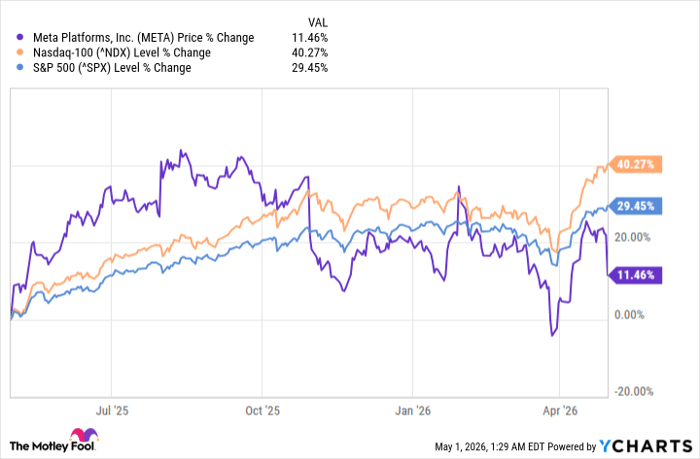
META data by YCharts
Let's take a closer look at what Meta Platforms' AI spending might mean for the share price – and if this AI stock is still worth believing in.
Meta: raising capital expenditures by (at least) 7% in 2026
According to its Wednesday earnings announcement, Meta Platforms expects $125 billion to $145 billion in capital expenditures during 2026. That's a significant increase from the company's prior estimated range of $115 billion to $135 billion. If Meta spends at the higher end of that range, capex will be 7% more than previous estimates.

Image source: Getty Images.
Are investors overreacting to Meta's news about capex? The company says that the higher spending range is due to "higher component pricing" and "additional data center costs to support future year capacity." Meta Platforms is getting hit by the same AI-driven memory shortage that has driven up the costs of consumer electronics.
And Meta's not the only AI company with higher capex this year. Alphabet also reported earnings on Wednesday, and also announced higher capex guidance for 2026 -- $180 billion to $190 billion, up from $175 billion to $185 billion. But investors seem more confident that Alphabet is spending wisely on AI, because the company is making money from AI cloud services and industry-leading AI products like Google Gemini.
But unlike Alphabet or Amazon, Meta doesn't have as clear of a story for how it makes money from AI. What exactly is Meta buying with all those billions of dollars?
AI revolution, or failed experiment?
Investors are starting to have serious doubts about whether Meta's AI investments will pay off -- or if this is another "Metaverse"-style experiment that failed to deliver ROI. Meta changed its name from "Facebook" and spent $80 billion on the Metaverse, and it didn't lead to any important gains for investors.
On the Wednesday earnings call, Meta CEO Mark Zuckerberg was asked by an analyst to share key factors for how to know if the company is on the right path in the next 12-24 months to generate healthy return on invested capital (ROIC). Zuckerberg said, "I don't think we have a very precise plan for exactly how each product is going to scale month over month or anything like that."
It's possible that Meta's team of AI researchers will develop a game-changing new AI experience or must-have AI product. Zuckerberg also said on the earnings call that the company is using AI to transform its work. But at the moment, the company's AI product plans seem vague. Its massive AI capex might not pay off.
If you want to buy the best AI stocks, you might be better off choosing companies like Alphabet and Amazon that are clearly making money from AI services right now. Meta is at risk of getting left behind in AI.
Should you buy stock in Meta Platforms right now?
Before you buy stock in Meta Platforms, consider this:
The Motley Fool Stock Advisor analyst team just identified what they believe are the 10 best stocks for investors to buy now… and Meta Platforms wasn’t one of them. The 10 stocks that made the cut could produce monster returns in the coming years.
Consider when Netflix made this list on December 17, 2004... if you invested $1,000 at the time of our recommendation, you’d have $496,473!* Or when Nvidia made this list on April 15, 2005... if you invested $1,000 at the time of our recommendation, you’d have $1,216,605!*
Now, it’s worth noting Stock Advisor’s total average return is 968% — a market-crushing outperformance compared to 202% for the S&P 500. Don't miss the latest top 10 list, available with Stock Advisor, and join an investing community built by individual investors for individual investors.
See the 10 stocks »
*Stock Advisor returns as of May 4, 2026.
Ben Gran has no position in any of the stocks mentioned. The Motley Fool has positions in and recommends Alphabet, Amazon, and Meta Platforms. The Motley Fool has a disclosure policy.
Recommended Articles


