




2 Top Bargain Stocks Ready for a Bull Run
Key Points
Buying Micron Technology stock is a no-brainer right now, considering its incredibly cheap valuation and stunning earnings growth.
Opera's latest results and guidance suggest that it could quietly deliver big gains to investors.
- 10 stocks we like better than Micron Technology ›
Finding undervalued companies and holding them for the long run is one of the best ways to make money in the stock market, especially if those companies have been clocking outstanding growth.
We are going to take a closer look at two such value stocks in this article -- Micron Technology (NASDAQ: MU) and Opera (NASDAQ: OPRA). Both companies have been experiencing solid growth, and the good news is that they can be bought at really attractive valuations right now.
Will AI create the world's first trillionaire? Our team just released a report on the one little-known company, called an "Indispensable Monopoly" providing the critical technology Nvidia and Intel both need. Continue »
Let's take a closer look at their prospects and check why buying these two stocks right now could turn out to be a smart move.

Image source: Micron Technology.
1. Micron Technology: Accelerating memory prices should ensure that its red-hot growth continues
Micron Technology is already on a terrific bull run in 2026. Micron stock has already jumped 90% this year, as of this writing. Even then, it is trading at just 26 times trailing earnings, a discount to the tech-focused Nasdaq-100 index's earnings multiple of 34.
The stock's forward earnings multiple of 5.5 makes it clear it is a massive bargain right now, as booming memory demand and a favorable pricing environment will drive stunning earnings growth for the company. The good news for Micron investors is that the increase in memory pricing shows no signs of slowing.
Market research firm TrendForce estimates that dynamic random-access memory (DRAM) contract prices could increase by 58% to 63% sequentially in the second quarter. Meanwhile, the contract prices of storage-oriented NAND flash memory could jump by 70% to 75% in the current quarter.
DRAM accounted for 79% of Micron's revenue in the previous quarter, with the rest coming from NAND flash sales. The persistent increase in the prices of these memory chips, which are used in various kinds of artificial intelligence (AI) accelerator chips, will remain a tailwind for Micron for the rest of the year.
Financial services provider D.A. Davidson recently initiated coverage on Micron stock. The firm rates Micron as a buy and has a $1,000 price target, which is the highest among Wall Street analysts. Davidson analyst Gil Luria notes that AI is creating a strong, long-lasting demand cycle for memory chips, which should ensure the favorable pricing environment that has fueled Micron's growth continues.
The firm's price target suggests that Micron could jump 84% from current levels. However, don't be surprised to see Micron crush D.A. Davidson's price target as its earnings in fiscal 2027 (which begins in late August this year) are expected to hit $101.47 per share. If Micron trades at even 20 times earnings at the end of fiscal 2027, its stock price could be more than double the firm's price target.
So, it isn't too late for investors to buy this growth stock as its phenomenal rally is here to stay.
2. Opera: This web browser company is quietly making investors richer
Opera's web browsers are used by approximately 6% of global internet users. The company has been able to monetize its sizable user base by offering premium slots to advertisers on the landing pages of its browsers, as well as by directing search queries to partner websites with whom it has revenue-sharing agreements.
The company released its first-quarter 2026 results on April 28. It reported a 23% year-over-year increase in revenue to $176 million, which exceeded its guidance range. Importantly, Opera's focus on adding high-value users led to a strong year-over-year jump of 25% in its annualized average revenue per user (ARPU) to $2.43. This explains the 28% year-over-year jump in Opera's earnings to $0.34 per share during the quarter.
Importantly, Opera is looking to push the envelope on the product development front to strengthen monetization of its huge monthly active user (MAU) base of 288 million. The company's MiniPay Stablecoin wallet, launched in September 2023, has gained impressive traction among users. The company notes that MiniPay had 15 million cumulative activated wallets in March 2026, a jump of 123% year over year.
Opera supports transactions in more than 40 currencies across 66-plus countries, so it won't be surprising to see this payments platform gaining further traction. Moreover, Opera has raised its full-year guidance and now expects 19% revenue growth in 2026 at the midpoint, up from its earlier expectation of an 18.5% increase in revenue.
What's more, analysts are anticipating strong double-digit earnings growth from Opera going forward.
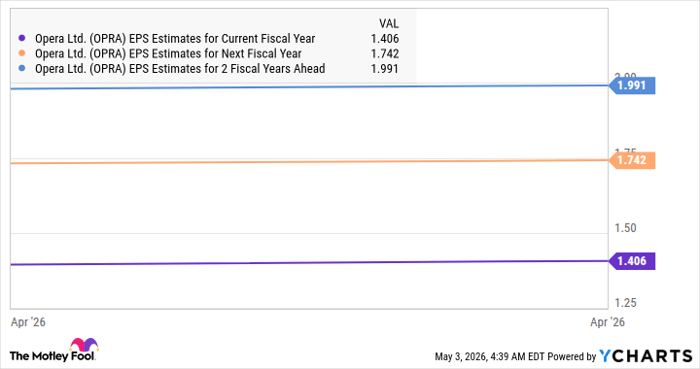
OPRA EPS Estimates for Current Fiscal Year data by YCharts
With the stock trading at just 15 times earnings, buying it is a no-brainer right now. This growth stock could surge higher following the 31% gains it has clocked so far in 2026, as the market could reward its solid growth with a higher valuation.
Should you buy stock in Micron Technology right now?
Before you buy stock in Micron Technology, consider this:
The Motley Fool Stock Advisor analyst team just identified what they believe are the 10 best stocks for investors to buy now… and Micron Technology wasn’t one of them. The 10 stocks that made the cut could produce monster returns in the coming years.
Consider when Netflix made this list on December 17, 2004... if you invested $1,000 at the time of our recommendation, you’d have $496,473!* Or when Nvidia made this list on April 15, 2005... if you invested $1,000 at the time of our recommendation, you’d have $1,216,605!*
Now, it’s worth noting Stock Advisor’s total average return is 968% — a market-crushing outperformance compared to 202% for the S&P 500. Don't miss the latest top 10 list, available with Stock Advisor, and join an investing community built by individual investors for individual investors.
See the 10 stocks »
*Stock Advisor returns as of May 4, 2026.
Harsh Chauhan has no position in any of the stocks mentioned. The Motley Fool has positions in and recommends Micron Technology. The Motley Fool has a disclosure policy.
Recommended Articles


