




Finally, Some Good News for Tesla Investors
Key Points
Robotaxi fleet expansion is slow but progressing, with 26 unsupervised vehicles now operating.
A major ramp-up depends on FSD V15, which is likely not going to be available before 2027.
EU regulatory progress could further improve Tesla's narrative and investor sentiment.
- These 10 stocks could mint the next wave of millionaires ›
Tesla (NASDAQ: TSLA) isn't a stock being valued for what it is now but rather for what it could become in a few years' time. That future largely depends on its robotaxi and Optimus initiatives, with the former being the key near-term catalyst.
While the robotaxi rollout has been far slower than anticipated, Tesla is beginning to show some incremental progress, however small, that shouldn't be dismissed by investors. It's something that, alongside increasing approvals for full self-driving (FSD) in Europe, can build investor confidence in the stock.
Will AI create the world's first trillionaire? Our team just released a report on the one little-known company, called an "Indispensable Monopoly" providing the critical technology Nvidia and Intel both need. Continue »
Tesla's expanding unsupervised robotaxi fleet
To be clear, this isn't the rollout most envisaged, and it's certainly not what CEO Elon Musk outlined almost a year ago. Having famously told investors to expect autonomous ride-hailing in half of the U.S. population by the end of 2025, investors had to wait until the end of January for the first truly unsupervised robotaxi to be operational in Austin, Texas.
Since then, progress has been slow, and Tesla entered April with just nine unsupervised robotaxis in operation in Austin. However, the good news is Tesla exited April with 26 in operation, including three apiece in Houston and Dallas. Moreover, Tesla has "preparations underway" in Phoenix, Miami, Orlando, Tampa, and Las Vegas.
When will the robotaxi fleet expand
While it's hard to call it an aggressive ramp-up, it is progress and the continuation of proving out the Tesla robotaxi. That said, don't expect too much too soon, because in the words of Musk on the recent earnings call, the large-scale ramp-up in unsupervised FSD/robotaxis won't occur because "I think it's not going to make sense for us to deploy unsupervised FSD or robotaxi large scale when we know that there are major architectural improvements to the software that can improve safety."
In a nutshell, Musk is talking about the next version of FSD software, V15, which is seen as a major upgrade over the V14.3 variants currently running on robotaxis. Musk is hoping to have V15 available by the end of this year, but certainly by early next year.
What Tesla investors should look out for
As such, while the incremental robotaxi expansion is fun to watch and helps validate the technology, it's clear that the exponential ramp-up in Tesla's robotaxi fleet deployment won't occur until V15 is available.

Image source: Tesla.
It's clear that a gradual ramp-up will take place using V14.3, from which Tesla will continue to gather data to improve safety and eliminate what Musk describes as "convenience issues" such as the robotaxis being "scared to move" or repeatedly going around a block after being unable to pass a certain point due to road construction. Consequently, it will be a slow ramp under 14.3 before Tesla prepares for a wide-scale deployment under V15, probably in 2027.
Is Tesla stock a buy?
While the recent earnings presentation was probably a net negative for the stock, the reality is that, for the first time in a long time, Tesla may well be set up to underpromise and overdeliver. The major robotaxi rollout ramp-up is highly unlikely to occur until 2027 and is contingent on V15's release. Still, that doesn't mean Tesla can't incrementally grow its fleet, as it did in April.
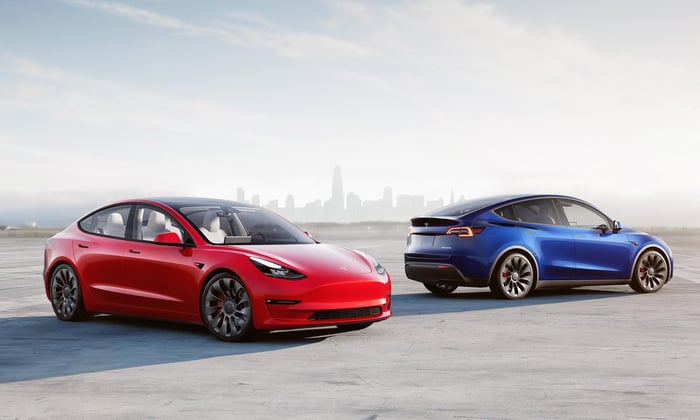
Image source: Tesla.
Now that investor expectations for the rollout have been somewhat reset by management's commentary on the call, any robotaxi fleet expansion will be seen as a positive and should subsequently contribute to a positive narrative on the stock. In addition, Tesla has now supervised FSD software approved in the Netherlands, and it may receive EU-wide approval, as the Dutch regulator RDW moved to seek EU-wide approval in May. In any case, individual EU countries can approve it independently.
It all speaks to an improving narrative for Tesla through 2026, which starts with growth in the robotaxi fleet in April. Tesla investors aren't looking for half the U.S. population to be covered in a few months' time anymore. Instead, the expectation is that Tesla's major robotaxi ramp-up will occur in 2027, and that realistic aspiration means any progress in 2026 will be taken as positive.
All told, Tesla remains an attractive stock for enterprising investors willing to take on significant risk for substantive reward, but patience is required.
Don’t miss this second chance at a potentially lucrative opportunity
Ever feel like you missed the boat in buying the most successful stocks? Then you’ll want to hear this.
On rare occasions, our expert team of analysts issues a “Double Down” stock recommendation for companies that they think are about to pop. If you’re worried you’ve already missed your chance to invest, now is the best time to buy before it’s too late. And the numbers speak for themselves:
- Nvidia: if you invested $1,000 when we doubled down in 2009, you’d have $514,753!*
- Apple: if you invested $1,000 when we doubled down in 2008, you’d have $53,344!*
- Netflix: if you invested $1,000 when we doubled down in 2004, you’d have $496,473!*
Right now, we’re issuing “Double Down” alerts for three incredible companies, available when you join Stock Advisor, and there may not be another chance like this anytime soon.
See the 3 stocks »
*Stock Advisor returns as of May 3, 2026.
Lee Samaha has no position in any of the stocks mentioned. The Motley Fool has positions in and recommends Tesla. The Motley Fool has a disclosure policy.
Recommended Articles


