




Warren Buffett's Successor, Greg Abel, Just Perpetuated the Oracle of Omaha's $195 Billion Warning to Wall Street -- and It's Terrible News for Stocks
Key Points
Berkshire's new boss, Greg Abel, has some big shoes to fill after Warren Buffett retired as CEO on Dec. 31, 2025.
Abel oversaw the net sale of $8.1 billion in stocks in the March-ended quarter.
Buffett's and Abel's persistent selling indicate that the stock market is historically pricey and likely to head lower.
- 10 stocks we like better than Berkshire Hathaway ›
This year marks a new era for trillion-dollar conglomerate Berkshire Hathaway (NYSE: BRKA)(NYSE: BRKB). For the first time in well over half a century, billionaire Warren Buffett isn't running the show. The Oracle of Omaha stepped down as CEO on Dec. 31, handing the reins to his longtime understudy, Greg Abel.
Abel has some big shoes to fill, with Buffett overseeing a nearly 6,100,000% return in Berkshire's Class A shares (BRKA) over six decades. This compares to the S&P 500's (SNPINDEX: ^GSPC) total return, including dividends, of around 46,000% over the same timeline.
Will AI create the world's first trillionaire? Our team just released a report on the one little-known company, called an "Indispensable Monopoly" providing the critical technology Nvidia and Intel both need. Continue »
On Saturday, May 2, Wall Street and investors got their first look at what an Abel-led Berkshire Hathaway might entail. Perhaps unsurprisingly, the company's first-quarter operating results showed that Abel is perpetuating Buffett's deafening warning to Wall Street.
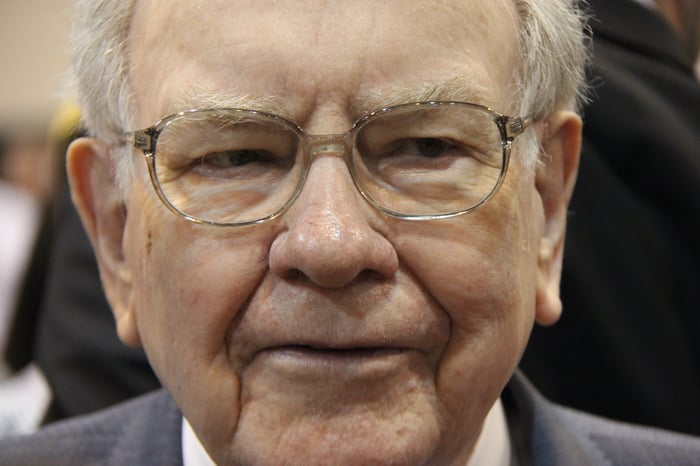
Warren Buffett retired as Berkshire Hathaway CEO on Dec. 31, 2025. Image source: The Motley Fool.
Buffett and Abel have been net sellers of stocks for 14 consecutive quarters
In many respects, Buffett and Abel are cut from the same cloth. They both favor investing in companies with competitive advantages, experienced management teams, and robust capital-return programs. But above all else, they're both unwavering when it comes to value and getting a good deal.
Berkshire's consolidated cash flow statement shows that Abel was a net seller of equities during the March-ended quarter. This marks the 14th consecutive quarter (Oct. 1, 2022 – March 31, 2026) that Berkshire Hathaway's lead investor has been a net seller of stocks:
- Q4 2022: $14.64 billion in net-equity sales
- Q1 2023: $10.41 billion
- Q2 2023: $7.981 billion
- Q3 2023: $5.253 billion
- Q4 2023: $0.525 billion
- Q1 2024: $17.281 billion
- Q2 2024: $75.536 billion
- Q3 2024: $34.592 billion
- Q4 2024: $6.713 billion
- Q1 2025: $1.494 billion
- Q2 2025: $3.006 billion
- Q3 2025: $6.099 billion
- Q4 2025: $3.164 billion
- Q1 2026: $8.149 billion
Collectively, Berkshire's bosses have sold approximately $194.8 billion more in stock than they've purchased over the last 3.5 years -- and there's a clear (and worrisome) reason why this pattern is continuing.

Image source: Getty Images.
A historically pricey stock market foreshadows trouble for equities
Regardless of how much Buffett or Abel appreciates a company's sustainable edge, management team, or capital-return program, nothing matters more than getting perceived value. For years, finding bargains on Wall Street has become challenging.
In a 2001 interview with Fortune magazine, Buffett referred to the market-cap-to-GDP ratio as "probably the best single measure of where valuations stand at any given moment." This ratio has since become known as the Buffett indicator.
Since 1970, the aggregate value of all U.S. public companies divided by U.S. gross domestic product (GDP) is 0.88, or 88%. As of April 30, the Buffett indicator hit an all-time high of 226.8%.
JUST IN 🚨: Stock Market reaches most expensive valuation in history after the Warren Buffett Indicator jumps to 227%, surpassing the Dot Com Bubble and the Global Financial Crisis 🤯👀 pic.twitter.com/t6zn8l8aKM
-- Barchart (@Barchart) April 19, 2026
It's a similar story for the S&P 500's Shiller Price-to-Earnings (P/E) Ratio, which is also known as the Cyclically Adjusted P/E Ratio (CAPE Ratio). Over the last 155 years, the Shiller P/E has averaged a little over 17. It ended the May 1 trading session above 41! The only time the CAPE Ratio has been higher is in the months leading up to the dot-com bubble bursting.
When the Shiller P/E tops 30, history shows it's been (eventually) followed by declines of at least 20% in the benchmark S&P 500. Warren Buffett's and Greg Abel's persistent net selling portend trouble for a historically pricey stock market.
Should you buy stock in Berkshire Hathaway right now?
Before you buy stock in Berkshire Hathaway, consider this:
The Motley Fool Stock Advisor analyst team just identified what they believe are the 10 best stocks for investors to buy now… and Berkshire Hathaway wasn’t one of them. The 10 stocks that made the cut could produce monster returns in the coming years.
Consider when Netflix made this list on December 17, 2004... if you invested $1,000 at the time of our recommendation, you’d have $496,473!* Or when Nvidia made this list on April 15, 2005... if you invested $1,000 at the time of our recommendation, you’d have $1,216,605!*
Now, it’s worth noting Stock Advisor’s total average return is 968% — a market-crushing outperformance compared to 202% for the S&P 500. Don't miss the latest top 10 list, available with Stock Advisor, and join an investing community built by individual investors for individual investors.
See the 10 stocks »
*Stock Advisor returns as of May 3, 2026.
Sean Williams has no position in any of the stocks mentioned. The Motley Fool has positions in and recommends Berkshire Hathaway. The Motley Fool has a disclosure policy.
Recommended Articles


