




Why April 22 Could Be a Huge Day for Tesla Investors
Key Points
Tesla already reported first-quarter electric vehicle deliveries and production.
But investors are more focused on Tesla's robotaxi fleet and humanoid robots.
The market will be looking for clues from CEO Elon Musk and other members of senior management regarding how future initiatives are progressing.
- These 10 stocks could mint the next wave of millionaires ›
On Wednesday, April 22, after the market closes, Tesla (NASDAQ: TSLA) will report first-quarter 2026 earnings, and then founder and CEO Elon Musk, along with other members of the senior management team, will hold a live conference call to provide an update on the business and answer analysts' questions.
While the team will touch on the core electric vehicle (EV) business, Musk and management will also discuss future initiatives that investors expect will drive Tesla's valuation.
Will AI create the world's first trillionaire? Our team just released a report on the one little-known company, called an "Indispensable Monopoly" providing the critical technology Nvidia and Intel both need. Continue »
Here's why April 22 could be a big day for Tesla investors.
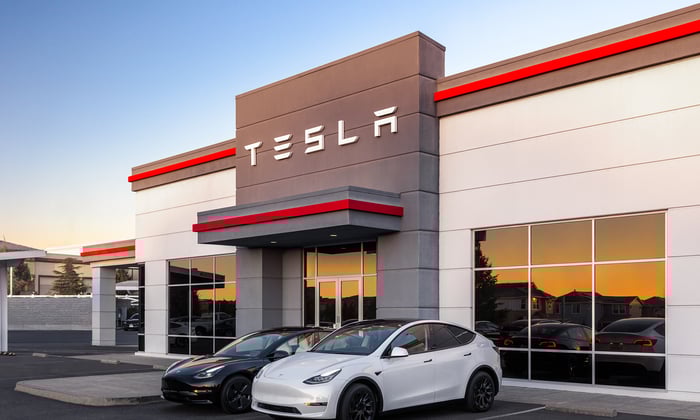
Image source: Tesla.
Looking for an update on robotaxis and humanoid robots
After each quarter concludes and before earnings, Tesla regularly releases deliveries and total production -- important numbers for the EV business that show how many vehicles the company made and roughly how many it sold.
In the first quarter of 2026, Tesla produced 408,386 vehicles and delivered 358,023. Not only was that the lowest number of deliveries in a year, but it also fell short of Wall Street estimates.
Furthermore, the gap between production and deliveries suggests Tesla will have higher-than-expected inventory, which could further weigh on free cash flow, given Tesla's previous guidance of significant capital expenditures (capex) this year. Investors will likely be interested in this dynamic, as well as an update on new EV models.
But the even bigger focus will likely be on Tesla's emerging robotaxi fleet and progress on humanoid robotics, which seem to be the main drivers behind Tesla's elevated valuation. Tesla's new robotaxi fleet is currently operating in Austin, Texas, and San Francisco, but it's hard to know exactly how many of its robotaxis are fully autonomous or are remotely controlled.
Furthermore, while Tesla has promised to expand robotaxis into seven new cities, it still hasn't happened over a third of the way through 2026, and it may happen more gradually than initially forecast, according to UBS analyst Joseph Spak.
"We believe Tesla will roll out [robotaxis] more slowly given their safety culture," Spak wrote in a recent research note. "They have to make sure the product works very well given the importance to the future of the company. While it's possible they have limited vehicles in more cities later this year, we do not see meaningful scaling."
Furthermore, Spak only sees Tesla making 5,000 Optimus robots by 2027, which will supposedly be able to complete chores normally done by humans, and 30,000 by 2030. Musk has previously said he believes Tesla will eventually be building a million humanoid robots annually, although he didn't provide a specific timeline.
What could move the stock?
The good news for Tesla shareholders is that Musk has rarely met his forecasted timelines for full self-driving and robotaxis in recent years, so I don't think the market expects him to be fully on schedule this year. Musk is also in the midst of bringing SpaceX public in what will likely be the largest initial public offering (IPO) to date, so he likely has his hands full.
Ultimately, investors will be parsing through every word he says very carefully. I think the market could be disappointed if there is a delay in the rollout of robotaxis to the seven new cities Musk had previously discussed. Robotaxis are expected to drive a significant new stream of revenue, currently supporting Tesla's valuation.
The stock's valuation has come down from nearly 300 times forward earnings at the end of last year to roughly 191 times, as of this writing. That is still multiples larger than peers in the "Magnificent Seven." The focus will be on robotaxis. Optimus robots are a focus, but not as front and center.
I continue to advise caution on Tesla stock. While the company may very well have a head start or even an advantage on robotaxis and humanoid robots, the valuation is dependent on these initiatives succeeding, which is why I don't like the risk-reward setup here.
Don’t miss this second chance at a potentially lucrative opportunity
Ever feel like you missed the boat in buying the most successful stocks? Then you’ll want to hear this.
On rare occasions, our expert team of analysts issues a “Double Down” stock recommendation for companies that they think are about to pop. If you’re worried you’ve already missed your chance to invest, now is the best time to buy before it’s too late. And the numbers speak for themselves:
- Nvidia: if you invested $1,000 when we doubled down in 2009, you’d have $523,131!*
- Apple: if you invested $1,000 when we doubled down in 2008, you’d have $51,457!*
- Netflix: if you invested $1,000 when we doubled down in 2004, you’d have $524,786!*
Right now, we’re issuing “Double Down” alerts for three incredible companies, available when you join Stock Advisor, and there may not be another chance like this anytime soon.
See the 3 stocks »
*Stock Advisor returns as of April 19, 2026.
Bram Berkowitz has no position in any of the stocks mentioned. The Motley Fool has positions in and recommends Tesla. The Motley Fool has a disclosure policy.
Recommended Articles


