




3 International ETFs Worth Considering as the Iran War Ceasefire Leaves Global Valuations in Flux
Key Points
The Vanguard Total International Stock ETF gained nearly 37% in the past year.
The Vanguard International High Dividend Yield ETF did even better, with a 37.1% return in the past year.
The State Street SPDR Portfolio Emerging Markets ETF is a low-cost fund that focuses on riskier emerging-market stocks.
- 10 stocks we like better than Vanguard Total International Stock ETF ›
If the Iran war is truly "over," that would be good news for humanity. It would also be good news for stock markets. Investors in U.S. stocks reacted with enthusiasm to last week's ceasefire in the Middle East -- the S&P 500 index and tech-heavy Nasdaq-100 index both reached new all-time highs on Friday.
What about international stocks? For most of the past year before the Iran war started on Feb. 28, the rest of the world's stocks (as represented by the FTSE Global All Cap ex-US Index) had largely been outperforming America's S&P 500. Investors have been looking for opportunities beyond the U.S. market. But the Iran war threatened to derail that global growth.
Will AI create the world's first trillionaire? Our team just released a report on the one little-known company, called an "Indispensable Monopoly" providing the critical technology Nvidia and Intel both need. Continue »
During the recent closure of the Strait of Hormuz, countries like Japan, which are heavily reliant on Middle East oil and gas, saw their stock markets plummet. Japan's Nikkei 225 index dropped 13% between Feb. 27 and March 31. But since that low point on March 31, the Nikkei 225 has gained more than 14%.
This performance suggests that the end of the Iran war, if the ceasefire holds (which was unfortunately in some doubt Saturday night), could be even better news for investors in international stocks. Economic growth can go on without the destruction of war.
Let's look at a few of the best international ETFs that could be good buys in a post-Iran-war investing landscape.

Image source: Getty Images.
VXUS: A big smorgasbord of international stocks
If you want to buy international stocks, one of the easiest, lowest-cost, and most-diversified ways to do it is to buy the Vanguard Total International Stock ETF (NASDAQ: VXUS). This international ETF holds 8,794 stocks from dozens of countries, including Japan (15.3% of the fund), the United Kingdom (9%), Canada (8.3%), China (8%), and Taiwan (7%).
In the past 15 years, since the fund's inception in January 2011, VXUS has delivered average annual returns (by net asset value) of 6%. That might not sound impressive compared to the S&P 500 index's long-term average of 10% per year. But the past few years have seen stronger gains for international investors. In the past three years, VXUS has delivered annual returns averaging 15.3%, and in the past year, it delivered an impressive 36.6% return.
VXUS charges an exceptionally low expense ratio of 0.05%. The fund has a price-to-earnings (P/E) ratio of 18.4, which is much lower than the S&P 500 index's P/E ratio of 30.6. International stocks might still be cheap compared to American equities. If you want to diversify your portfolio away from U.S. stocks, VXUS could offer international upside at an ultra-low cost.
VYMI: International stocks that pay high dividends
Some U.S. investors might want to buy international stocks that feel less "risky" and that have a strong track record of profitability. The Vanguard International High Dividend Yield ETF (NASDAQ: VYMI) can be suitable for those goals. This international stock ETF comprises 1,597 companies that are expected to deliver higher-than-average dividend yields.
Instead of owning nearly 8,800 stocks like VXUS, this ETF is more narrowly focused. Its top holdings come from countries like Japan (11.8% of the fund), the United Kingdom (11.3%), Canada (8.5%), Switzerland (7.6%), and Australia (7.4%). The top 10 holdings include major pharmaceutical stocks, international banks, global energy company Shell PLC, and a few household names such as Nestlé and Toyota Motor.
In the past 10 years, since the fund's inception in February 2016, VYMI has delivered average annual returns (by net asset value) of 10.9%. The past three years have been even better, with annual returns averaging 20.35%, and the past year's gains were 37.1%. This fund has outperformed VXUS over the past few years. And VYMI has an even cheaper P/E ratio of 14.56. This fund could be worth a look for globally minded dividend investors.
SPEM: Bet on a brighter future for emerging markets
For investors who are willing to take a bit more risk, international stock ETFs also offer exposure to some of the world's up-and-coming economies. The State Street SPDR Portfolio Emerging Markets ETF (NYSEMKT: SPEM) holds 2,984 stocks from emerging markets -- countries with developing economies that have potential for strong future growth.
Top markets represented in this ETF include China (29% of the fund), Taiwan (26.9%), India (16.02%), Brazil (5.2%), and South Africa (3.33%). Top stock holdings include major Asian tech names such as Taiwan Semiconductor Manufacturing (12.94% of the fund), Tencent, and Alibaba Group. The fund is a bit top-heavy with tech stocks but still offers decent diversification across dozens of countries.
Emerging markets don't always deliver exciting gains. In the past 19 years since this fund's inception in March 2007, SPEM has delivered average annual returns (by net asset value) of 5.12%. That's barely better than half the long-term average of 10% for the S&P 500. The past few years have seen stronger growth for SPEM, with average annual returns of 13.4% over the past three years and 36.1% over the past year. Its P/E ratio of 17.09 looks cheaper than the S&P 500, and SPEM charges a low expense ratio of 0.07%.
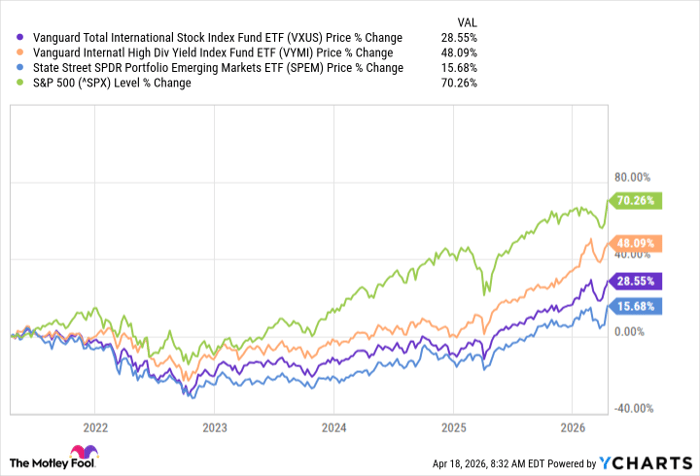
Which of these international ETFs is the best buy? Here's a chart that shows their five-year performance head-to-head, and against the S&P 500:
Data by YCharts.
SPEM has underperformed VYMI and VXUS, as well as the S&P 500, for the past five years. But if you believe emerging markets are poised for stronger growth than the rest of the world after the end of the Iran war, SPEM could be worth buying. If you want more of a tried-and-true dividend-focused approach, VYMI has a strong recent track record. Or if you just want to buy "the rest of the world" in a low-cost, low-effort, diversified way, VXUS could be the simplest choice for most U.S. investors.
Should you buy stock in Vanguard Total International Stock ETF right now?
Before you buy stock in Vanguard Total International Stock ETF, consider this:
The Motley Fool Stock Advisor analyst team just identified what they believe are the 10 best stocks for investors to buy now… and Vanguard Total International Stock ETF wasn’t one of them. The 10 stocks that made the cut could produce monster returns in the coming years.
Consider when Netflix made this list on December 17, 2004... if you invested $1,000 at the time of our recommendation, you’d have $524,786!* Or when Nvidia made this list on April 15, 2005... if you invested $1,000 at the time of our recommendation, you’d have $1,236,406!*
Now, it’s worth noting Stock Advisor’s total average return is 994% — a market-crushing outperformance compared to 199% for the S&P 500. Don't miss the latest top 10 list, available with Stock Advisor, and join an investing community built by individual investors for individual investors.
See the 10 stocks »
*Stock Advisor returns as of April 19, 2026.
Ben Gran has positions in Vanguard Total International Stock ETF. The Motley Fool has positions in and recommends Taiwan Semiconductor Manufacturing, Tencent, and Vanguard Total International Stock ETF. The Motley Fool recommends Alibaba Group and Nestlé. The Motley Fool has a disclosure policy.
Recommended Articles


