




Dogecoin Price Forecast: DOGE bulls eye potential bottom amid steady retail interest
- Dogecoin consolidates in a narrow range between $0.0750 and $0.0800, reflecting a constrained outlook in the broader crypto market.
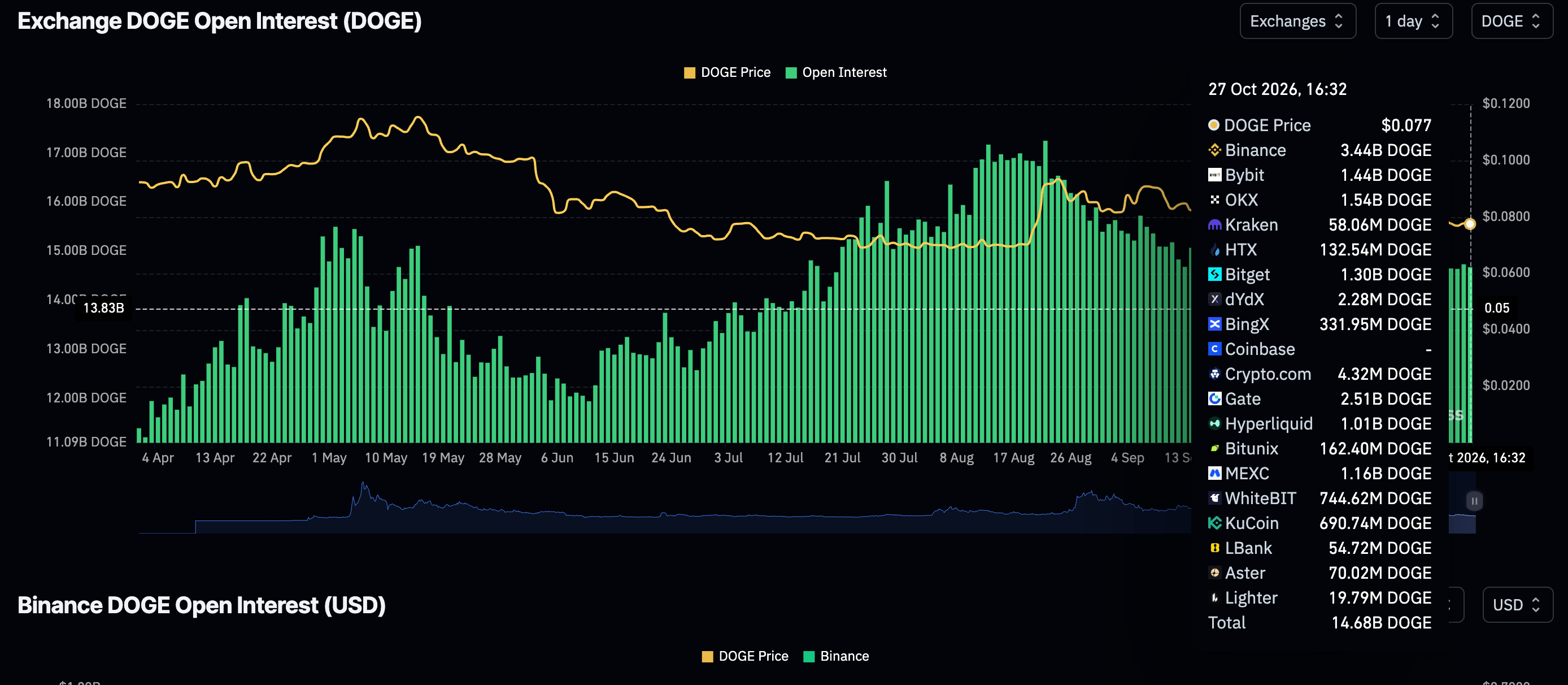
- Dogecoin derivatives appear to be stabilizing, with perpetual futures open interest at 14.7 billion.
- Technically, Dogecoin faces weak momentum indicators, but a recovery could ensue if range support holds.
Dogecoin (DOGE) trades sideways on Tuesday between the $0.0750 support and $0.0800 supply. The meme coin outlook aligns with persistent neutral-to-bearish sentiment, accentuated by macro concerns ahead of Wednesday's Federal Reserve (Fed) interest rate decision.
In addition to the rate decision, which is widely expected to remain in the 3.75-4.00% range, traders will focus on Fed Chair Kevin Warsh's post-meeting press conference, searching for clues on policy direction amid persistent inflation and the impact of broader geopolitical tensions on Oil and energy prices.
“Wednesday's Fed meeting is the key macro event,” Crypto Finance said in an emailed analysis report, adding, “We expect rates to remain unchanged."
Beyond October’s likely decision to keep interest rates unchanged, economists anticipate a December rate hike. The Fed increased rates for the first time in three years in September, underscoring the central bank’s efforts to bring inflation down to the 2% target.
“Markets currently price a 90% probability of a skip, followed by a December hike and two further hikes by year-end 2027, taking the target range to 4.50-4.75%,” Crypto Finance added.
Dogecoin retail activity stabilizes
The derivatives market remains relatively stable, with futures Open Interest standing at 14.68 billion DOGE on Tuesday, down only marginally from 14.73 billion DOGE the day before. Broadly, OI has not exceeded the 15 billion DOGE threshold since October 21, with the lowest reading at 18.64 billion. Traders will watch retail behavior, as a steady increase in OI could support a short- to medium-term recovery. Conversely, if retail activity falls, the path of least resistance could remain downward, forcing traders to target lower support levels at $0.0750 and $0.0700, respectively.
Technical analysis: Dogecoin eyes consolidation as sell-side pressure eases
Doge trades at $0.0777, extending a bearish bias as price holds below all key Exponential Moving Averages (EMAs) and the active SuperTrend line. The 50-day EMA at $0.0841 and the 100-day EMA at $0.0845 sit overhead, suggesting a capped tone, while the 200-day EMA at $0.0908 reinforces the broader downside structure.
The SuperTrend at $0.0876 continues to track a resistance regime, and the Relative Strength Index (RSI) around 36 hints at subdued momentum rather than outright oversold conditions, leaving room for further weakness if sellers stay in control.
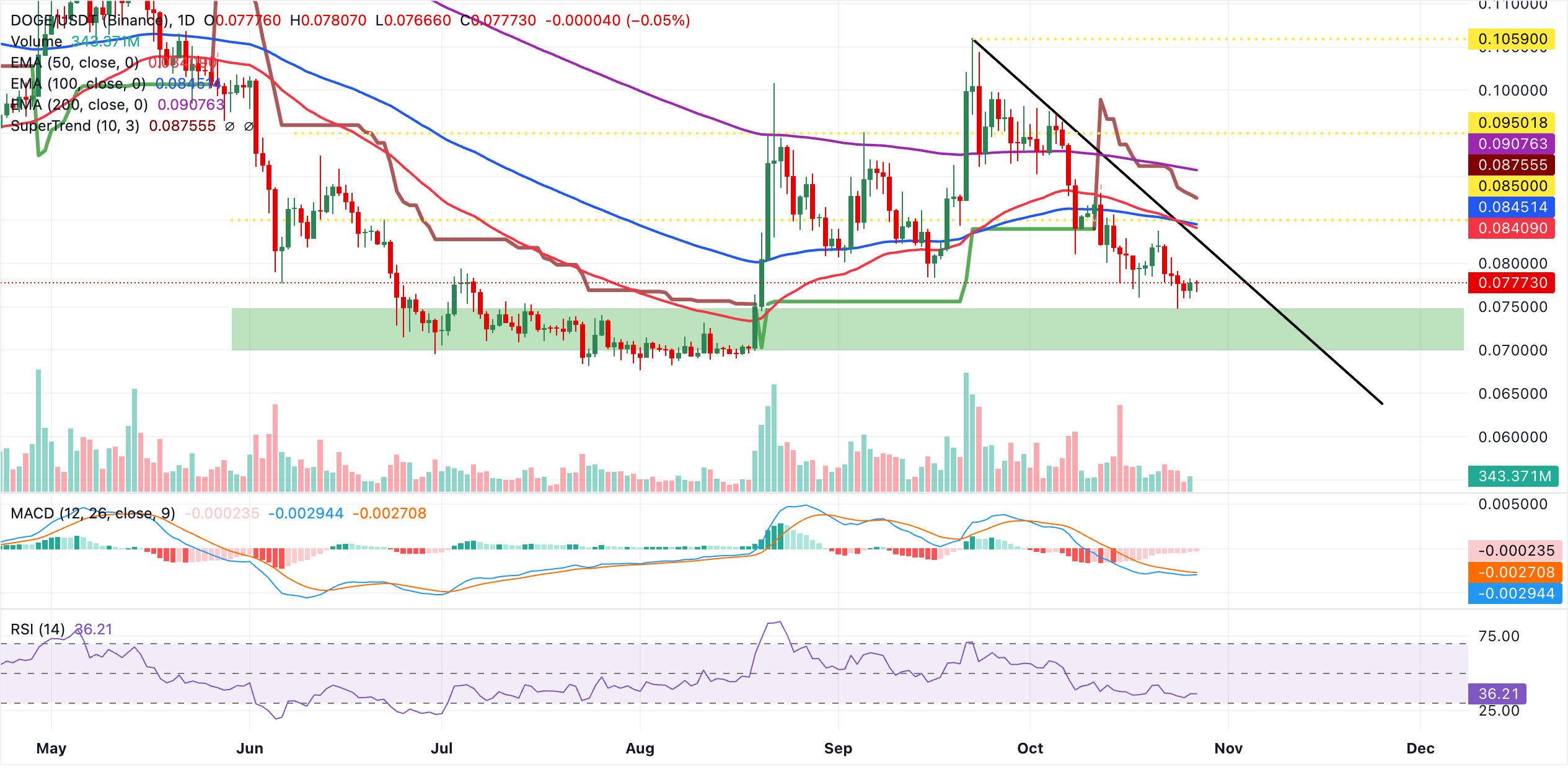
Initial resistance appears at the downward trendline near $0.0825, followed by the clustered short- and medium-term EMAs around $0.0840-$0.0845, which would need to be overcome to ease immediate selling pressure. Above that zone, the SuperTrend barrier near $0.0876 precedes the 200-day EMA at $0.0908, which acts as a key structural cap for any more ambitious recovery attempts.
With no clear nearby technical support defined by the current indicator set on the daily chart, intraday traders will likely focus on how price reacts to these overhead levels to gauge whether the current drift lower can stabilize or extend into fresh declines.
While DOGE retains the bearish near-term bias on the weekly chart, the RSI at 43 stays in neutral-to-soft territory, reinforcing sideways trading and consolidation ahead of another recovery attempt.
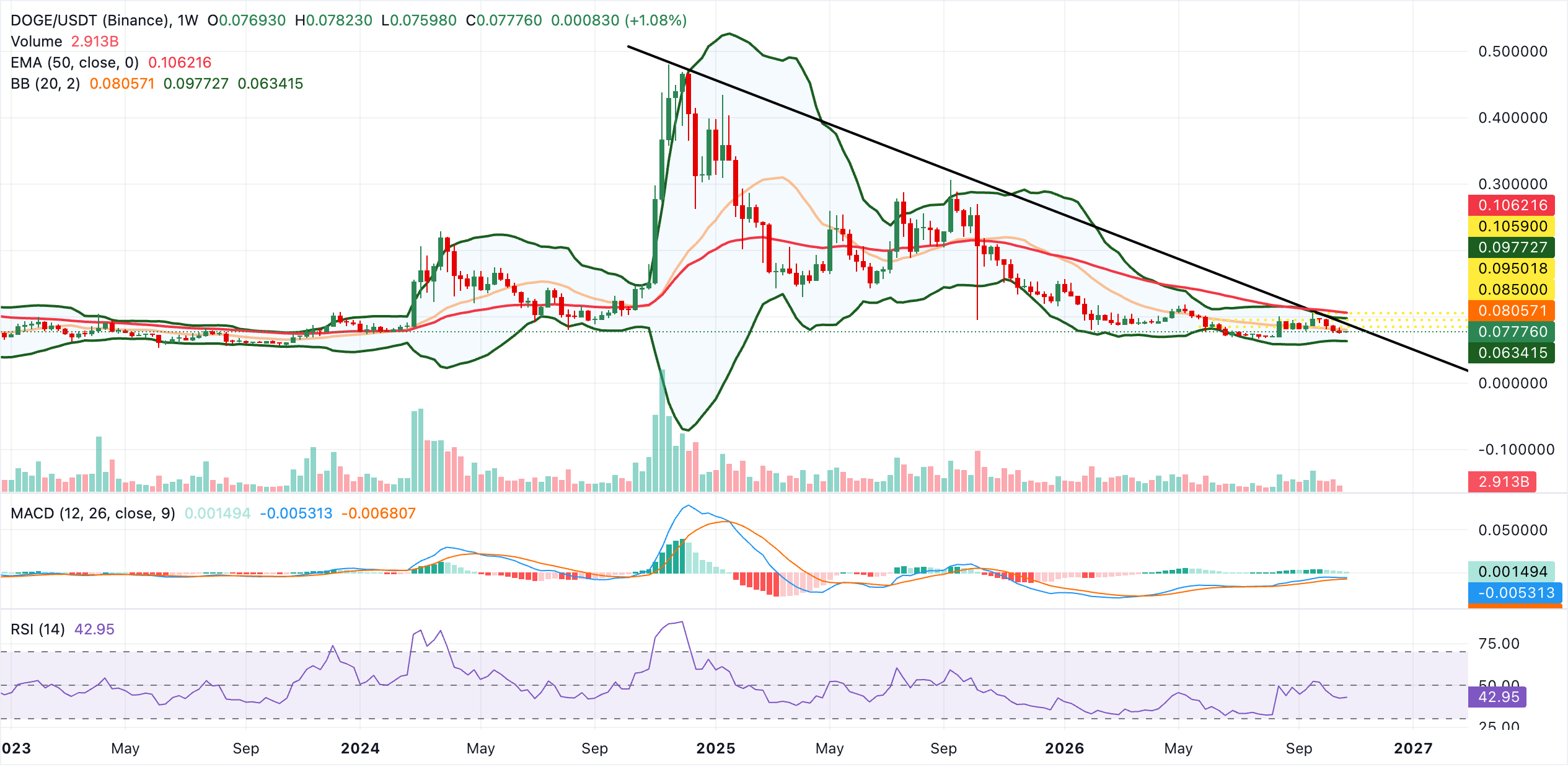
Meanwhile, initial resistance emerges at the Bollinger Bands simple moving average center at $0.0806, ahead of the downward resistance trendline level at $0.0888, with further barriers at the upper Bollinger band near $0.0977 and the 50-EMA at $0.1062. On the downside, immediate support lies at the lower Bollinger band around $0.0634. As long as price trades below the $0.0806-$0.0888 band, rallies are likely to be capped, and the pair is vulnerable to a retest of that lower-volatility floor.
(The technical analysis of this story was written with the help of an AI tool. Know more.)
Open Interest, funding rate FAQs
Higher Open Interest is associated with higher liquidity and new capital inflow to the market. This is considered the equivalent of increase in efficiency and the ongoing trend continues. When Open Interest decreases, it is considered a sign of liquidation in the market, investors are leaving and the overall demand for an asset is on a decline, fueling a bearish sentiment among investors.
Funding fees bridge the difference between spot prices and prices of futures contracts of an asset by increasing liquidation risks faced by traders. A consistently high and positive funding rate implies there is a bullish sentiment among market participants and there is an expectation of a price hike. A consistently negative funding rate for an asset implies a bearish sentiment, indicating that traders expect the cryptocurrency’s price to fall and a bearish trend reversal is likely to occur.
Recommended Articles


