




Brazil's banks sell crypto to clients while keeping it off their books
Brazil’s biggest banks are bringing cryptocurrency into their consumer platforms; however, Banco Central do Brasil documents indicate that Brazilian banks had zero virtual assets held on their balance sheets as of March 2026.
This distinction is important as Brazil is essentially evaluating if banks can offer crypto products and services to clients without exposing themselves to the volatility of cryptocurrencies.
The consumer-facing aspect is already evident. Itaú allows clients to get 15 different cryptos such as Bitcoin, Ether, and USDC, while the official website of Nubank indicates 28 crypto assets available to consumers. Banco do Brasil, which started offering Bitcoin and Ether from January of this year, reported over R$11 million ($2.1 million) worth of transactions.
Growing shelves, empty balance sheets
It seems clear that the banks are purposely creating a well-defined separation. They allow their clients to engage in cryptocurrency operations without classifying the related crypto assets as investment instruments.
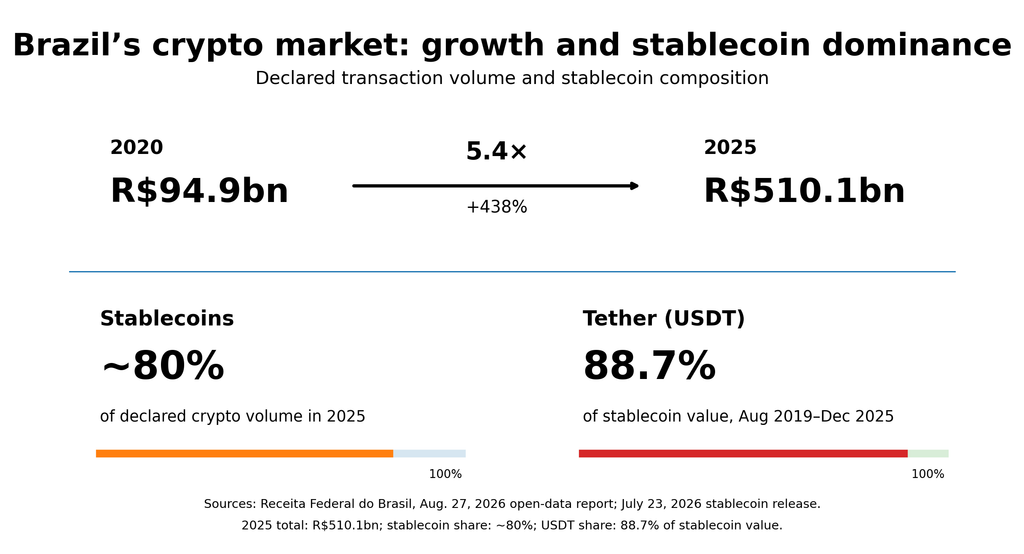
In addition, the Brazilian cryptocurrency market has been rapidly expanding. The most recent open-dataset report from Receita Federal indicates that transaction volume reported increased from R$94.9 billion in 2020 to R$510.1 billion in 2025, which is 5.4 times larger. Approximately R$499.9 billion, or 98%, came from filings made by legal entities, which include local crypto exchanges.
What the November rulebook demands
Law No. 14,478 signed on December 21, 2022, introduced the legal framework for virtual assets in Brazil and established the permitting scheme for virtual asset service providers (VASPs). Later, under Decree No. 11,563 dated June 13, 2023, the supervision and regulation of the regime was assigned to Banco Central do Brasil (BCB).
Subsequently, three resolutions adopted by the BCB in November 2025 provided the specific framework for the operation of the regime: Resolution BCB No. 519/2025 pertains to permits, Resolution BCB No. 520/2025 is aimed at controlling providers and services, while Resolution BCB No. 521/2025 regulates specific activities involving virtual assets in terms of foreign exchange and international investment legislation.
As stipulated by the framework, custodians, intermediaries, and brokers will need to meet capital, governance, cybersecurity, AML/CFT, and consumer protection requirements. According to the estimates provided by Chainalysis, the minimum amount of capital can range from R$10.8 million to R$37.2 million depending on the type of activity, as well as the obligation to segregate assets, undergo auditing, and follow Travel Rule requirements.
A faster lane for the banks themselves
The banks that have already complied with regulations will be able to more simply enter the crypto space. Resolution 520 permits banks that fulfill the criteria to commence crypto intermediation and custody within three months of informing the BCB, given that they secure a certification and undergo regulatory assessment.
The technical certification needed for approval is detailed in Instrução Normativa BCB No. 701, published in January 23, 2026.
The assessment includes customer asset segregation, proof of reserves, outsourcing, cloud-based solutions, cybersecurity, governance and measures against financial crime. According to reports by Cryptopolitan, the framework allows banks to enter into crypto easily while making sure that all processes are under the supervision of BCB.
Why the stablecoin tilt makes Brazil a model to watch
According to the Receita Federal, stablecoins made up approximately 80% of all crypto volumes reported in 2025. Between August 2019 and December 2025, USDT made up a whopping 88.7% of this volume, amounting to approximately R$1 trillion.
Brazil was also the world’s fifth-biggest market according to Chainalysis’s Global Crypto Adoption Index in 2025.
This provides some context as to why Resolution 521 is more relevant beyond the trading scene. It regulates fiat-referenced token transactions as well as cross-border virtual-asset activity under foreign-exchange rules.
According to the Global Financial Stability Report of the International Monetary Fund published in April 2026, the widespread use of stablecoins in developing economies could facilitate payment systems and enable easier access to dollar-denominated assets, but it could also lead to currency substitution and spillover effects through countries involved.
Therefore, Brazil will now be a practical experiment in whether banks will be able to provide access to crypto without having to hold custody, bank balances or stablecoin flows on their premises—and at the same time not having to engage in actual trading of cryptocurrencies.
Don’t just read crypto news. Understand it. Subscribe to our newsletter. It's free.
Recommended Articles


