




Cryptopolitan Report: 38% of Our Readers Have Never Used an AI Agent. Here’s What That Tells Us About Where Adoption Actually Stands
The global AI agent market currently stands at an approximate valuation of over $12 billion in 2026 and this is growing at nearly 45% annually. Despite this explosive rise, our newsletter poll highlights an adoption gap that continues to exist even among a digitally savvy and tech forward audience. This report breaks down the growth of this space, the results from the poll and what the numbers tell us about awareness and, ultimately, the obstacles holding back adoption.
In its simplest form, an AI agent is software that not only responds to a user’s prompt but also takes action. Standard large language models interaction is based on the user asking a question and receiving an answer. An agent on the other hand can plan multi-step tasks, use external tools, browse the internet, write and execute code, manage files, send emails and make decisions autonomously on behalf of the user. The key differentiator here is autonomy.
This is a massive departure and leap from the chatbot era. ChatGPT revolutionised the way we find and dissect information and every new model continues to excel in this aspect. That said, agents are built to complete workflows and that brings a whole new set of use cases for enterprises and individuals. A customer service agent can handle a complaint end to end without human intervention. A coding agent can write, test, debug, and deploy. A research agent can gather, synthesise, and present findings across dozens of sources in minutes.
How Fast Is This Market Growing?
The numbers show that the growth is nothing short of remarkable. The global AI agents market is valued at $12.06 billion in 2026, up from $8.29 billion in 2025 and is estimated to touch $53.2 billion by 2030 at a CAGR of 44.9%, according to Research and Markets. Other longer term forecasts have a higher growth rate as a report from Grand View Research places this figure to reach $182.97 billion by 2023. That’s roughly a 15x from where we stand today.
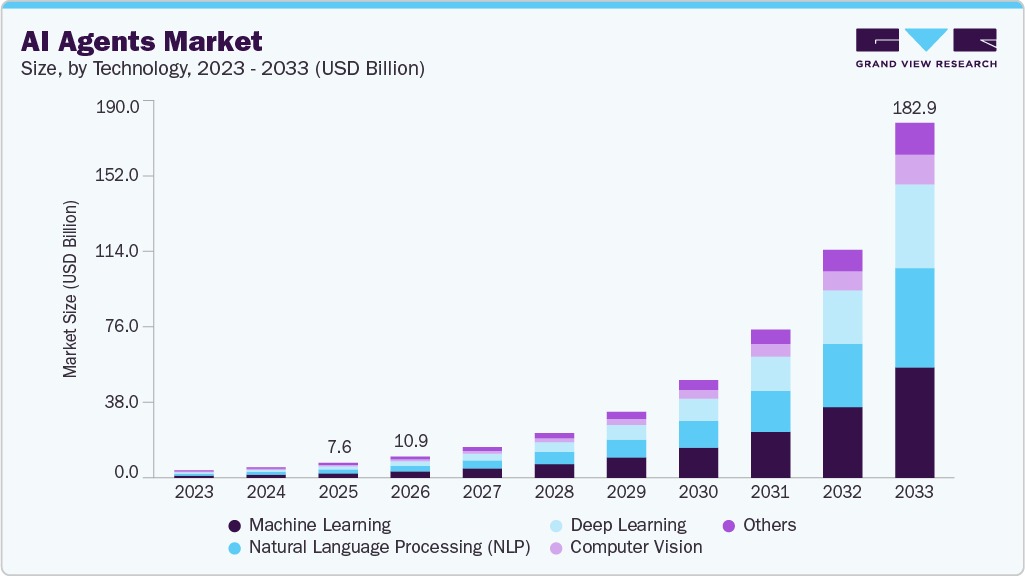
Enterprise adoption of AI agents is exploding at the same time. According to McKinsey’s 2025 State of AI survey covering 1,993 participants across 105 countries, 88% of organisations now use AI in at least one function, up from 78% the prior year and a significant leap from 20% in 2017. 62% of organisations are at least experimenting with AI agents, with 23% actively scaling and an additional 39% having begun experimenting, per the same survey. Gartner forecasts that 40% of enterprise applications will embed task-specific AI agents by 2026, up from less than 5% in 2025.
The use cases driving adoption are concentrated but expanding. According to a Langchain survey of over 1,300 professionals conducted as far back as late 2024, the top applications are research and summarisation at 58%, personal productivity and workflow automation at 53.5%, and customer service and ticket resolution at 45.8%. Critically, 90% of non-tech companies either use or plan to use AI agents, nearly matching the tech sector at 89%. In 2026, this is not a niche technology story. It is a broad enterprise shift.
Reader Pulse: The Poll
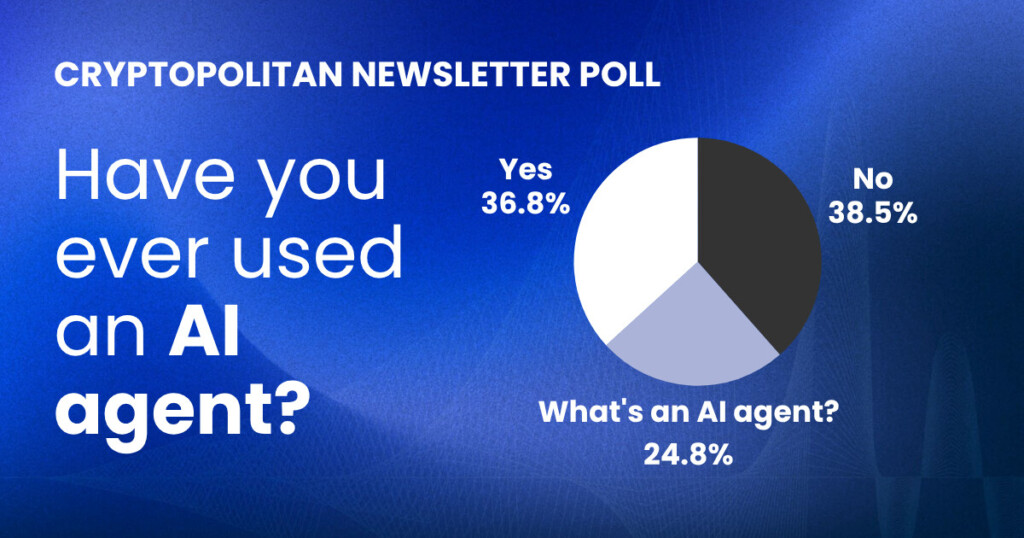
The poll, conducted via the Cryptopolitan newsletter, draws responses from a digitally engaged, investment-aware audience that actively tracks developments across crypto, AI, and emerging technology. These are readers who consume this space daily, making the results a sharper and more meaningful signal than a broad consumer survey would produce. The fact that non-usage still leads in this cohort is precisely what makes the data worth examining.
No (38.46%): The leading response, and the most revealing one. Nearly four in ten respondents from an audience that actively follows AI and crypto developments have never used an AI agent. This is not a general population survey. The fact that non-usage leads among this cohort underscores a critical point: awareness of AI does not automatically translate to hands-on engagement with its most powerful applications.
Yes (~36.75%): Roughly one in three have used an AI agent, a figure that broadly tracks with enterprise-level adoption data. The Langchain report cited above found 51% of over 1,300 surveyed professionals rely on AI agents, while broader surveys suggest around 35% of organisations report widespread usage. Our poll’s “yes” cohort sits within that range, suggesting the Cryptopolitan audience reflects the wider digitally engaged professional population reasonably well.
What’s an AI agent? (~24.79%): Nearly one in four respondents did not know what an AI agent is. This is arguably the most important data point in the poll. In an audience that reads about AI daily, a 25% awareness gap signals that the technology, despite its rapid growth in enterprise deployment, has not yet crossed into mainstream comprehension. The terminology itself remains a barrier. The gap between market growth statistics and actual user understanding is wider than the headline numbers suggest.
Combined, the non-users and unaware respondents represent over 63% of the poll. In an audience predisposed to emerging technology, this signals that AI agents are still in the early adopter phase for individual users, even as enterprise deployment accelerates rapidly.
The Barriers Holding Back Broader Adoption
Enterprise momentum is real, but so are the constraints. Over 40% of agentic AI projects are projected to be cancelled by the end of 2027, with escalating costs, unclear business value, and inadequate risk controls as primary drivers, according to Gartner. According to a UiPath 2025 Agentic AI Research Report, based on a survey of 252 U.S. IT executives at companies with over $1 billion in revenue, IT security tops the list of concerns around adopting agentic AI at 56%, followed by cost of implementation at 37% and integration with existing systems at 35%. When asked what would be most critical to effective implementation, executives ranked ensuring safety and privacy as the single most important factor, ahead of regulatory compliance and system integration
For individual users, the barrier is simpler: the tools are not yet intuitive enough to onboard people who do not already know what they are looking for. The “What’s an AI agent?” response in our poll is, in part, a product design and communication problem as much as it is an awareness problem.
What the Numbers Mean for 2026
2026 has been widely described as the year AI agents move from experiment to infrastructure. According to Salesforce’s annual CIO study, based on a survey of 200 CIOs across 24 countries, full AI implementation jumped from 11% in 2024 to 42% in 2025, a 282% increase year on year, with CIOs now dedicating 30% of their AI budgets specifically to agentic AI, The enterprise side of the equation is moving quickly.
The individual side is where the story becomes more nuanced, and where our poll adds something the market size reports do not. The roughly 37% of our audience who have used an AI agent are ahead of the curve. The 38% who have not, and the 25% who have not yet encountered the concept, represent the next wave of potential users. Whether that wave arrives in months or years depends on how quickly the technology becomes accessible, intuitive, and visible in everyday digital life.
If you're reading this, you’re already ahead. Stay there with our newsletter.
Recommended Articles


