




Gold steadies below $4,000 as hawkish Fed outlook caps recovery
- Gold holds firm on Friday but lacks follow-through, heading for a second consecutive weekly loss.
- Renewed disruption in the Strait of Hormuz lifts Oil prices and revives inflation concerns.
- Technically, XAU/USD retains a bearish bias below the Bollinger middle band, with sellers eyeing a break below the lower band.
Gold (XAU/USD) holds firm on Friday but lacks bullish momentum as rising Oil prices revive inflation concerns and reinforce expectations that the Federal Reserve (Fed) could raise interest rates later this year.
At the time of writing, XAU/USD trades around $3,992 after falling to $3,969 on Thursday, its lowest level since July 1.
Meanwhile, the US Dollar (USD) stages a comeback after falling earlier this week following softer-than-expected US inflation data. The recovery in the Greenback limits Gold’s upside and keeps the precious metal on track for a second consecutive weekly loss.
The US Dollar Index (DXY), which tracks the Greenback's value against a basket of six major currencies, trades around 100.86 after hitting a more than three-week low of 100.35 on Wednesday.
The United States (US) carried out strikes against Iran for a sixth consecutive night, while Tehran responded with missile and drone attacks on US military facilities across the Middle East.
Iran’s Revolutionary Guards said no Oil or gas exports would pass through the Strait of Hormuz as long as US attacks persist, according to the Tasnim news agency. The longer the disruption to traffic through the Strait lasts, the greater the upside risks to energy prices and inflation, factors that tend to weigh on Gold.
This keeps the hawkish Fed narrative alive, even as softer US inflation data released this week prompted traders to scale back bets on a near-term interest rate hike. According to the CME FedWatch Tool, markets currently price in around a 73% chance that the Fed will raise interest rates by December.
Recent hawkish remarks from Fed officials have also kept the possibility of tighter monetary policy on the table. Dallas Fed President Lorie Logan said on Thursday that “modestly higher interest rates would better balance the outlook and risks,” adding that inflation does not appear to be heading sustainably back to the 2% target on its own.
Kansas City Fed President Jeff Schmid said the recent inflation data was encouraging but added: “Inflation is too hot and above target for too long.”
Technical analysis: XAU/USD bears retain control below Bollinger mid-band
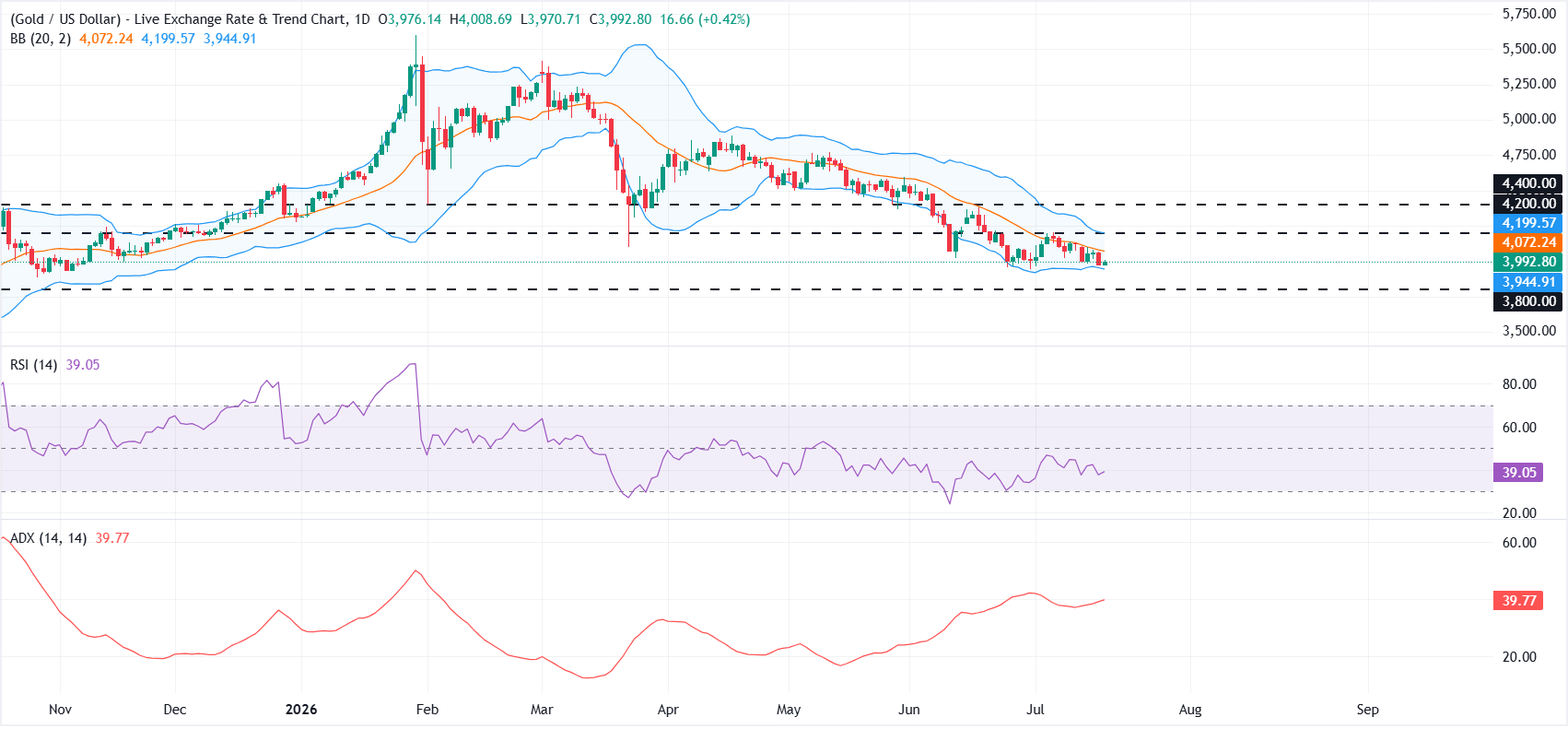
In the daily chart, XAU/USD remains under pressure, trading below the Bollinger Bands 20-day Simple Moving Average (SMA) at $4,072. The Relative Strength Index (RSI) at 39.12 is still below the 50 line, while the Average Directional Index (ADX) near 39.77 suggests the prevailing downtrend retains notable strength.
On the topside, initial resistance is aligned with the Bollinger middle band at $4,072, ahead of the upper band at $4,199, which closely aligns with the nearby horizontal barrier at $4,200, with a more distant cap emerging at $4,400.
On the downside, immediate support is seen at the lower Bollinger band near $3,945, before the more pronounced horizontal floor at $3,800, where sellers could look to extend the current bearish phase if the latter gives way.
(The technical analysis of this story was written with the help of an AI tool. Know more.)
Inflation FAQs
Inflation measures the rise in the price of a representative basket of goods and services. Headline inflation is usually expressed as a percentage change on a month-on-month (MoM) and year-on-year (YoY) basis. Core inflation excludes more volatile elements such as food and fuel which can fluctuate because of geopolitical and seasonal factors. Core inflation is the figure economists focus on and is the level targeted by central banks, which are mandated to keep inflation at a manageable level, usually around 2%.
The Consumer Price Index (CPI) measures the change in prices of a basket of goods and services over a period of time. It is usually expressed as a percentage change on a month-on-month (MoM) and year-on-year (YoY) basis. Core CPI is the figure targeted by central banks as it excludes volatile food and fuel inputs. When Core CPI rises above 2% it usually results in higher interest rates and vice versa when it falls below 2%. Since higher interest rates are positive for a currency, higher inflation usually results in a stronger currency. The opposite is true when inflation falls.
Although it may seem counter-intuitive, high inflation in a country pushes up the value of its currency and vice versa for lower inflation. This is because the central bank will normally raise interest rates to combat the higher inflation, which attract more global capital inflows from investors looking for a lucrative place to park their money.
Formerly, Gold was the asset investors turned to in times of high inflation because it preserved its value, and whilst investors will often still buy Gold for its safe-haven properties in times of extreme market turmoil, this is not the case most of the time. This is because when inflation is high, central banks will put up interest rates to combat it. Higher interest rates are negative for Gold because they increase the opportunity-cost of holding Gold vis-a-vis an interest-bearing asset or placing the money in a cash deposit account. On the flipside, lower inflation tends to be positive for Gold as it brings interest rates down, making the bright metal a more viable investment alternative.
Recommended Articles


