




ECB President Lagarde speaks next with the Euro under 1.1000
- EUR/USD falls further under 1.1000 to its lowest in at least five months.
- Fed minutes show nearly all officials expect to raise rates again.
- ECB President Lagarde speaks Thursday and Friday, with US jobless claims due.
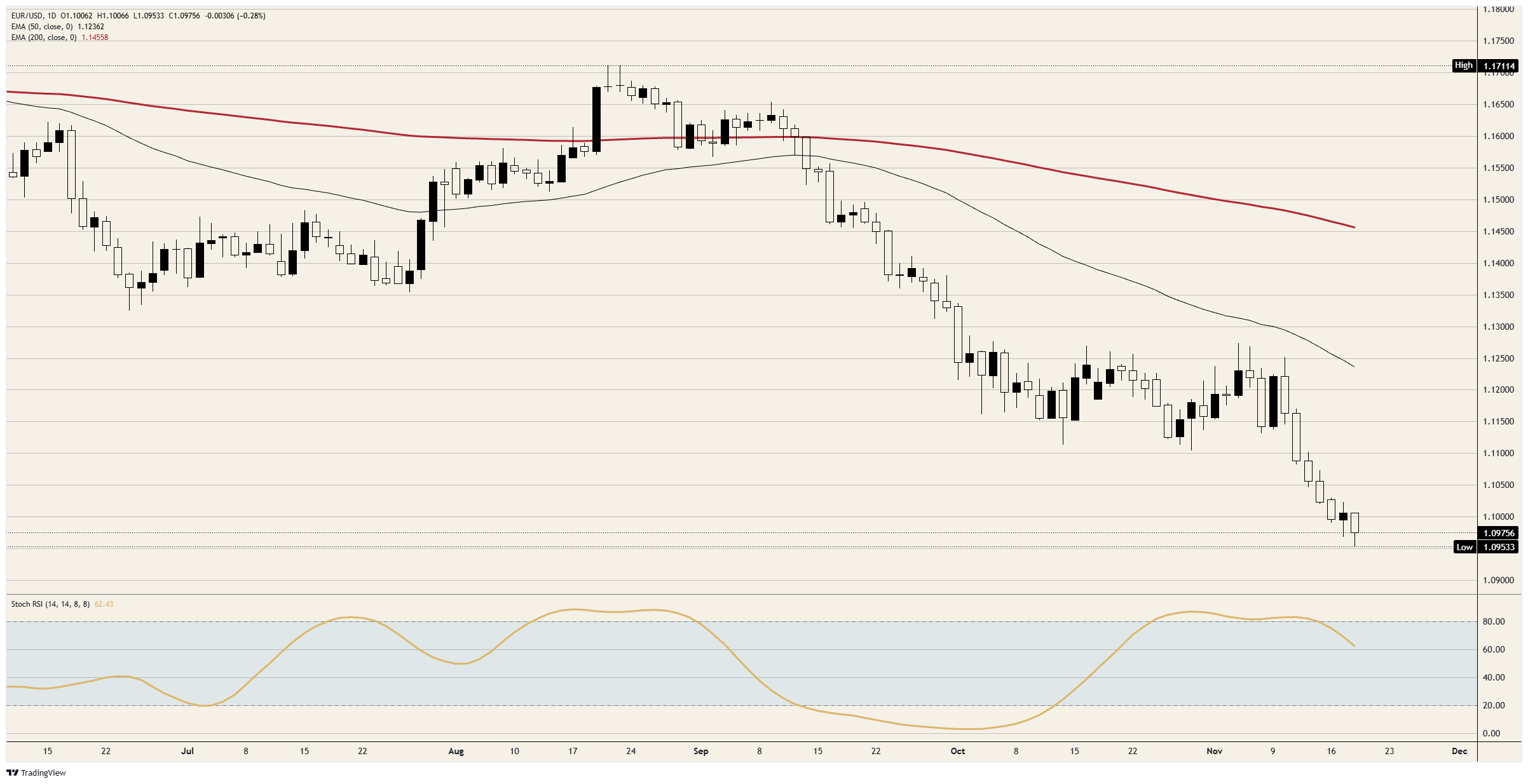
Eurozone core inflation was revised up and the Euro still fell, because the argument at the Federal Reserve has moved from whether to hike in December to how much. EUR/USD opened at its high for the session just above 1.1000, dropped to just above 1.0950, its lowest in at least five months, and is trading between the two. It has fallen in six of the last seven sessions.
The Federal Open Market Committee (FOMC) minutes, from a 10-2 vote to hold rates at 3.75%-4.00% in October, showed a couple of officials open to more than a quarter-point hike in December. Fed Governor Waller argued for a half-point hike on CNBC before the rate decision was released, and traders already treat a hike on December 9 as certain. The European Central Bank (ECB) rate is 2.50%, at least 1.25 points below the Fed's, and the Dollar Index rose to its highest since April 2025.
Eurostat's final figures put October core inflation at 2.6%, up from a first estimate of 2.5%, and confirmed the headline rate at 4.0%, the highest in three years. Traders expect the ECB to raise rates on December 17, eight days after the Fed is expected to do the same. A hike from each in the same month would leave the gap between the two rates where it is.
On the calendar
ECB President Lagarde speaks at 13:30 GMT on Thursday and at 08:30 GMT on Friday, and Bundesbank President Nagel follows at 13:00 GMT on Friday. Eurozone consumer confidence for November is due at 15:00 GMT on Friday, forecast at -17.9, the same as October. Each feeds the ECB's December 17 decision, the European side of the rate gap.
US initial jobless claims are due at 13:30 GMT on Thursday, forecast at 197K after 200K, with the Philadelphia Fed manufacturing survey forecast at 20 after 20.9. Both bear on how large a hike the Fed delivers on December 9.
On the charts
EUR/USD held between 1.1100 and just above 1.1250 from early October until it broke lower on November 11, and every close since has been below that range. The drop from the August high just above 1.1700 is now about 6%. The 50-day Exponential Moving Average (EMA) is just under 1.1250, at the top of the old range, and the 200-day EMA is near 1.1450.
EUR/USD daily chart
Euro FAQs
The Euro is the currency for the 20 European Union countries that belong to the Eurozone. It is the second most heavily traded currency in the world behind the US Dollar. In 2022, it accounted for 31% of all foreign exchange transactions, with an average daily turnover of over $2.2 trillion a day. EUR/USD is the most heavily traded currency pair in the world, accounting for an estimated 30% off all transactions, followed by EUR/JPY (4%), EUR/GBP (3%) and EUR/AUD (2%).
The European Central Bank (ECB) in Frankfurt, Germany, is the reserve bank for the Eurozone. The ECB sets interest rates and manages monetary policy. The ECB’s primary mandate is to maintain price stability, which means either controlling inflation or stimulating growth. Its primary tool is the raising or lowering of interest rates. Relatively high interest rates – or the expectation of higher rates – will usually benefit the Euro and vice versa. The ECB Governing Council makes monetary policy decisions at meetings held eight times a year. Decisions are made by heads of the Eurozone national banks and six permanent members, including the President of the ECB, Christine Lagarde.
Eurozone inflation data, measured by the Harmonized Index of Consumer Prices (HICP), is an important econometric for the Euro. If inflation rises more than expected, especially if above the ECB’s 2% target, it obliges the ECB to raise interest rates to bring it back under control. Relatively high interest rates compared to its counterparts will usually benefit the Euro, as it makes the region more attractive as a place for global investors to park their money.
Data releases gauge the health of the economy and can impact on the Euro. Indicators such as GDP, Manufacturing and Services PMIs, employment, and consumer sentiment surveys can all influence the direction of the single currency. A strong economy is good for the Euro. Not only does it attract more foreign investment but it may encourage the ECB to put up interest rates, which will directly strengthen the Euro. Otherwise, if economic data is weak, the Euro is likely to fall. Economic data for the four largest economies in the euro area (Germany, France, Italy and Spain) are especially significant, as they account for 75% of the Eurozone’s economy.
Another significant data release for the Euro is the Trade Balance. This indicator measures the difference between what a country earns from its exports and what it spends on imports over a given period. If a country produces highly sought after exports then its currency will gain in value purely from the extra demand created from foreign buyers seeking to purchase these goods. Therefore, a positive net Trade Balance strengthens a currency and vice versa for a negative balance.
Recommended Articles


