




Bank of Japan Takes Action Again. USD/JPY Falls to 155 Level Again, How Should Investors Prepare?
TradingKey - The Japanese yen strengthened significantly during the Asian session on Wednesday, with USD/JPY briefly dropping to the 155 level. Markets concluded that Japanese authorities had intervened again. Although Japan possesses ample foreign reserves, the number of interventions this year is limited by IMF guidelines; the Bank of Japan is currently engaged in a deep strategic battle with the market over policy space.
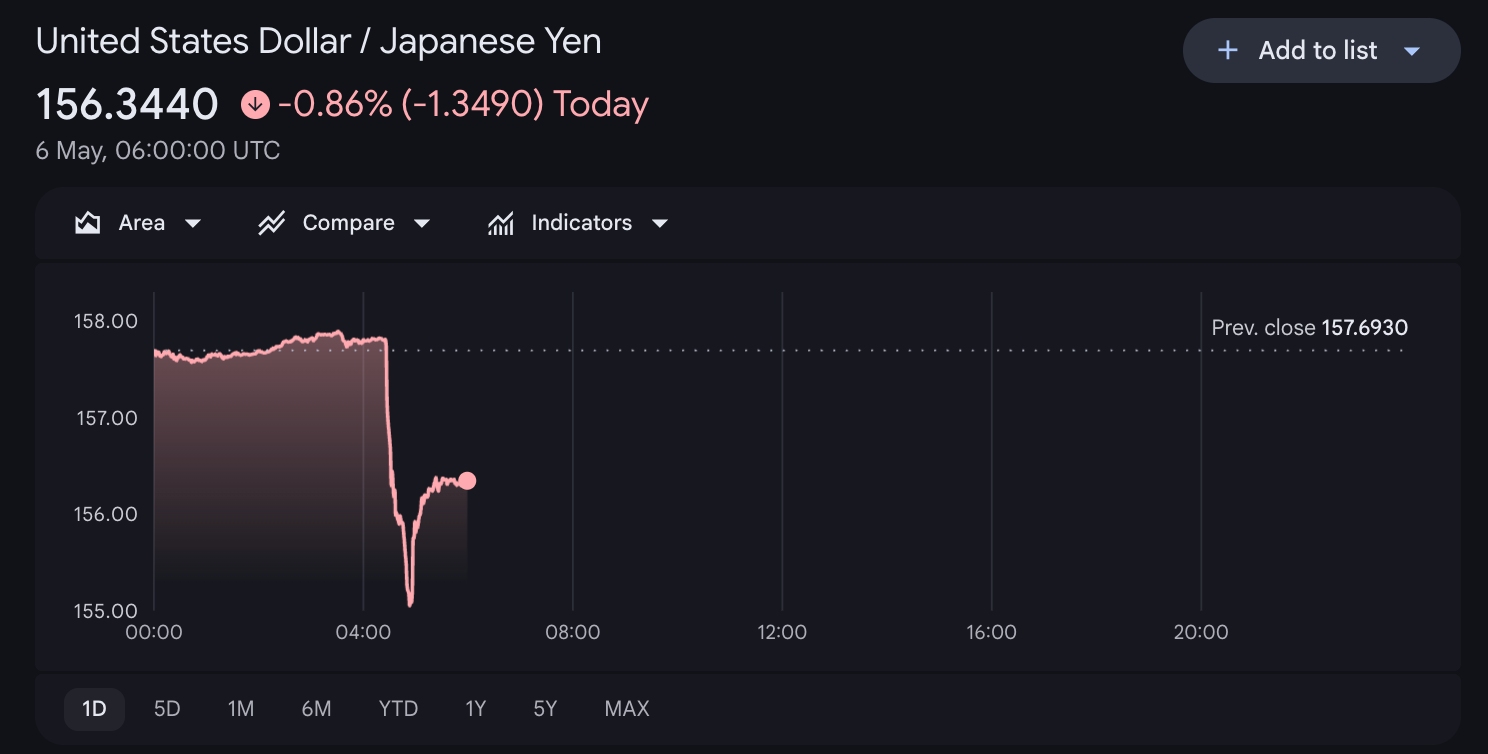
[USD/JPY plunges in the short term (to the 155 level); Source: Google Finance]
On Wednesday, the yen rose as high as 155.032 per dollar, its strongest level since February 24, with its intraday gain reaching 1.8%. Previously on April 30, Japanese authorities returned to the foreign exchange market for the first time in over a year, during which the yen rose by as much as 3% intraday. According to Bloomberg, intervention has indeed occurred; an analysis of Bank of Japan account data indicates that authorities utilized approximately $34.5 billion this time.
Previously, Japanese Finance Minister Satsuki Katayama noted regarding the exchange rate, "the market timing for taking decisive action is approaching." On May 6, she reiterated that the government "stands ready to take decisive action against speculative exchange rate fluctuations."
Japanese officials have yet to officially confirm the aforementioned operations, and the Ministry of Finance did not respond to requests for comment during non-business hours on the national holiday. However, Japanese Finance Minister Satsuki Katayama has stated multiple times that the government's stance on exchange rate intervention is clear.
Tactical Ranges for Intervention and Diminishing Effectiveness
Japanese authorities have effectively implemented a tiered strategy to defend their exchange rate's line in the sand. Once the USD/JPY rate approaches or breaches the 160 level, they directly conduct large-scale dollar sales to block the appreciation breakthrough at its source.
The intervention in late April was triggered by exactly this condition, pushing USD/JPY from above 160 down to the 155 range in one fell swoop.
However, multiple interventions have also exposed the risk of "diminishing effectiveness." On April 30 and May 2, USD/JPY was twice suppressed from above 157 and 160 to near 155; yet, after a brief period of sideways trading, the exchange rate began to slowly resume its upward trend. During the Asian session on May 6, another drop following a narrow consolidation was seen as the Bank of Japan intervening again. Despite these actions, USD/JPY has gradually recouped its gains, indicating that the impact of intervention is exhibiting a marginal diminishing effect.
Questions have therefore resurfaced regarding whether the Japanese authorities have sufficient ammunition for intervention. Analysis from the Goldman Sachs trading desk pointed out that even if Japan deploys large-scale intervention again, the dollar's downside is highly linked to external variables—oil price trends, Federal Reserve policy, and the China-US trade situation.
ING's assessment suggests that if the intervention remains unilateral, the initial retaliatory rally may only be sustained in the short term; for the yen to achieve a true structural strengthening, it still requires the US Treasury's cooperation to launch a joint intervention.
How should yen investors position themselves?
For investors with Japanese yen exposure, several factors that have recently impacted the currency warrant close attention.
Upcoming U.S. April non-farm payrolls macro data If the trend of slightly missing expectations continues, the U.S. dollar may weaken further, indirectly expanding the room for a yen rebound.
Furthermore, speculative positioning remains in a "crowded short" state. CFTC data shows that yen short positions are still near historic highs; if intervention triggers stop-loss liquidations again, short-term volatility could be exponentially magnified.
For position holders, the sustainability of the yen's rebound and a market landscape dominated by short-term intervention are shifting yen bets from a certain one-way shorting opportunity into a new environment of constant long-short positioning and a convergence of internal and external factors.
Recommended Articles


