




Wheat Futures (WHEAT-F) Surges on Jul 16: What Lie behind the Move?
Wheat Futures (WHEAT-F) is up 2.29% at Jul 16 03:55(ET), now at $691.7, with a 7-day up of 11.74%.
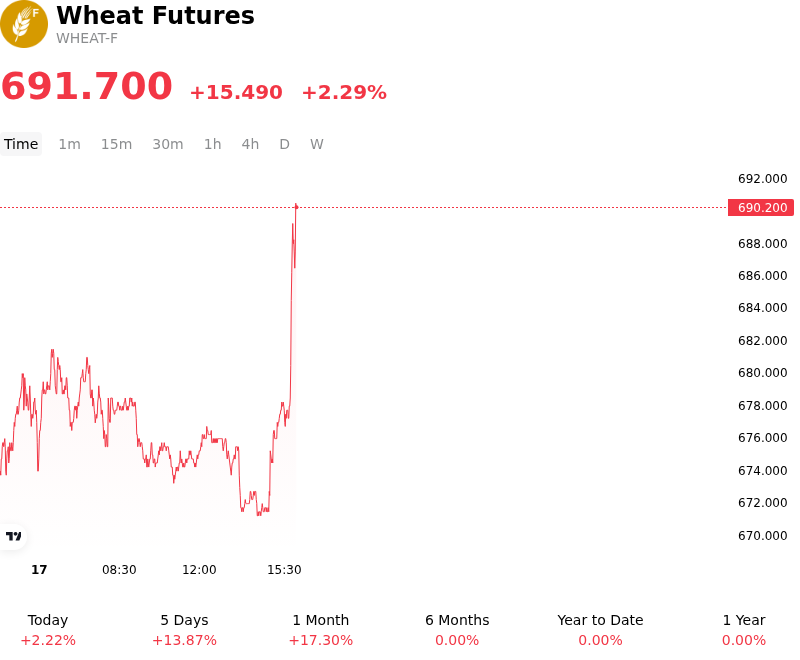
What is driving Wheat Futures (WHEAT-F)’s stock price up today?
The upward momentum in the wheat complex is primarily driven by deteriorating crop conditions across the European Union and the Black Sea region. Intense heatwaves and persistent soil moisture deficits in key producing countries, notably France and southern Russia, have significantly lowered yield expectations during the critical late-development stage. This has forced market participants to re-evaluate the availability of high-quality milling wheat as the Northern Hemisphere harvest progresses, leading to a tightening of the global exportable surplus.
Furthermore, the latest supply-and-demand data from major agricultural agencies have reinforced a more bullish fundamental outlook. Downward revisions to global ending stocks, particularly among major exporters, suggest a thinner cushion against potential supply shocks than previously anticipated. The combination of lower-than-expected yields in the European Union and logistical bottlenecks in Black Sea ports has heightened concerns over the ability of global supplies to meet robust demand from North African and Middle Eastern importers who are currently seeking to replenish their strategic reserves.
Macroeconomic factors are providing additional tailwinds to the sector. A softening in the US Dollar index has made US-origin wheat more competitive on the global stage, encouraging a rotation of institutional capital into agricultural futures. This currency-driven support is coinciding with a shift in fund positioning, as systematic trend-followers and institutional investors move to cover short positions in response to the emerging supply-side risks.
Geopolitical tensions remain a persistent risk premium factor. Renewed uncertainty regarding maritime security in the Black Sea and potential export restrictions from major producers seeking to manage domestic food inflation have limited the downside for prices. As the market digests the impact of adverse weather on harvest quality and quantity, the focus remains on the structural tightening of the global wheat balance sheet, which continues to support a constructive pricing environment for the near term.
More details about Wheat Futures (WHEAT-F)
Recent Events and Risks:
- Seasonal Harvest Pressure: The rapid advancement of the U.S. winter wheat harvest is injecting significant new-crop supply into the market, prompting commercial hedging and technical selling as physical grain flow increases during the peak harvest window.
- Policy-Driven Demand Destruction: Turkey's decision to halt wheat imports through late 2024 to support domestic prices has created an immediate demand shock, leaving major exporters in the Black Sea and Europe with uncommitted surpluses that may necessitate aggressive price cuts to clear inventory.
- Correction of Weather Risk Premiums: Forecasts indicating beneficial rains for previously parched Russian growing regions and parts of the Australian wheat belt are prompting a liquidation of long positions as the extreme supply-shortfall scenarios factored into recent price spikes begin to moderate.
- Inter-Commodity Spreads and Competitive Pricing: Wheat's significant price premium over corn is encouraging livestock producers to switch to cheaper feed grains for rations, while aggressive export pricing from Russian origins continues to undercut U.S. and European futures, capping attempts at a sustained price recovery.
Recommended Articles


