




When Will the Strait of Hormuz Finally Reopen? Hard to Return to Pre-War Levels Before 2027? Conflicting U.S. and Iran Statements Trigger Market Skepticism
TradingKey - Despite Trump's remarks on the 14th that a U.S.-Iran agreement would be signed this Friday (June 19) and the Strait of Hormuz would subsequently reopen, the market remains highly skeptical. Data from prediction market Polymarket shows only a 23% probability that the Strait of Hormuz will return to normal by the end of June.
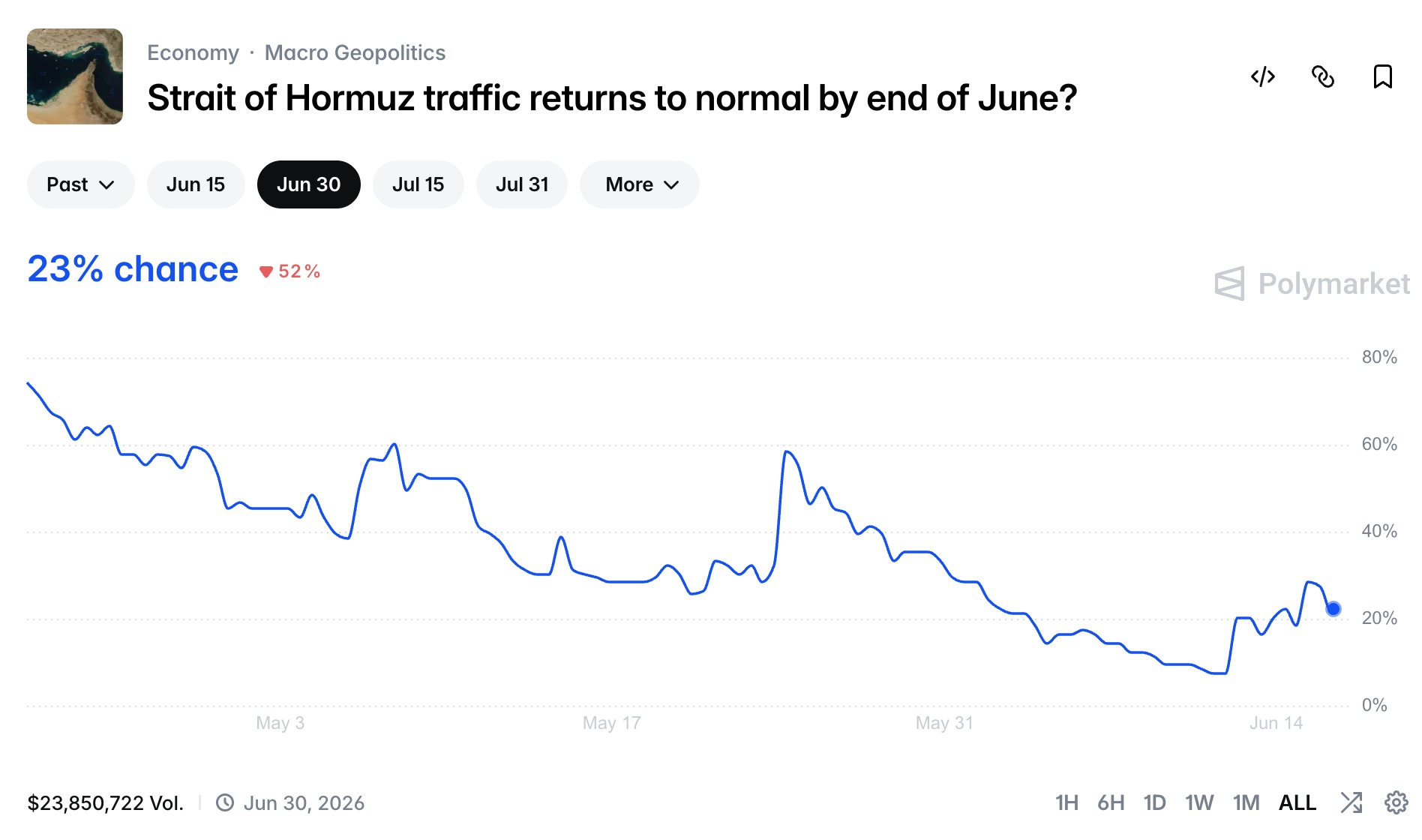
From Polymarket
America's European allies also harbor reservations. According to reports, during the G7 summit in France this Monday, member nations struggled to reach a common position on how to address the situation in the strait.
U.S. and Iran Offer Conflicting Accounts; Strait Traffic Shows No Significant Increase
Despite the signing of an interim agreement, the United States and Iran have differing interpretations of its contents. A senior U.S. official revealed that the memorandum of understanding will explicitly stipulate that the strait will be open to passing vessels free of charge for 60 days, and the U.S. will require this clause to be incorporated into the final agreement. According to a CNBC report, U.S. Vice President Vance stated on the 15th that the Strait of Hormuz is expected to remain open long-term without transit fees.
Iran’s understanding, however, is completely different. Iranian state media reported that the Strait of Hormuz will implement a policy of opening to transit vessels for 60 days without charging fees. Iran’s Tasnim News Agency reported that the strait will thereafter be jointly managed by Iran and Oman.
Trump stated on Truth Social that many tankers laden with oil have begun to sail out of the Strait of Hormuz; U.S. Vice President Vance also indicated that traffic in the strait has increased. However, the situation may not be so optimistic. On the 15th local time, the information conveyed from the Iranian side was that Iran had not issued any transit permits in the past 96 hours. Vessel tracking data from the international shipping information platform MarineTraffic showed that the LNG carrier 'Disha' was the only large energy vessel to pass through the Strait of Hormuz on the 15th.
Number of naval mines in the strait remains unknown; mine-clearing plans have yet to be implemented.
Beyond disagreements over the text of the agreement, the actual passage through the Strait of Hormuz faces another practical hurdle: an unknown number of naval mines remain within the waterway. Iran has previously claimed on several occasions to have deployed mines in the strait, information that was confirmed by the U.K. in March.
European allies expressed their willingness at the G7 summit to assist the U.S. with minesweeping operations and patrols in the strait, but all attached preconditions. Reports noted that even Italian Prime Minister Giorgia Meloni, who has historically avoided provoking Donald Trump, stated that Italian assistance is contingent on a cessation of hostilities in Lebanon. According to earlier reporting by Bloomberg, G7 leaders are set to decide on a demining framework for the waterway—including agreements with Iran and other relevant parties—with European leaders planning to seek Trump’s approval at the G7 meeting.
Caitlin Talmadge, an associate professor of political science at the Massachusetts Institute of Technology, said that verifying the safety of the strait will be a laborious undertaking, though the clearing process could be significantly expedited if Iran provides location data for the mines. While European nations possess substantial minesweeping capabilities, the vessels involved would be highly vulnerable if hostilities resume, placing both the ships and their operators at risk should Iran restart its attacks.
Shipping may not return to normal until 2027.
Perspectives vary regarding when normal passage can resume, with most parties maintaining a wait-and-see approach. Asian and European shipping firms generally believe that restoring market confidence will take time, and navigation is unlikely to return to normal levels in the short term; several shipping agencies stated they are awaiting further details, particularly regarding demining progress and security guarantees.
Haider Anjum, an analyst at Jyske Bank, noted in a client report that companies prefer to wait and see if the agreement can be effectively implemented. Jakob Larsen, Head of Maritime Safety & Security at BIMCO, stated that the next step is for shipowners to confirm that transiting Hormuz is not only permitted but also safe. Mitsui O.S.K. Lines explicitly stated it will only resume routes once safety is fully confirmed.
As of June 15, Kpler data shows that approximately 155 tankers transporting oil and chemicals are stranded in the Middle East Gulf region, while another firm, Oil Brokerage, estimates the number at 215. Anoop Singh, Head of Global Shipping Research at Oil Brokerage, stated that the backlog could be cleared within 8 to 10 days once full freedom of navigation is restored. Matt Wright, Lead Freight Analyst at Kpler, said that in the first 30 days after the agreement takes effect, the daily average of tankers entering the Persian Gulf is expected to reach 12, roughly 50% of pre-war levels.
However, David Jorbenaze, Head of Global Oil Markets at ICIS, pointed out that achieving a substantial recovery in shipping requires not only the completion of demining but also the normalization of insurance costs. He believes that returning to pre-conflict shipping levels may realistically take until 2027, contingent on the stable implementation of the agreement and a rapid recovery in production.
Recommended Articles


