




2 Super Semiconductor Stocks for the Next Stage of the AI Supercycle. Buy Them Before They Soar by 74% to 81%.
Key Points
Broadcom and Marvell Technology have been growing at healthy rates in recent quarters, fueled by the growing demand for custom AI processors.
Analysts expect both companies to see significant earnings growth over the next couple of years.
Those bottom-line gains should be a tailwind for their stock prices.
- 10 stocks we like better than Marvell Technology ›
The artificial intelligence (AI) trend has been the biggest growth driver for the stock market over the past three and a half years, which isn't surprising, as the technology has attracted trillions of dollars in investment.
The emergence of ChatGPT sparked a gold rush of sorts among enterprises and governments to train powerful and capable AI models. This triggered a surge in demand for the hardware needed to train those models upon. From chips to server racks to connectivity components to storage devices, demand for hardware has dominated the first phase of the AI supercycle.
Will AI create the world's first trillionaire? Our team just released a report on the one little-known company, called an "Indispensable Monopoly" providing the critical technology Nvidia and Intel both need. Continue »
Of course, there is still an insatiable need for AI hardware components. However, AI companies and hyperscalers are now preparing for the next phase of the AI supercycle -- the inference era. Once an AI model is trained on large datasets to recognize patterns, it can then be deployed in the real world, where it is fed fresh data to generate real-time responses and address real users' needs.
This process of using new data to generate responses from a trained AI model is known as inference, and it is this AI niche that's poised to take off. And Broadcom (NASDAQ: AVGO) and Marvell Technology (NASDAQ: MRVL) are two AI stocks investors can buy to capitalize on it.
Image source: The Motley Fool.
Broadcom and Marvell Technology design chips ideal for AI inference
Graphics processing units (GPUs) have been at the forefront of the AI semiconductor market in recent years, driven mainly by their ability to train complex models. GPUs are high-powered parallel processors with sufficient computational muscle for the workloads involved in training AI models. However, inference tasks don't need as much computing power as training does, which is why demand for Broadcom's and Marvell's chips is taking off.
These two companies design application-specific integrated circuits (ASICs) -- custom processors built to perform a narrower range of tasks. The specialized nature of ASICs makes them ideal for inference workloads. Their costs are lower because they only include the components required for their specific functions. Even better, they can outperform GPUs while performing the tasks they are designed for, and use less electricity to do them.
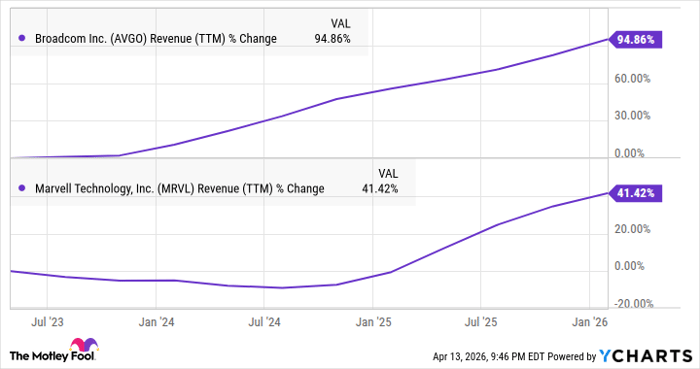
This explains why Broadcom and Marvell have seen significant sales growth acceleration lately.
AVGO Revenue (TTM) data by YCharts.
The good news for their shareholders is that these chipmakers are at the beginning of a terrific growth curve. According to research by Goldman Sachs, unit demand for ASICs in AI data centers is poised to catch up to GPU demand by 2027. The investment bank estimates that there will be a 50-50 split between ASICs and GPUs being installed in AI servers by next year. Last year, GPUs dominated the AI server market, with an estimated 62% share.
It is easy to see why that's the case. Hyperscalers such as Alphabet, Microsoft, and Amazon have been increasingly betting on chips they designed in collaboration with Marvell or Broadcom to run AI workloads more cost-effectively and to reduce their reliance on Nvidia's GPUs. Even AI start-up Anthropic is now considering designing its own chips. Anthropic currently relies heavily on Alphabet's custom AI processors to run its AI workloads. The tech megacap co-designs those chips with Broadcom.
Amazon and Microsoft, on the other hand, reportedly tap Marvell's chip-designing prowess for their in-house chips. So, the secular growth of the custom AI processor market should be a tailwind for both semiconductor stocks in the long run, even though one of them is the more dominant player in this space.
Counterpoint Research expects Broadcom to remain the dominant ASIC designer in 2027, forecasting that it will have a 60% market share. Though the research firm expects a slide in Marvell's market share from 12% in 2024 to 8% next year, I think that's unlikely to occur. After all, Marvell has been quickly racking up design wins for its custom AI processors.
As Marvell CEO Matthew Murphy remarked on the March earnings call, it has "20-plus design wins or product sockets that are either in production or going into production" over the next three years. A design win means that Marvell's chips have been selected by a customer for deployment.
As such, it won't be surprising to see Marvell cornering 20% to 25% share of the ASIC market in the future. However, as Counterpoint Research anticipates that ASIC shipments of AI servers will triple between 2024 and 2027, both Marvell and Broadcom are poised to win big from this fast-growing market.
These stocks can deliver terrific gains
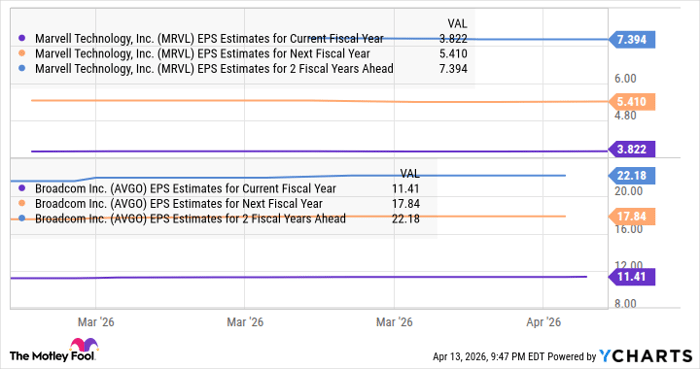
The impressive growth opportunity in custom AI processors explains why analysts forecast that both Marvell and Broadcom's earnings will grow rapidly over the next three years.
MRVL EPS Estimates for Current Fiscal Year data by YCharts.
The chart above indicates that the earnings of both companies could nearly double in just two years. The tech-heavy Nasdaq-100 index has an average earnings multiple of 31. Assuming both Marvell and Broadcom trade at that multiple after three years and reach the earnings levels shown in the chart above after a couple of years, their stock prices could hit $229 and $687, respectively.
For Marvell, that would amount to a 74% jump from its current stock price. Broadcom investors, on the other hand, could expect a gain of 81% from current levels. So, both these stocks are primed to win big from the tech sector's persistent investments in AI data center infrastructure, which is why it would be a good idea to buy them before they soar higher.
Should you buy stock in Marvell Technology right now?
Before you buy stock in Marvell Technology, consider this:
The Motley Fool Stock Advisor analyst team just identified what they believe are the 10 best stocks for investors to buy now… and Marvell Technology wasn’t one of them. The 10 stocks that made the cut could produce monster returns in the coming years.
Consider when Netflix made this list on December 17, 2004... if you invested $1,000 at the time of our recommendation, you’d have $573,160!* Or when Nvidia made this list on April 15, 2005... if you invested $1,000 at the time of our recommendation, you’d have $1,204,712!*
Now, it’s worth noting Stock Advisor’s total average return is 1,002% — a market-crushing outperformance compared to 195% for the S&P 500. Don't miss the latest top 10 list, available with Stock Advisor, and join an investing community built by individual investors for individual investors.
See the 10 stocks »
*Stock Advisor returns as of April 16, 2026.
Harsh Chauhan has no position in any of the stocks mentioned. The Motley Fool has positions in and recommends Alphabet, Amazon, Broadcom, Goldman Sachs Group, Marvell Technology, Microsoft, and Nvidia. The Motley Fool has a disclosure policy.
Recommended Articles


