




WTI Oil Price Surges Above US$93: Can Crude Oil Hit US$100 as Hormuz Disruption Deepens?
How to Trade Oil CFDs in Australia
WTI crude oil prices have surged to their highest levels in months as the risk of prolonged disruption to Middle Eastern oil shipments continues to increase.
On 8 September 2026, WTI crude climbed to around US$93.70 per barrel, while Brent crude moved close to US$98. The latest rally has been driven by renewed US-Iran military tensions, attacks involving oil tankers and regional energy infrastructure, and a sharp reduction in shipping activity through the Strait of Hormuz.
The key question for traders is now:
Can WTI crude oil reach US$100 per barrel?
The answer increasingly depends on whether oil flows through the Strait of Hormuz recover or remain constrained into late 2026 and potentially 2027.
Goldman Sachs has warned that crude oil could rise as high as US$120 per barrel if attacks on Middle Eastern shipping intensify. At the same time, the bank has raised its oil price forecasts because it expects shipping disruptions to persist for longer than previously anticipated.
For Australian traders, the oil rally is particularly important because higher global crude prices can feed into petrol prices, inflation, interest-rate expectations and the Australian dollar.
WTI Oil Price Today: What Is Driving the Rally?
The latest WTI rally is not being driven by a single factor. Instead, several supply-side risks are reinforcing each other.
WTI Crude Oil Key Market Drivers
WTI has already climbed substantially from the levels seen earlier in the summer. Reuters reported that WTI reached around US$92.65 on 7 September, before extending gains on 8 September.
The move towards US$100 therefore represents an important psychological and technical threshold for oil traders.
Why Is the Strait of Hormuz So Important for Oil Prices?
The Strait of Hormuz is one of the world's most strategically important energy chokepoints.
A large proportion of global oil and LNG shipments normally pass through the narrow waterway connecting the Persian Gulf with the Gulf of Oman.
The problem for oil markets is that shipping activity has fallen sharply as military tensions have escalated.
Reuters reported that only seven commodity vessels passed through the Strait of Hormuz on Monday, compared with eight the previous day, according to Kpler data. At the same time, Iran has warned that Gulf energy infrastructure and US oil and gas interests could become targets.
This creates a potentially powerful feedback loop:
Military escalation → fewer vessels → lower oil exports → tighter physical supply → higher crude prices
If the disruption remains temporary, oil prices could eventually retreat as alternative supply routes and inventories compensate for lost barrels.
However, a prolonged disruption could produce a much larger supply shock.
Could the Strait of Hormuz Disruption Continue Into 2027?
This is becoming one of the most important questions for the oil market.
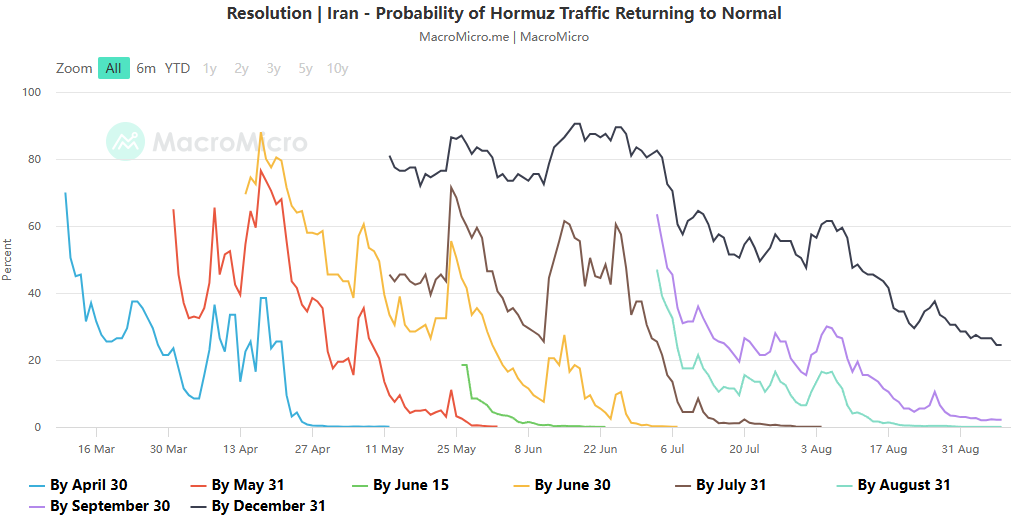
The latest market assessment suggests that the disruption may not be resolved quickly.
Iran - Probability of Hormuz Traffic Returning to Normal
Source: macromicro.me
Goldman Sachs has raised its oil price forecasts by US$5 per barrel for both December 2026 and 2027, reflecting expectations that Middle Eastern shipping disruptions could continue for longer.
The market is therefore no longer pricing the situation purely as a short-term geopolitical shock.
Instead, traders are increasingly considering three possible scenarios:
Scenario 1: Hormuz Reopens Quickly
If diplomatic negotiations succeed and shipping normalises:
oil supply improves;
risk premiums decline;
WTI could retreat from current highs;
prices could potentially move back towards the US$80 area.
Goldman Sachs has previously highlighted that a normalisation of regional oil exports could produce a substantial decline in crude prices.
Scenario 2: Partial Disruption Continues
This is arguably the most important scenario for traders right now.
If some tankers continue to move through Hormuz but volumes remain well below normal:
physical oil markets remain tight;
geopolitical risk premium remains elevated;
WTI could consolidate above US$90;
US$100 becomes increasingly realistic.
Scenario 3: Full Escalation
If attacks on oil tankers and energy infrastructure intensify, the market could face a much larger supply shock.
Goldman Sachs has warned that crude could potentially reach US$120 per barrel if attacks on Middle Eastern shipping become more severe.
That would represent a significant upside risk for both WTI and Brent.
WTI Oil Price Forecast: Can WTI Reach US$100?
Source: tradingview
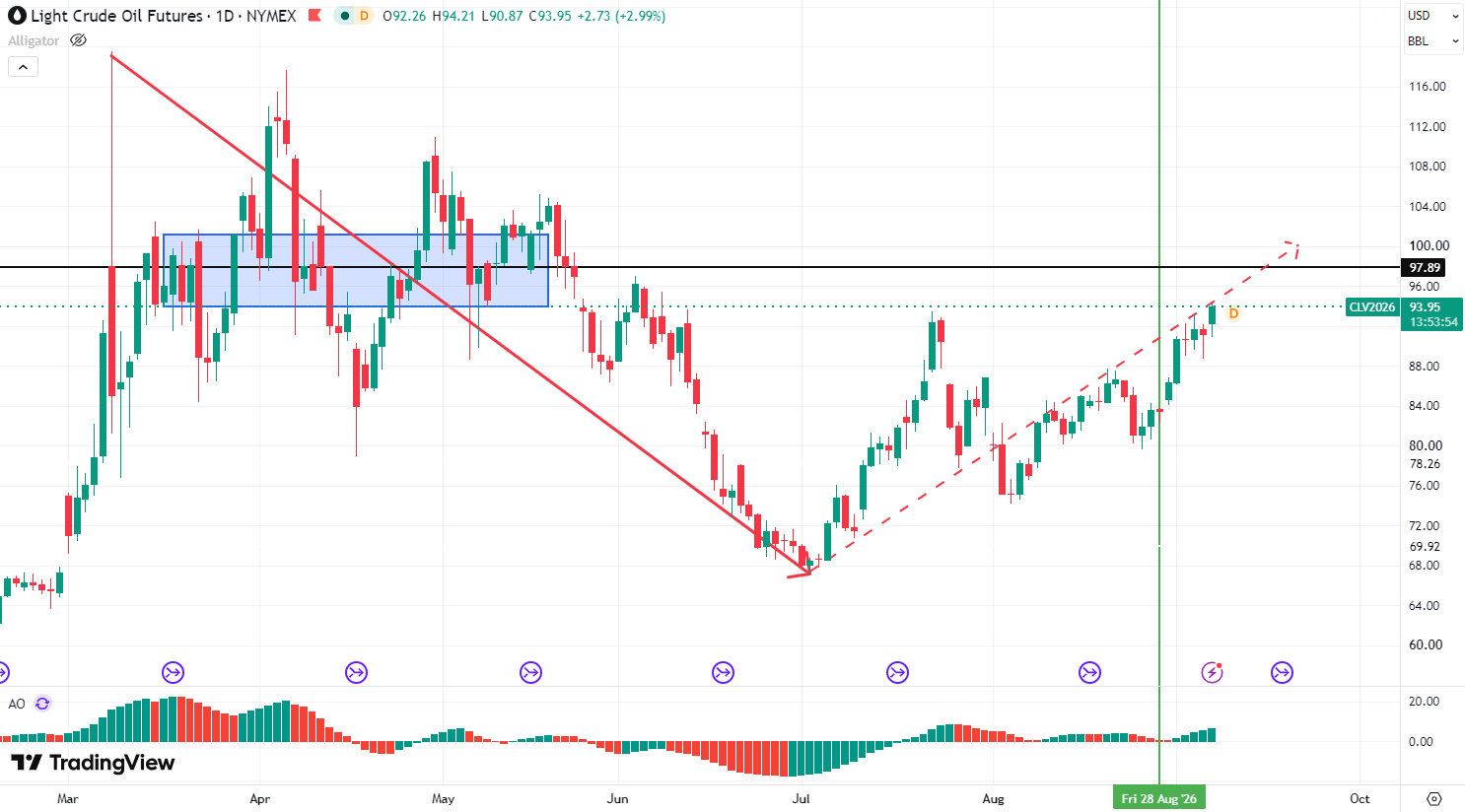
The short-term technical structure remains bullish.
WTI has broken above previous July highs and is now trading around the US$93–94 area, meaning the US$100 psychological level is becoming the next major target.
Key WTI Levels to Watch
Bullish WTI Scenario
A sustained break above US$94–95 could strengthen the bullish trend.
The next major levels to watch would be:
US$97 → US$100 → US$105
US$100 is particularly important because it is both a psychological threshold and a level that could attract significant speculative interest.
If WTI breaks above US$100 with strong momentum, traders may begin looking towards US$105 and US$110.
A further escalation in Middle Eastern supply disruptions could potentially open the door to even higher levels.
Bearish WTI Scenario
However, traders should not assume that WTI must reach US$100.
Oil markets can reverse very quickly when geopolitical risk premiums decline.
If:
US-Iran tensions ease;
Hormuz shipping recovers;
alternative export routes expand;
global inventories increase;
demand weakens;
WTI could experience a sharp correction.
The first important downside area would be around US$90.
A break below US$88 would weaken the immediate bullish structure, while a move below US$82 would significantly increase the risk of a broader trend reversal.
How to Trade WTI Crude Oil CFDs in Australia
Australian traders do not necessarily need to buy physical barrels of crude oil to gain exposure to oil prices.
A CFD broker can provide exposure to the price movements of WTI crude.
With a WTI CFD, traders can potentially:
Go Long
A long position attempts to profit if WTI rises.
For example, if a trader believes that continued disruption around the Strait of Hormuz will push WTI from US$94 towards US$100, they could consider a long CFD position.
Go Short
A short position attempts to profit if WTI falls.
For example, if diplomatic negotiations improve and oil shipping returns to normal, traders could look for opportunities from a potential decline in WTI.
This two-way flexibility is particularly relevant in the current market because geopolitical headlines can cause oil prices to reverse rapidly.
With WTI approaching the psychologically important US$100 level, crude oil is becoming one of the most closely watched markets in September 2026.
The key question is no longer simply “Will oil rise?” but rather whether the current supply disruption will prove temporary or become a prolonged structural shock.
If the Strait of Hormuz remains disrupted and attacks on Middle Eastern shipping intensify, the upside risk could remain substantial, with Goldman Sachs warning that oil could potentially reach US$120 under a severe escalation scenario.
However, if shipping normalises, the geopolitical risk premium could unwind quickly.
That creates opportunities in both directions for CFD traders — but also significantly higher risk.
Want to trade WTI crude oil? Open a CFD trading account and gain access to oil markets with the flexibility to trade both rising and falling prices.



What Does Higher Oil Mean for Australia?
The Reserve Bank of Australia has already highlighted the inflationary impact of higher energy prices. In its August 2026 Statement on Monetary Policy, the RBA said Middle East disruptions were contributing to high global oil and LNG prices, while higher fuel prices were feeding into Australian inflation.
The relationship is relatively straightforward:
Higher crude oil → higher fuel costs → higher transport costs → higher business input costs → inflation pressure
The RBA estimates that global crude oil prices account for around 40% of the final price of retail fuel in Australia, with changes in oil prices generally flowing through to Australian fuel prices with a lag of around one to two weeks.
That means Australian households and businesses could feel the impact of another leg higher in WTI and Brent.
If oil remains elevated for an extended period, Australian traders may therefore need to monitor:
CPI inflation;
petrol and diesel prices;
RBA interest-rate expectations;
Australian government bond yields;
AUD/USD;
consumer spending;
transport and manufacturing costs.
This could create cross-market trading opportunities because oil does not move independently of the wider macroeconomic environment.
You might be interested in…
Disclaimer: The content presented above, whether from a third party or not, is considered as general advice only. CFD trading involves significant risk of loss. Past performance does not guarantee future results. This article serves informational purposes only and does not constitute financial advice. Consider your risk tolerance before trading.


