




Gold Price Forecast September 2026: Gold Rebounds Above US$4,300 Before the Fed Decision
How to Start Trading Gold CFDs in Australia
Gold price has rebounded sharply after falling to a one-month low, recovering above US$4,300 as traders wait for the Federal Reserve's September interest-rate decision. With markets pricing in a high probability of a 25-basis-point rate hike, can gold extend its rebound — or will higher US Treasury yields cap the upside?
Gold Price Today Australia: Market Snapshot
Gold has staged a strong short-term recovery after coming under heavy pressure earlier this week.
On Wednesday, September 16, spot gold rose around 0.8% to approximately US$4,327 per ounce, reversing part of its recent decline. Gold had previously fallen to a one-month low as the US dollar strengthened and Treasury yields climbed.
The rebound has taken gold back above the psychologically important US$4,300 level.
Latest Market Situation & Key Levels
The key question for Australian gold traders is no longer simply “Will gold fall further?”
Instead, the market is now waiting to see whether the latest rebound represents a temporary relief rally before the Fed decision or the beginning of a broader recovery.
Why Is Gold Rising Today?
There are several reasons behind gold's recovery above US$4,300.
1. Markets Have Already Priced in a Fed Rate Hike
The Federal Reserve's September meeting is the dominant market event this week.
Markets are pricing in a very high probability of a 25-basis-point rate hike, with Reuters reporting a probability of around 92.7% on Wednesday morning.
That means a significant portion of the expected rate increase may already be reflected in financial markets.
This creates a classic “buy the rumour, sell the fact” setup.
If the Fed raises rates as expected and Fed Chair Kevin Warsh does not deliver a significantly more hawkish message, some traders could interpret the decision as a relief event for gold.
The key issue is therefore not only:
Will the Fed raise rates?
but also:
What will the Fed signal about future rate hikes?
2. US Inflation Remains Above the Fed's Target
The August US CPI report has strengthened the case for tighter monetary policy.
Headline CPI increased 0.4% month-on-month in August, while core CPI rose 0.3%. Annual headline inflation stood at 3.4%, while core inflation was 2.4%.
This leaves the Federal Reserve facing a difficult policy environment.
On one side:
Inflation remains above the 2% target
Oil prices are elevated
Wage and employment conditions remain relatively resilient
On the other:
Higher interest rates could weigh on economic activity
Long-term Treasury yields are already elevated
Financial-market volatility is increasing
For gold, this creates two competing forces.
Higher inflation
Potentially bullish for gold because investors may seek protection against declining purchasing power.
Higher interest rates
Potentially bearish for gold because higher yields increase the opportunity cost of holding a non-yielding asset.
The direction of gold therefore depends heavily on which force dominates.
3. US Treasury Yields Are the Bigger Risk for Gold
One of the most important developments for the gold market this week has been the sharp rise in US Treasury yields.
The US 10-year Treasury yield briefly reached 5.041%, its highest level since 2007, before easing back toward 5%. The 30-year Treasury yield also moved above 5.4%.
The latest 20-year Treasury auction also cleared at approximately 5.42%, highlighting the elevated cost of long-term US government borrowing.
This matters because gold does not generate an interest payment.
When Treasury yields rise sharply, investors may become more willing to hold government bonds rather than gold.
However, there is an important complication.
If long-term yields rise because investors are increasingly concerned about US fiscal deficits, government debt and inflation, gold can simultaneously benefit from demand for an alternative store of value.
That means the relationship between yields and gold may become less straightforward than the traditional “higher yields = lower gold” relationship suggests.
Gold Price Forecast: Can Gold Hold Above US$4,300?
Source: TradingView
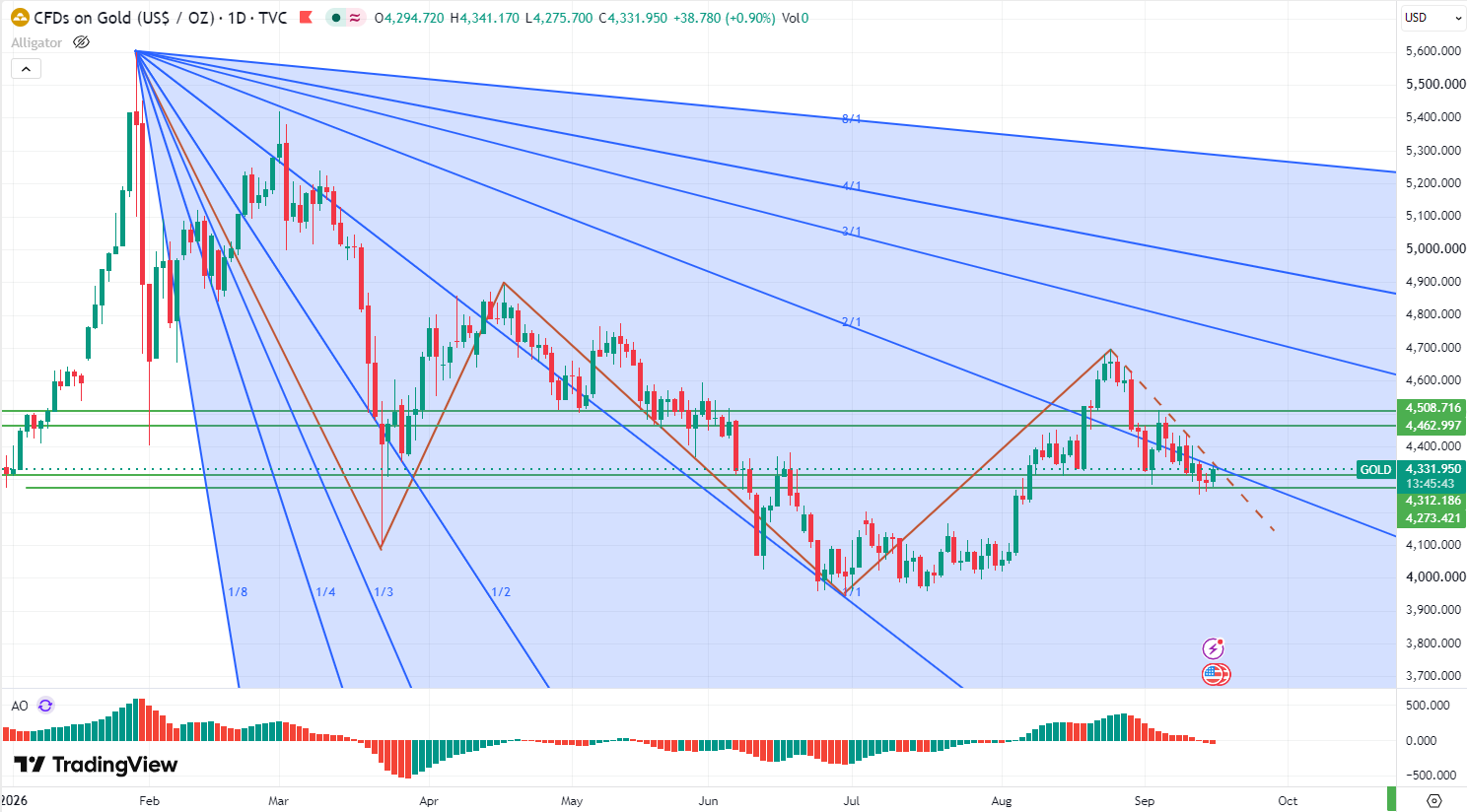
The daily gold chart currently shows a market attempting to stabilise after a sharp decline.
The previous bearish momentum pushed XAU/USD below US$4,300, but buyers have since returned.
This creates three important zones.
Bullish scenario
If XAU/USD breaks above US$4,400 and establishes support there, the next upside target could be around US$4,500.
A move above US$4,500 would significantly improve the short-term technical structure and bring US$4,600 back into focus.
A more aggressive recovery could eventually retest the US$4,700–4,800 area.
Bearish Scenario
The downside risk has not disappeared.
If gold fails to hold US$4,300 and breaks below the recent low, traders could focus on:
US$4,250 → US$4,200 → US$4,150
The US$4,150 area is particularly important because it was also identified as a potential downside target during the previous correction.
A sustained break below US$4,150 would suggest that the current decline is developing into a deeper correction rather than a short-term pullback.
What Could the Fed Decision Mean for Gold?
The Fed decision itself may not be enough to determine the next major gold move.
The market could instead focus on Kevin Warsh's post-meeting comments and forward guidance.
There are three potential scenarios.
Fed Outcome vs Gold Reaction
• Impact on Gold: Bearish pressure
• Impact on Gold: Potential rebound
• Impact on Gold: Potentially bullish
These are scenario analyses, not predictions.
Reuters reported that markets were particularly focused on whether the Fed would signal further tightening after the expected September hike.
This is why the hours immediately following the Fed decision could produce significantly higher volatility in XAU/USD.
How to Trade Gold CFDs in Australia
The current market environment is particularly relevant for traders looking to trade short-term movements in gold.
Rather than buying and storing physical bullion, eligible Australian traders can use Gold CFDs to speculate on price movements in either direction.
Depending on their market view, traders can:
Go long if they expect gold to rise
Go short if they expect gold to fall
Trade around major economic events such as Fed decisions
Use stop-loss orders to manage downside risk
Monitor technical levels such as US$4,300 and US$4,400
For Australian retail clients, CFD leverage is subject to ASIC's product intervention rules. Gold CFDs have a maximum retail leverage ratio of 20:1, equivalent to a 5% minimum margin requirement.
Trade Gold CFDs with an ASIC-Regulated Broker
The current Fed decision creates a potentially important trading window for XAU/USD.
Australian traders can monitor the US$4,300–4,400 range, follow Fed policy announcements and use appropriate risk-management tools when trading gold CFDs.
Trade Gold CFDs and access rising and falling gold markets from one platform.
* CFDs are complex instruments and come with a high risk of losing money rapidly due to leverage. Consider whether you understand how CFDs work and whether you can afford to take the high risk of losing your money.

Trade XAU/USD with Tight Spreads
You might be interested in…
Disclaimer: The content presented above, whether from a third party or not, is considered as general advice only. CFD trading involves significant risk of loss. Past performance does not guarantee future results. This article serves informational purposes only and does not constitute financial advice. Consider your risk tolerance before trading.


