


Investing $500 a Month in Coca-Cola, Realty Income, and Altria Could Generate Over $1,000 in Monthly Dividend Income by 2046
Key Points
Contrary to a common assumption, most retirement nest eggs are built slowly over time, a few dollars at a time.
When handled correctly, certain dividend stocks can deliver growth-like returns.
Don’t underestimate the impact of taxes on your retirement savings, then or in the meantime.
- 10 stocks we like better than Coca-Cola ›
Will you need dividend income at some point in the future? For most people who plan on eventually retiring from the world of work, the answer is yes. They're growing their nest eggs in the meantime, in fact, largely with the intention of converting their growth investments into income investments when the time comes.
That isn't necessarily the only way to meet your future income needs, though. As difficult as it may be to believe, there's an argument to be made for beginning to build your dividend-paying positions right now, even if you don't need the income yet.
Missed AI’s "Act 1"? Act 2 Could Be 15x Bigger. Most investors think they missed the AI boat because they didn't buy Nvidia in 2005. But according to our analysts, we’re only at the end of "Act 1"—the R&D phase. "Act 2" is the global rollout. Continue »
And while nobody can perfectly predict the future, your most promising dividend prospects for this purpose are Coca-Cola (NYSE:KO), Realty Income (NYSE:O), and Altria Group (NYSE:MO).
Here's the math.
Crunching the numbers
These names are among the market's most reliable and highest-yielding dividend payers, and each has raised its annualized dividend for at least 50 consecutive years, reflecting the resiliency of their underlying businesses. That makes all three of them Dividend Kings.
Their dividend pedigrees aren't as important as the process, however. How does one turn a $500 monthly investment in these names into a portfolio capable of producing more than $1,000 in monthly dividend income by, say, 20 years from now, in 2046?

Image source: Getty Images.
There are two stages to the process.
The first is the growth phase. Rather than pocketing the dividends these stocks will be paying in the coming two decades, you'll be reinvesting these payments into more shares of the ticker while also purchasing more of these same stocks with your monthly contributions of $500.
This is no minor growth driver. Over the past 20 years, dividend reinvestment has essentially doubled the effective net returns each of these stocks would have achieved with price appreciation alone.
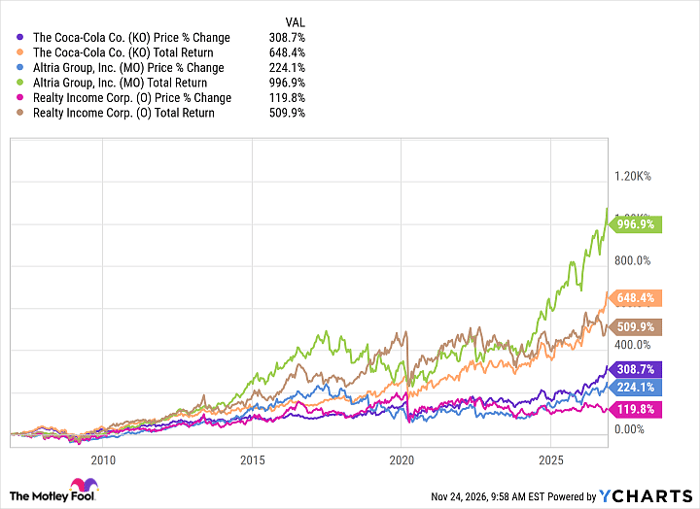
KO data by YCharts
The other aspect of the first stage is a bit trickier to get a handle on. That's figuring out the likely net returns these three names will achieve between now and 2046. Although past performance doesn't guarantee future results, experienced investors know that it's a pretty good indicator of what's likely to happen.
Nevertheless, given the modest but steady traction the smoking-cessation movement is getting, it seems unlikely that tobacco giant Altria will deliver a repeat performance of the past two decades in the next two. For that matter, Coca-Cola's net gains since 2006 have also been exaggerated.
So, for the sake of simplicity and plausibility, let's just assume all three of these stocks have and will continue to at least match the overall market's average annual net gain of 10%. (Each has beaten this figure, actually.) Investing $500 per month in any instruments achieving this sort of annual return for 20 years would leave you with a portfolio worth a little more than $380,000 at the end of this time frame.
And again, just for the sake of simplicity, let's assume this $380,000 nest egg is evenly allocated between Altria, Realty Income, and Coca-Cola. Those are positions of roughly $127,000 each. How much dividend income would these collective investments be producing then?
We're still required to make some assumptions, albeit not unreasonable ones. Namely, let's assume these stocks' current dividend yields will more or less be their yields at that time. That's 2.2% for Coca-Cola, 5.6% for Realty Income, and 6% for Altria. Based on those numbers, this $380,000 in stock holdings should generate over $17,000 in dividends every year, or more than $1,400 in monthly spendable income.
Just don't forget to turn your dividend reinvestment plan off when you're ready to start collecting these dividend payments in cash. That's the second stage of the process.
Never too soon to start laying the groundwork
These results are just hypothetical, of course, although the assumptions are rooted in real-world numbers that should be roughly repeatable.
The big takeaway isn't identifying these three dividend payers as your top future income prospects, although there's little doubt that these companies will still be experiencing solid demand for their goods and services into the foreseeable future.
No, the real takeaway is just how much even small regular investments in dividend stocks, paired with a dividend reinvestment plan, can grow your portfolio over time. This strategy can yield growth-like returns — the key is just giving it enough time to do the job. Note that most of the net growth for all three of these positions materialized in just the last one-third of the 20-year accumulation period.
The other related takeaway is that even though it may be years down the road for you, it wouldn't be wrong to start thinking about — and even building — positions in the dividend-paying stocks that you know you'll want to own as your income-generating positions then. Although dividends paid by stocks not held in retirement accounts are taxable as income for the year in which they're paid, that may still be a smarter option for you than buying growth investments that will result in large capital gains tax bills when you're ready to convert them into income-generating holdings.
Should you buy stock in Coca-Cola right now?
Before you buy stock in Coca-Cola, consider this:
The Motley Fool Stock Advisor analyst team just identified what they believe are the 10 best stocks for investors to buy now… and Coca-Cola wasn’t one of them. The 10 stocks that made the cut could produce monster returns in the coming years.
Consider when Netflix made this list on December 17, 2004... if you invested $1,000 at the time of our recommendation, you’d have $320,394!* Or when Nvidia made this list on April 15, 2005... if you invested $1,000 at the time of our recommendation, you’d have $917,381!*
Now, it’s worth noting Stock Advisor’s total average return is 776% — a market-crushing outperformance compared to 199% for the S&P 500. Don't miss the latest top 10 list, available with Stock Advisor, and join an investing community built by individual investors for individual investors.
See the 10 stocks »
*Stock Advisor returns as of November 26, 2026.
James Brumley has positions in Coca-Cola. The Motley Fool has positions in and recommends Realty Income. The Motley Fool has a disclosure policy.
Recommended Articles


