


Should You Buy Oracle Stock After Its 53% Collapse? The Answer Might Shock You.
Key Points
Oracle operates some of the most cost-efficient data centers in the artificial intelligence (AI) industry.
The company has borrowed large sums of money to build more data centers, but some of its top customers might not be able to follow through on their commitments.
Oracle stock is down 53% from its peak and is trading at a seemingly low valuation, but that doesn't mean it's a buy.
- Motley Fool Issues Rare "Total Conviction" Buy Alert ›
The stock market is in the throes of a steep correction right now. The technology-heavy Nasdaq-100 index closed 19.8% below its record high last Friday, so it's flirting with bear market territory.
But Oracle (NYSE:ORCL) stock has plummeted by an even steeper 53% from its peak. The company has taken on a substantial amount of debt to build artificial intelligence (AI) data centers, and investors are increasingly worried this infrastructure won't be as lucrative as initially thought.
Missed AI’s "Act 1"? Act 2 Could Be 15x Bigger. Most investors think they missed the AI boat because they didn't buy Nvidia in 2005. But according to our analysts, we’re only at the end of "Act 1"—the R&D phase. "Act 2" is the global rollout. Continue »
Concerns are especially high following Jensen Huang's recent departure from Nvidia (NASDAQ:NVDA). The chip giant is one of the biggest investors in OpenAI, which has agreed to rent hundreds of billions of dollars' worth of infrastructure from Oracle. Huang was reinstated on Monday, but I predict the board of directors will place more guardrails over his ability to make decisions this time around, which could extend to how he allocates the company's resources.
If OpenAI loses Nvidia as one of its top funding partners, it would be very bad news for Oracle. It's tempting to think those risks are fully priced into Oracle stock after its sharp decline, but here's why investors should think twice before buying it right now.

Image source: The Motley Fool.
Oracle's data centers are among the best in the AI industry
A growing number of businesses want to use AI, but very few of them have the billions of dollars or technical resources required to build data centers, which is where the necessary computing power lives. Renting data center capacity from a third party like Oracle is a much cheaper option, because businesses only pay for what they use, without having to worry about the huge upfront cost.
Oracle's data centers are fitted with thousands of graphics processing units (GPUs) from top suppliers like Nvidia and Advanced Micro Devices (NASDAQ:AMD). These chips do most of the heavy lifting in AI workloads, and by offering different options, Oracle caters to a wide range of customers.
All of Oracle's data centers use a similar architectural blueprint regardless of their size, so the company can bring more infrastructure online faster than many of its competitors. It has also invested heavily in automation through software, and its proprietary remote direct memory access (RDMA) networking technology moves data between chips and devices faster than traditional Ethernet networks. These attributes lead to exceptional processing speeds at an attractive price, which is a desirable combination for AI developers.
OpenAI, Meta Platforms (NASDAQ:META), Cohere, and Elon Musk's xAI are just some of Oracle's top AI customers. They are eagerly waiting for more infrastructure to come online, but it's increasingly unclear whether they can actually follow through on their enormous orders, which could be bad news for Oracle.
Oracle continues to produce rapid revenue growth, but it might not be sustainable
Oracle delivered $19.3 billion in total revenue during its fiscal 2027 first quarter (ended Aug. 31), a 30% increase from the year-ago period. But revenue from its cloud infrastructure business, specifically, surged by a whopping 120% to $7.4 billion, primarily thanks to AI customers.
The rapid growth is widely expected to continue because of Oracle's $664 billion in remaining performance obligations (RPO), which is effectively its order backlog from customers who are waiting for more data center capacity to come online. RPO would be a useful indicator of future revenue under normal circumstances, but there is an uncomfortable amount of uncertainty surrounding that big number right now.
In September 2025, The Wall Street Journal reported that OpenAI alone accounted for $300 billion of Oracle's order backlog. But OpenAI currently has just $50 billion in annualized revenue, and it continues to lose money, so it relies on investors for additional funding. Since Nvidia could take on a much smaller role as the AI industry's financial backer, it's unclear whether companies like OpenAI can fully cover their long-term commitments.
Oracle has borrowed a significant amount of money to fund its data center projects, and is now carrying over $117 billion in long-term debt. Oracle's credit default swaps, which investors buy as protection, are signaling growing doubts about the company's ability to repay its debt. In other words, the market isn't confident that all of Oracle's RPO will actually turn into revenue.
Oracle stock looks cheap, but valuation isn't everything in this case
Oracle generated generally accepted accounting principles (GAAP) earnings of $6.38 per share over the last four quarters, placing its stock at a price-to-earnings (P/E) ratio of 15.6 -- less than half its five-year average of 34.6. It's also much lower than the P/E ratio of the Nasdaq-100 index, which is currently 27.3, so Oracle looks very undervalued compared to a group of America's largest technology companies.
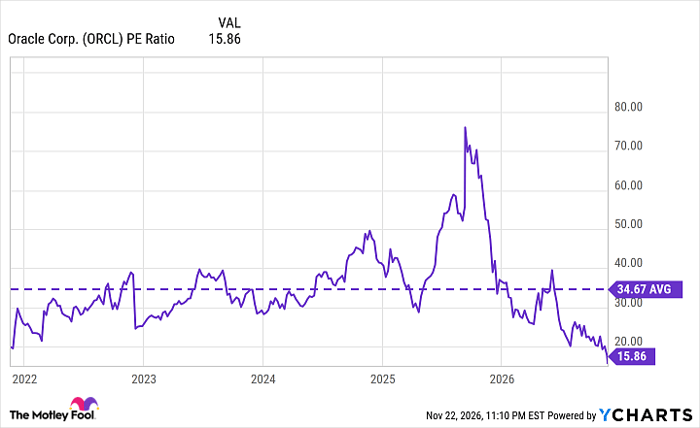
ORCL PE Ratio data by YCharts
However, beaten-down stocks aren't always cheap. It's getting harder to forecast Oracle's future earnings because of the uncertainty surrounding the quality of its backlog, which explains why investors simply aren't willing to pay a premium for its stock right now. The company's mountain of debt makes the situation even riskier.
As a result, I don't think Oracle stock is a good buy at the moment. Despite its low P/E ratio, the stock could decline even further if Wall Street analysts start lowering their earnings estimates for next year, which is a very real possibility.
Should you buy stock in Oracle right now?
Before you buy stock in Oracle, consider this:
The Motley Fool Stock Advisor analyst team just identified what they believe are the 10 best stocks for investors to buy now… and Oracle wasn’t one of them. The 10 stocks that made the cut could produce monster returns in the coming years.
Consider when Netflix made this list on December 17, 2004... if you invested $1,000 at the time of our recommendation, you’d have $313,329!* Or when Nvidia made this list on April 15, 2005... if you invested $1,000 at the time of our recommendation, you’d have $1,014,158!*
Now, it’s worth noting Stock Advisor’s total average return is 796% — a market-crushing outperformance compared to 200% for the S&P 500. Don't miss the latest top 10 list, available with Stock Advisor, and join an investing community built by individual investors for individual investors.
See the 10 stocks »
*Stock Advisor returns as of November 25, 2026.
Anthony Di Pizio has no position in any of the stocks mentioned. The Motley Fool has positions in and recommends Advanced Micro Devices, Meta Platforms, Nvidia, and Oracle. The Motley Fool has a disclosure policy.
Recommended Articles


