


Sandisk Just Split Its Stock 8-for-1. Is It Time to Buy?
Key Points
Sandisk's cheap valuation has nothing to do with the stock price.
The company will benefit for years from the AI build-out.
- Motley Fool Issues Rare "Total Conviction" Buy Alert ›
If you're wondering why Sandisk (NASDAQ:SNDK) just saw its share price get a huge cut, it's not time to panic. Although the stock is valued at an eighth of what it was, that was on purpose.
Sandisk enacted an 8-for-1 stock split on Nov. 19, which replaced one share with eight — each of them costing an eighth as much as a pre-split share. This is a mostly cosmetic effect, but it does let the company issue stock options to employees at more reasonable prices.
Missed AI’s "Act 1"? Act 2 Could Be 15x Bigger. Most investors think they missed the AI boat because they didn't buy Nvidia in 2005. But according to our analysts, we’re only at the end of "Act 1"—the R&D phase. "Act 2" is the global rollout. Continue »
With most brokerages offering access to fractional shares, stock price really doesn't matter much to investors. What matters more is the business behind it. For a company to justify a split, its share price must have increased significantly. That only happens to companies that are doing well, and Sandisk fits that bill.

Image source: The Motley Fool.
Sandisk is thriving in current market conditions
Sandisk makes memory chips, which are in short supply. The artificial intelligence (AI) infrastructure build-out has consumed all available production capacity for memory, with different effects on suppliers and clients.
For Sandisk, the lack of supply means it can charge premium prices for its products. None of its input costs have changed significantly, so this is almost pure profit for Sandisk. This has shown up in a big way in its most recent results, with profit margins skyrocketing in recent quarters.
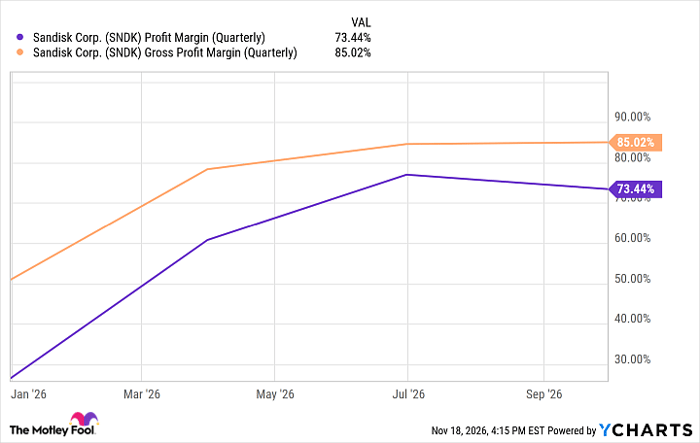
SNDK Profit Margin (Quarterly) data by YCharts
A 73% profit margin is absurd, and it shows just how profitable Sandisk is.
While Sandisk and its investors are thrilled about this, not everyone is. Consumers who want to buy laptops, phones, or external storage devices face prices several times higher than they were just a couple of years ago. The AI hyperscalers are experiencing the same thing, paying a premium to secure memory for data centers.
With the AI build-out expected to last several more years, it's unlikely that Sandisk and its peers' supply constraint issues are fixed. Although many in the industry are planning production expansion (Sandisk is too), there are questions about whether that will be enough to meet demand. After all, there is a huge risk of overbuilding production capacity.
Sandisk and its memory chip peers are cyclical companies, which means their businesses ebb and flow. The AI build-out is the largest demand surge this industry has ever seen, and they were woefully underprepared for it in terms of capacity.
But for most of their existence, memory chip companies have significantly underutilized the capacity at their disposal. The AI build-out won't last forever, so Sandisk must be careful not to overbuild; otherwise, it could find itself in a rough spot when the build-out slows.
However, the build-out may not wrap up for several more years, so some capacity investments are warranted. Still, the market is pricing Sandisk's stock like it's going to collapse tomorrow, and that's a perfect opportunity to buy.
Sandisk stock is cheaper than cheap
Very few companies ever trade at a forward valuation like this.
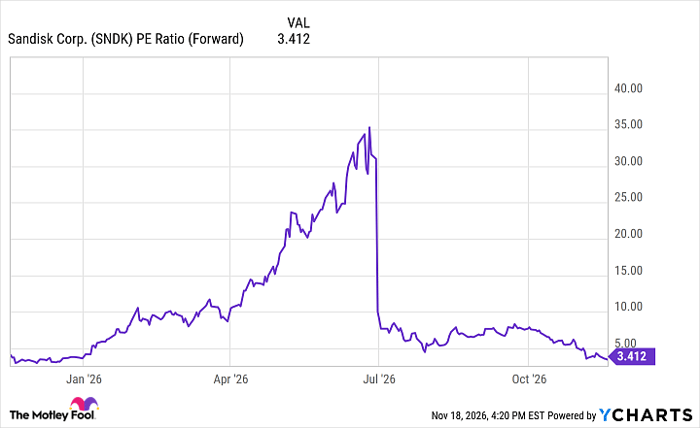
SNDK PE Ratio (Forward) data by YCharts
Sandisk shares go for a mere 3.4 times forward earnings. That is an incredibly cheap valuation, and it conveys the market's message that it doesn't think Sandisk will be able to maintain its earnings growth.
However, this flies in the face of what major AI companies have said, so something has to give. I think it's more likely than not that the market is misvaluing Sandisk's stock, and today it represents an excellent buying opportunity. I think that Sandisk has a ton of potential, and with it being an important component supplier for the AI build-out, the stock is well worth buying.
Should you buy stock in Sandisk right now?
Before you buy stock in Sandisk, consider this:
The Motley Fool Stock Advisor analyst team just identified what they believe are the 10 best stocks for investors to buy now… and Sandisk wasn’t one of them. The 10 stocks that made the cut could produce monster returns in the coming years.
Consider when Netflix made this list on December 17, 2004... if you invested $1,000 at the time of our recommendation, you’d have $305,941!* Or when Nvidia made this list on April 15, 2005... if you invested $1,000 at the time of our recommendation, you’d have $771,325!*
Now, it’s worth noting Stock Advisor’s total average return is 719% — a market-crushing outperformance compared to 192% for the S&P 500. Don't miss the latest top 10 list, available with Stock Advisor, and join an investing community built by individual investors for individual investors.
See the 10 stocks »
*Stock Advisor returns as of November 23, 2026.
Keithen Drury has no position in any of the stocks mentioned. The Motley Fool has no position in any of the stocks mentioned. The Motley Fool has a disclosure policy.
Recommended Articles


