


Warren Buffett's Successor, Greg Abel, Just Gave Investors a Big Clue as to What's Next for Stocks
Key Points
Greg Abel has taken over Berkshire Hathaway’s day-to-day operations and its $356 billion investment portfolio following the Oracle of Omaha’s retirement as CEO.
Abel sold a net of $426 million in stocks during the third quarter.
Warren Buffett’s preferred valuation tool has reached uncharted territory.
- Motley Fool Issues Rare "Total Conviction" Buy Alert ›
This has been a year of big changes for Berkshire Hathaway (NYSE:BRKA)(NYSE:BRKB), the trillion-dollar conglomerate that Warren Buffett built. At the end of last year, the Oracle of Omaha retired as CEO, passing the oversight of the company's day-to-day operations and its $356 billion investment portfolio to longtime understudy, Greg Abel.
Abel aided Buffett in his greater-than-6,000,000% outperformance of the benchmark S&P 500 (SNPINDEX:^GSPC), and wasted little time overhauling Berkshire's portfolio once he took over as CEO.
Missed AI’s "Act 1"? Act 2 Could Be 15x Bigger. Most investors think they missed the AI boat because they didn't buy Nvidia in 2005. But according to our analysts, we’re only at the end of "Act 1"—the R&D phase. "Act 2" is the global rollout. Continue »
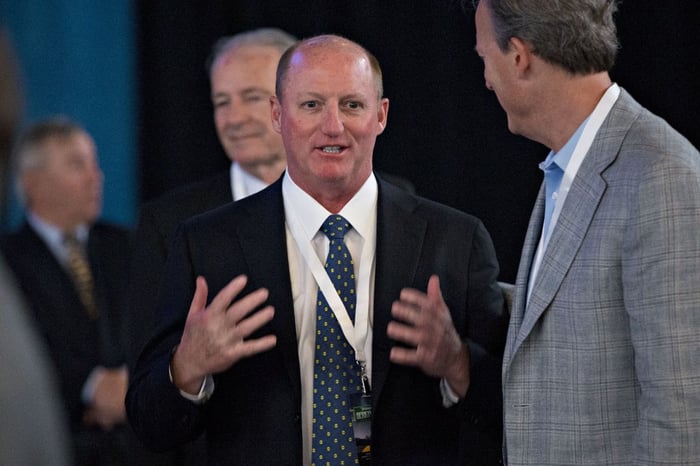
Greg Abel was a net seller of stocks in the September-ended quarter. Image source: Getty Images.
More importantly, for those who paid attention to Berkshire Hathaway's latest earnings report, he's given investors a massive clue about what's next for stocks.
Berkshire's new boss sent shockwaves through Wall Street with this $426 million warning
Although Greg Abel isn't Warren Buffett, the two share somewhat similar investing styles. Both favor long-term investing, strong management teams, and companies with sustainable moats/competitive advantages.
But the one factor Buffett and Abel are unwavering on is value. Both demand a good deal when putting Berkshire's capital to work and won't chase after perceived-to-be great companies if they don't offer an attractive value proposition.
Berkshire Hathaway's consolidated cash flow statements for the third quarter show that Abel and his team purchased $2.366 billion in equity securities and sold $2.792 billion, resulting in net selling activity of $426 million. It's the 15th time over the last 16 quarters that Berkshire's bosses have sold more stocks than they've purchased.
Though neither Buffett nor Abel comments on individual investments in their company's portfolio or makes assessments on short-term stock movements, this persistent net selling speaks volumes about their near-term view of the stock market. Namely, equities are historically expensive.

Image source: Getty Images.
The Buffett indicator is in uncharted territory
Back in 2001, the Oracle of Omaha spilled the beans on his favorite valuation metric in an interview with Fortune magazine. He called the market-cap-to-GDP ratio "probably the best single measure of where valuations stand at any given moment." This valuation metric has since become known as the Buffett indicator.
When backtested to December 1970, the Buffett indicator has averaged 89%. This is to say that the cumulative value of all U.S. public companies has averaged 89% of U.S. gross domestic product (GDP) over 56 years. In mid-August, the Buffett indicator reached an all-time high of 236.42%.
Stock Market reaches most expensive valuation in history after the Warren Buffett Indicator hits 239%, surpassing the Dot Com Bubble, the Global Financial Crisis, and the 2022 Bear Market 🤯 👀 pic.twitter.com/K5LBAN6S2Q
— Barchart (@Barchart) August 15, 2026
While the Buffett indicator can't pinpoint when the music will stop on Wall Street, it does have an uncanny ability to foreshadow significant stock market declines.
Given that Greg Abel is a long-term-minded investor, a historically pricey stock market doesn't change his approach concerning Berkshire's core holdings. In other words, Abel isn't going to overreact to the stock market being historically expensive.
At the same time, Abel has demonstrated a willingness to sit on his proverbial hands and wait for stock valuations to come back into his wheelhouse before deploying Berkshire Hathaway's treasure trove of capital. It's the same strategy that Warren Buffett employed during and after the Great Recession, allowing him to scoop up a $5 billion investment in Bank of America (NYSE:BAC) preferred stock at well below the company's per-share book value.
Though Abel is an unabashed long-term optimist like his predecessor, he's sending worrisome signals about where stocks are headed in the short term.
Should you buy stock in Berkshire Hathaway right now?
Before you buy stock in Berkshire Hathaway, consider this:
The Motley Fool Stock Advisor analyst team just identified what they believe are the 10 best stocks for investors to buy now… and Berkshire Hathaway wasn’t one of them. The 10 stocks that made the cut could produce monster returns in the coming years.
Consider when Netflix made this list on December 17, 2004... if you invested $1,000 at the time of our recommendation, you’d have $305,941!* Or when Nvidia made this list on April 15, 2005... if you invested $1,000 at the time of our recommendation, you’d have $771,325!*
Now, it’s worth noting Stock Advisor’s total average return is 719% — a market-crushing outperformance compared to 192% for the S&P 500. Don't miss the latest top 10 list, available with Stock Advisor, and join an investing community built by individual investors for individual investors.
See the 10 stocks »
*Stock Advisor returns as of November 23, 2026.
Bank of America is an advertising partner of Motley Fool Money. Sean Williams has positions in Bank of America. The Motley Fool has positions in and recommends Berkshire Hathaway. The Motley Fool has a disclosure policy.
Recommended Articles


