


Warren Buffett’s Successor, Greg Abel, Has Invested Nearly 47% of Berkshire Hathaway’s $360 Billion Stock Portfolio in Just 3 Stocks (and None Are AI Hyperscalers)
Key Points
Some of Berkshire's top stocks were purchased in the 1990s, while others are more recent.
Berkshire has generated terrific returns for shareholders, and without going all in on AI.
- Motley Fool Issues Rare "Total Conviction" Buy Alert ›
One of the most fascinating parts of Berkshire Hathaway's sprawling business is its roughly $360 billion equity portfolio, in which the company invests the float generated by its insurance business in a wide range of stocks across sectors.
In his more than six decades as CEO of Berkshire, Warren Buffett built one of the best investing track records in history. He has since passed the torch to new CEO Greg Abel, a longtime Berkshire veteran and close confidant of Buffett, who plans to continue Buffett's remarkably concentrated approach to investing.
Missed AI’s "Act 1"? Act 2 Could Be 15x Bigger. Most investors think they missed the AI boat because they didn't buy Nvidia in 2005. But according to our analysts, we’re only at the end of "Act 1"—the R&D phase. "Act 2" is the global rollout. Continue »
To this day, just three stocks make up nearly 47% of Berkshire's portfolio. Perhaps even more amazing is that none of these three are traditional artificial intelligence hyperscalers.
While Berkshire's investment moves are a strong starting point, investors should realize that Berkshire rarely explains its positions. Its filings arrive with a delay, so treat them as a starting point for your own research, not a shopping list.
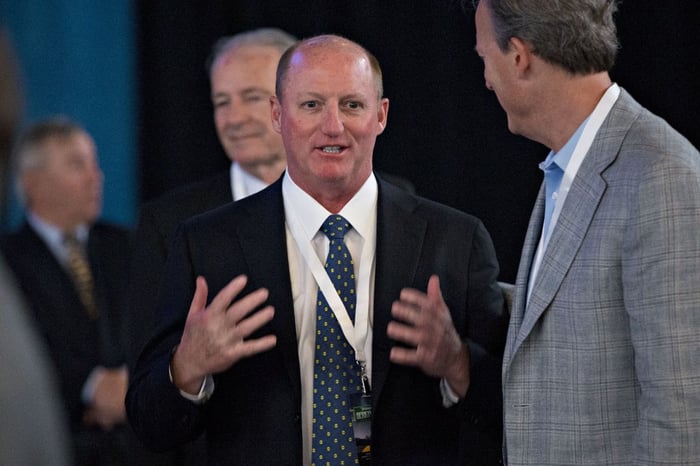
Greg Abel. Image source: Getty Images.
Apple -- 22.3%
Apple (NASDAQ:AAPL) is Berkshire's largest position by a wide margin. The roughly 228 million shares haven't changed in four straight quarterly filings, a notable pause after Buffett trimmed the stake for nearly two years.
Buffett, Abel, and the Berkshire team probably like Apple due to its loyal customer base of more than 2.5 billion active devices, high-margin Services revenue, and massive share repurchases over the past decade-plus that have significantly reduced Apple's outstanding shares, thereby increasing Berkshire's slice of profits.
Apple repurchased $24 billion of stock in its latest quarter, on top of a new $100 billion authorization announced in the spring.
With a market capitalization above $5 trillion, Apple is now the largest stock in the world by market value. The results back it up: Fiscal 2026 revenue hit a record $478.8 billion, up 15%, and earnings per share rose 20% to $8.98. September-quarter iPhone revenue set a record, and services revenue also reached an all-time high of $31.6 billion.
Trading around 39 times trailing earnings, Apple stock isn't cheap. It has a new CEO, John Ternus, and shareholders are keen to ensure the company can keep producing innovative consumer tech products.
Apple is also in an enviable position: It's not investing hundreds of billions in data centers and therefore not experiencing issues with free cash flow. Furthermore, Apple's leadership in consumer tech hardware, such as the iPhone, means it is likely to play a major role in delivering artificial intelligence to the public.
American Express -- 13.3%
Berkshire has held American Express (NYSE:AXP) since the early 1990s and owns more than 22% of the company. Amex has a fantastic brand and business model that are difficult to replicate.
Amex is both a credit card issuer and a payments network, meaning it extends credit to consumers and businesses and facilitates transactions between customers and merchants.
When run well, the credit card business can generate strong returns on capital, and Amex caters to a more affluent customer base that is typically more resilient during recessions. Meanwhile, the payments business generates capital-light recurring fee revenue. In the third quarter, net card fee growth accelerated to 17% year over year.
However, the stock has struggled this year, lagging the S&P 500 as investors worry about stablecoins and regulatory pressure on card economics. The business, however, is doing fine. Q3 revenue hit a record $20.1 billion, up 9%. Billed business rose 8% to $454 billion, and Amex raised its full-year earnings guidance.
Berkshire hasn't touched its Amex position since the 1990s, so Abel and the team clearly do not share current investor concerns.
Coca-Cola -- 11%
Coca-Cola (NYSE:KO) may be the most Buffett stock of all. Berkshire has owned it since 1988 and holds 400 million shares. With the quarterly dividend now $0.53 per share, those shares generate roughly $848 million in annual dividends. The company has raised its payout for 64 consecutive years.
Abel and his team likely value many of the attributes that have always made the iconic beverage company attractive: global brands, pricing power, and steady cash flow. Management expects at least $13 billion in free cash flow this year.
The stock has been a big winner this year, as investors rotate somewhat out of artificial intelligence and tech and into the best-in-breed consumer staples stock.
In Q3, unit case volume at the company grew 5%, organic revenue rose 7%, and comparable earnings per share climbed 11%. After the strong run this year, Coca-Cola is no longer cheap, trading over 29 times forward earnings.
So while upside may be capped in the near term, Coca-Cola can generate solid long-term returns through the business cycle.
Should you buy stock in Apple right now?
Before you buy stock in Apple, consider this:
The Motley Fool Stock Advisor analyst team just identified what they believe are the 10 best stocks for investors to buy now… and Apple wasn’t one of them. The 10 stocks that made the cut could produce monster returns in the coming years.
Consider when Netflix made this list on December 17, 2004... if you invested $1,000 at the time of our recommendation, you’d have $305,941!* Or when Nvidia made this list on April 15, 2005... if you invested $1,000 at the time of our recommendation, you’d have $771,325!*
Now, it’s worth noting Stock Advisor’s total average return is 719% — a market-crushing outperformance compared to 192% for the S&P 500. Don't miss the latest top 10 list, available with Stock Advisor, and join an investing community built by individual investors for individual investors.
See the 10 stocks »
*Stock Advisor returns as of November 22, 2026.
American Express is an advertising partner of Motley Fool Money. Bram Berkowitz has no position in any of the stocks mentioned. The Motley Fool has positions in and recommends American Express, Apple, and Berkshire Hathaway. The Motley Fool has a disclosure policy.
Recommended Articles


