


Does Anthropic Have a Competitive Advantage? These are the Four Big Ones
Key Points
Anthropic went public in the biggest IPO in history, raising $91.6 billion.
The company doesn't have an obvious sustainable competitive advantage, though its brand could be becoming one.
Management believes its competitive advantage comes from two flywheels embedded in its business model.
- Motley Fool Issues Rare "Total Conviction" Buy Alert ›
Anthropic (NASDAQ:ANT) just made stock market history with its IPO.
At $91.6 billion, the company raised more cash in its debut than any company before it. That would seem to be a bullish sign for the stock, but after an initial pop, Anthropic closed Friday trading just 7% above its IPO price, and at one point the stock was trading just five cents above the $83 listing price.
Missed AI’s "Act 1"? Act 2 Could Be 15x Bigger. Most investors think they missed the AI boat because they didn't buy Nvidia in 2005. But according to our analysts, we’re only at the end of "Act 1"—the R&D phase. "Act 2" is the global rollout. Continue »
The company had the misfortune of going public while the broader AI sector is crashing on fears surrounding Nvidia. Anthropic also has plenty of skeptics, who have called out risks like the $900 billion it has in purchase commitments, falling token prices, competition from cheaper models, and concerns about circular financing in the industry involving Nvidia.
Those risks are all valid, but the company has also reported revenue growth of 1,200% year-over-year through the first three quarters of the year, and it's already reached a revenue run rate of $68 billion. No company this young has ever been this big. Over the longer term, Anthropic sees its technology playing a role in everything from curing diseases to designing chips to making robots and beyond. In other words, it's a high-risk, high-reward stock.
Anthropic is in a new, rapidly evolving industry, and one of the most pressing questions for investors at this point is whether it has a sustainable competitive advantage.
Investors typically look for one of four types of competitive advantage. Those include:
- Low-cost provider: A company like Walmart offers a good example of this.
- Brand: Apple is one business that has thrived in part because of its brand strength.
- Switching costs: Banks are an example of switching costs. Once you've opened an account, you're more likely to stick with that bank rather than switching to a new bank.
- Network effects. Network effects play a major role in the success of social media platforms like Meta's Facebook and Instagram.
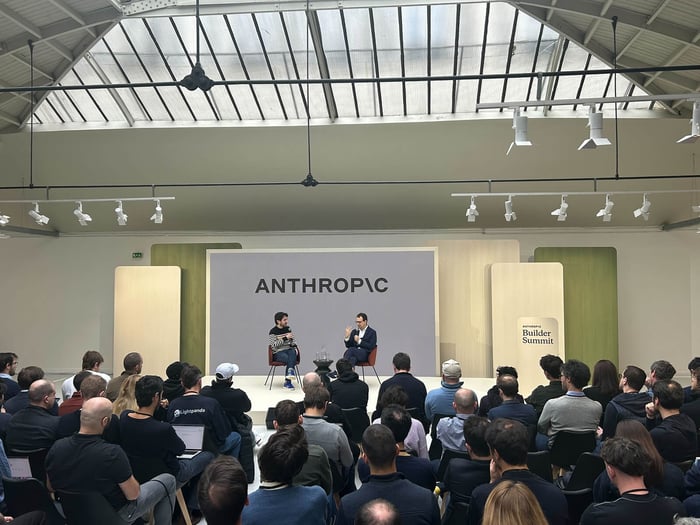
Image source: Anthropic.
How Anthropic stacks up
Anthropic clearly isn't the low-cost provider. It's a frontier AI lab running on state-of-the-art chips from Nvidia and others. Distillation models like DeepSeek's R1 are an example of low-cost providers in generative AI.
Anthropic's brand is getting stronger and becoming more of a competitive advantage. Claude, its core intelligence platform and chatbot, now rivals OpenAI's ChatGPT in recognition, and its other products like Claude Cowork and Claude Code have become well-known as well. Anthropic's brand helps attract new users and keep existing ones. If Anthropic's brand is recognized as the best AI, that gives it a competitive advantage.
At an enterprise level, switching costs do apply to a product like Claude, as they do to the rest of the software industry. A business that's paid for hundreds or even thousands of Claude seats is going to face friction if it wants to switch to another provider. At the individual consumer level, switching costs are minimal.
Network effects do not really apply to AI, as it isn't used to connect with other users.
Of these four, brand seems like Anthropic's best opportunity to build a competitive advantage, much like Apple's in smartphones and consumer electronics.
Is technology a source of competitive advantage?
Technology on its own isn't generally considered a source of sustainable competitive advantage, especially in a rapidly evolving field like AI. Anthropic took the lead from OpenAI in part by introducing more capable models, but the race between the two companies continues, and Anthropic is not guaranteed to maintain its lead.
Technology can help build a competitive advantage when it's combined with patents or trade secrets, regulatory barriers to entry, or a strong brand, and it's clearly a major reason for Anthropic's meteoric growth.
Being the technology leader in an industry is a competitive advantage, but it's often not seen as sustainable.
How Anthropic sees it
Anthropic sees its competitive advantage stemming from the flywheel below, which shows how its usage improves its models, similar to Google Search, and also drives more investment, which makes its models better.

Anthropic's flywheels. Image source: Anthropic.
What Anthropic describes here is more about how its business model creates a flywheel that makes it better, rather than a true competitive advantage.
For a market leader, however, this kind of flywheel can drive a competitive advantage, as it has for Google Search, which learns and improves from the way consumers use the product.
What's the verdict?
I don't think it's correct to say that Anthropic doesn't have a competitive advantage, even though none of the four main ones strongly apply. I think the combination of its brand, technology, and the improvement flywheels constitutes an emerging competitive advantage that will be tested over the coming months and years.
If the company can continue to gain market share, that should be interpreted as a sign that its competitive advantage is getting stronger, which makes the stock much more likely to be a winner.
We'll learn more over the coming months as Anthropic's first earnings report comes out, and the AI boom responds to its biggest test yet in the stock market, but if Anthropic can build a sustainable competitive advantage, it could become the most valuable company in the world.
Should you buy stock in Anthropic right now?
Before you buy stock in Anthropic, consider this:
The Motley Fool Stock Advisor analyst team just identified what they believe are the 10 best stocks for investors to buy now… and Anthropic wasn’t one of them. The 10 stocks that made the cut could produce monster returns in the coming years.
Consider when Netflix made this list on December 17, 2004... if you invested $1,000 at the time of our recommendation, you’d have $305,941!* Or when Nvidia made this list on April 15, 2005... if you invested $1,000 at the time of our recommendation, you’d have $771,325!*
Now, it’s worth noting Stock Advisor’s total average return is 719% — a market-crushing outperformance compared to 192% for the S&P 500. Don't miss the latest top 10 list, available with Stock Advisor, and join an investing community built by individual investors for individual investors.
See the 10 stocks »
*Stock Advisor returns as of November 22, 2026.
Jeremy Bowman has positions in Meta Platforms and Nvidia. The Motley Fool has positions in and recommends Meta Platforms, Nvidia, and Walmart. The Motley Fool recommends Anthropic. The Motley Fool has a disclosure policy.
Recommended Articles


