


Report: Goldman Sachs Predicts the S&P 500 Will Gain 26% in 12 Months
Key Points
Research from the Wall Street firm predicts that the S&P 500 will climb to 8,700 in the next 12 months, for a gain of about 26% from Friday's close.
Goldman strategists believe that valuations of tech stocks and AI hyperscalers have reached attractive levels after their recent sell-off.
The S&P 500 forward price-to-earnings ratio is at a 15% discount compared to its past five-year average.
- Motley Fool Issues Rare "Total Conviction" Buy Alert ›
The stock market has had a rough few weeks. As of Nov. 20, the S&P 500 index (SNPINDEX:^GSPC) had declined by about 10.4% in the prior month, largely driven by investor worries over the sustainability of the artificial intelligence (AI) trade. The tech-heavy Nasdaq-100 index has declined almost enough to qualify as a bear market, with a drop of nearly 20% since its Oct. 6 record high.
But according to Bloomberg reporting from Nov. 13, Goldman Sachs (NYSE:GS) strategists are bullish on the S&P 500 for next year. Recent research from Goldman suggests that the benchmark S&P index will gain 26% in the next 12 months by November 2027, despite possibly lower earnings growth compared to 2026.
Let's look at what this might mean for investors -- and why it's a good sign to keep buying stocks with low-cost index funds like S&P 500 ETFs.
Missed Nvidia in 2009? This Rare Signal Is Flashing Again. In 2009, a "Double Down" signal flashed for a little-known chipmaker called Nvidia. For the first time in years, that same "Total Conviction" signal is flashing for a company 1/100th the size of Nvidia. Continue »

Image source: Getty Images.
Goldman's forecast for the S&P 500 by the end of 2027
Goldman strategists predict that the S&P 500 will reach 8,700 points in the next 12 months. On Nov. 20, the index closed at about 6,910, so this would imply a gain of about 26% from that level.
That's not an outlandish return to expect for the S&P 500. A 26% gain in 12 months would be an exceptionally strong year, much better than the average. But it's well within the realm of possibility.
Keep in mind that the long-term average annual return for the S&P 500, based on historical data since 1928, is 9.98%. And in the past few years, the Vanguard S&P 500 ETF (NYSEMKT:VOO) has delivered annual returns of about 17.8% in 2025, 25% in 2024, and 26.3% in 2023.
Why does Goldman think the S&P 500 will do so well in the next 12 months? If so many investors are nervous about tech companies spending too much on AI data centers, isn't now a bad time to buy the S&P? After all, as of Nov. 19, eight of the top 10 holdings in the S&P 500 were tech names, and those top eight stocks made up about 33.5% of the index by weight.
The answer is in the valuations.
Tech stock valuations have become cheaper
Recent investor skepticism about AI stocks might actually be healthy for future returns. Recent declines in tech stock prices have driven down those companies' valuations. Goldman's research finds that AI hyperscalers are trading "well below" their historic valuations and says that "we see Technology -- and Hyperscalers in particular -- as relatively defensive."
The very same tech stocks that have been going through a correction in the past month might be poised for bigger gains in the next 12 months. Goldman says that even though some of the biggest hyperscalers have negative cash flow due to their aggressive AI investments, these companies still have strong balance sheets and could become attractive in the next 12 months if growth opportunities elsewhere are harder to find.
This trend of lower valuations can also be seen if you look at the S&P 500 index forward price-to-earnings ratio (P/E). This metric shows the index's earnings multiple based on the next 12 months' estimated earnings. The S&P forward P/E has dropped from a recent high of 30 to 21.08, trading at about a 15% discount compared to its five-year average.
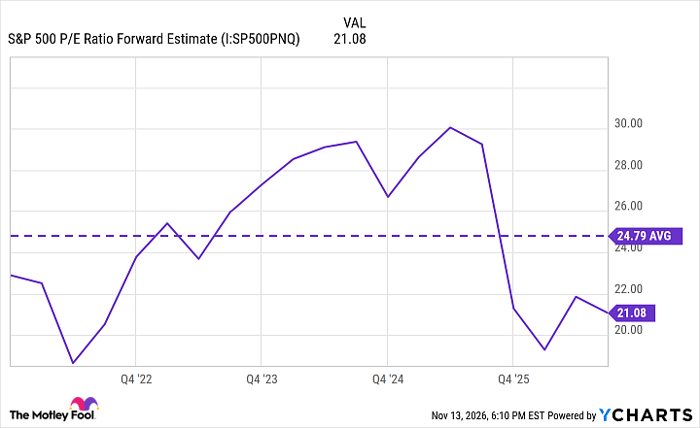
S&P 500 P/E Ratio Forward Estimate data by YCharts
Why buy S&P 500 ETFs
Long-term investors need to think beyond today, tomorrow, or even the next 12 months. One year is not "long term." But this Goldman Sachs research is a helpful sign that there are many reasons to be optimistic about the stock market, despite some recent volatility.
If you share Goldman's optimism about the S&P 500 in 2027, now can be a good time to buy low-cost index funds like the Vanguard S&P 500 ETF (VOO). This ultra-low-cost ETF lets you track the performance of the S&P.
You don't have to pick stocks or worry about which companies or industries are winning or losing; this Vanguard ETF lets you own 500 of the largest publicly traded companies in America, representing about 80% of the total U.S. stock market. If Goldman's analysis is on target, your investment in the ETF could go up by 26% in the next 12 months.
But even if that forecast doesn’t come true, you can rest assured that the S&P 500 has delivered strong average annual returns of about 10% for long-term investors who can buy and hold through temporary ups and downs along the way.
Should you buy stock in S&P 500 Index right now?
Before you buy stock in S&P 500 Index, consider this:
The Motley Fool Stock Advisor analyst team just identified what they believe are the 10 best stocks for investors to buy now… and S&P 500 Index wasn’t one of them. The 10 stocks that made the cut could produce monster returns in the coming years.
Consider when Netflix made this list on December 17, 2004... if you invested $1,000 at the time of our recommendation, you’d have $315,271!* Or when Nvidia made this list on April 15, 2005... if you invested $1,000 at the time of our recommendation, you’d have $896,981!*
Now, it’s worth noting Stock Advisor’s total average return is 768% — a market-crushing outperformance compared to 198% for the S&P 500. Don't miss the latest top 10 list, available with Stock Advisor, and join an investing community built by individual investors for individual investors.
See the 10 stocks »
*Stock Advisor returns as of November 20, 2026.
Ben Gran has no position in any of the stocks mentioned. The Motley Fool has positions in and recommends Goldman Sachs Group and Vanguard S&P 500 ETF. The Motley Fool has a disclosure policy.
Recommended Articles


