


Kospi Plunges 5% Triggering Circuit Breaker, SoftBank Tumbles Over 14%, Kioxia Slumps 11%, Samsung and SK Hynix Fall Over 6%
TradingKey - Japanese and South Korean stocks both plunged over 5% amid fierce sell-offs! KOSPI fell below the 5,000-point mark to trigger circuit breakers, while SoftBank plummeted over 14% and Kioxia tumbled 11%.
During Asian trading hours on November 20, both major Asia-Pacific stock markets in Japan and South Korea faced intense selling pressure, falling sharply throughout the day to end down over 5% each and surrender key psychological levels. South Korea's KOSPI index widened its intraday decline to over 5% at one point, triggering a sidecar curb on program sell orders and a futures trading halt mechanism.
South Korea's benchmark KOSPI opened lower and trended downward throughout the day, ultimately closing down 5.21% and breaking below the 5,000-point threshold to finish at 4,869.96 points. The two major heavyweight stocks both tumbled over 6%, with Samsung Electronics falling 6.86% to close at 183,400 won, and SK Hynix dropping 6.09% to 1,111,000 won.
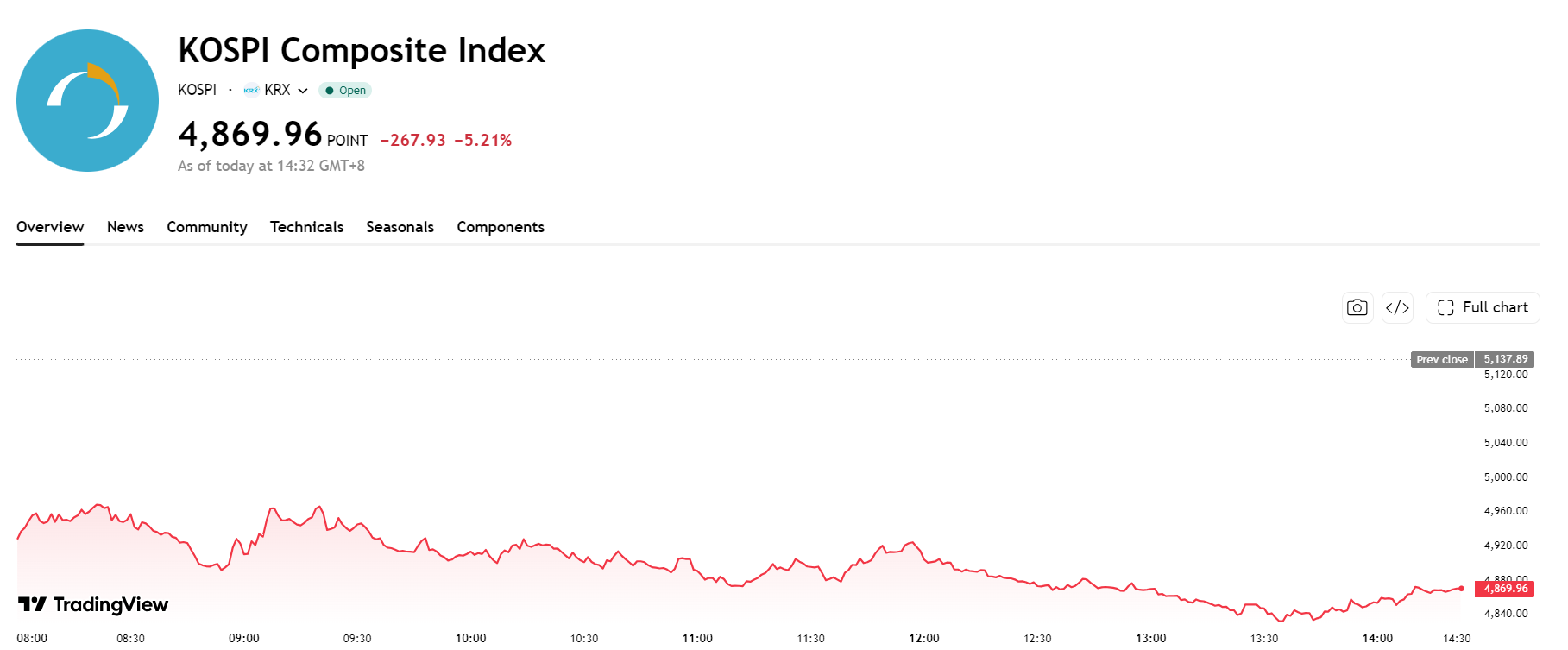 KOSPI index chart, source: TradingView
The Nikkei 225 index also trended lower throughout the day, closing down 5.06% at 56,436.65 points. Kioxia tumbled 11.66%, falling below the 8,000 mark to close at 7,307 yen. SoftBank was the worst performer, plunging 14.48% to approach the 3,000 mark and closing at 3,025.0 yen.
Broad weakness in Wall Street chip stocks, coupled with disruptions from recent news regarding semiconductor export compliance and regulatory tightening, left Japanese and South Korean markets—which are heavily dependent on global semiconductor and AI supply chains—bearing the brunt of the impact. Significant drops in South Korean memory giants Samsung Electronics and SK Hynix weighed heavily on the KOSPI's weighted structure across the board.
Although Anthropic (ANT) raised $81.3 billion on its November 19 debut and closed up about 17%, it tumbled over 6% in overnight trading. Ultimately, this failed to alleviate market concerns regarding returns on AI infrastructure investments, massive capital commitments, and rising financing costs, instead intensifying profit-taking and deleveraging pressures across the technology and semiconductor sectors.
Recommended Articles


