


Warren Buffett Says Berkshire's Own Stock History Is the Strongest Argument Against Buying Stocks With Borrowed Money
Key Points
Berkshire Hathaway stock has been an incredible long-term winner, but it has still experienced significant pullbacks.
Warren Buffett used big declines in Berkshire's share price to show the dangers of using debt to buy stocks.
- Motley Fool Issues Rare "Total Conviction" Buy Alert ›
Warren Buffett stepped down as CEO of Berkshire Hathaway (NYSE: BRKA)(NYSE: BRKB) and passed the reins to Greg Abel at the beginning of this year, but it's little wonder that investors around the world are still looking to the Oracle of Omaha for investing advice and guidance. Buffett's expertise as a stock picker and leader over more than six decades would have turned a $1,000 investment in Berkshire held across his tenure into more than $34 million.
Buffett had an incredible track record of success that shows he is an exceptional investor, but he also understood the dangers of using debt to fund investment moves. Moreover, he clearly illustrated the hazards of this potential pitfall using the performance of his own company's stock.
Missed Nvidia in 2009? This Rare Signal Is Flashing Again. In 2009, a "Double Down" signal flashed for a little-known chipmaker called Nvidia. For the first time in years, that same "Total Conviction" signal is flashing for a company 1/100th the size of Nvidia. Continue »
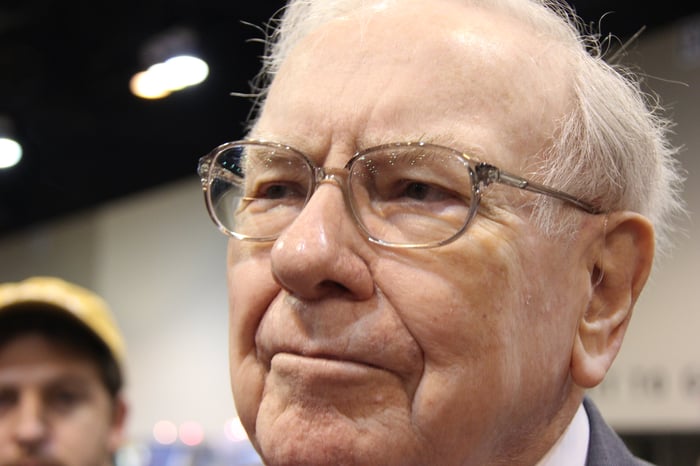
Image source: The Motley Fool.
Investors should heed Buffett's warning about using debt to buy stocks
Despite Berkshire Hathaway's market-crushing history, the stock has still suffered periods of massive drawdowns. In Berkshire's annual letter to shareholders in 2017, Warren Buffett pointed to periods in which the company's stock saw huge valuation contractions. His idea was to show how using debt to fund even an investment as strong as Berkshire has been long-term can be devastating.
The table below reflects the periods of huge share price declines outlined by Buffett in Berkshire Hathaway's shareholder letter.
| Period | Percentage Decline for Berkshire Stock |
|---|---|
| March 1, 1973 to Jan. 1, 1975 | 59.1% |
| Oct. 2, 1987 to Oct. 27, 1987 | 37.1% |
| June 19, 1998 to March 10, 2000 | 48.9% |
| Sept. 19, 2008 to March 5, 2009 | 50.7% |
Data source: Berkshire Hathaway.
The long-term performance of the company's stock is a reflection of smart investing decisions and a consistent approach that was applied intelligently, but even Berkshire isn't immune to misfires and the trends shaping the broader market. Valuations for stocks have been pressured this month by macroeconomic dynamics and concerns connected to the funding, monetization, and growth outlooks for artificial intelligence companies.
Amid these trends, the benchmark S&P 500 index has been volatile recently -- falling 4.36% in a single daily session on Nov. 5. The sell-off marked the largest valuation pullback for the index since April 2025. The broader market has seen some recovery in subsequent trading, but stocks could remain volatile in the near term.
The big sell-offs that Buffett pointed to highlight the risks that come with relying on debt to fund investments. Despite some bearish catalysts, the S&P 500 is still up roughly 10.5% this year. Meanwhile, Berkshire is up roughly 18%. Investors should approach the market right now with the understanding that stocks can quickly see large valuation pullbacks.
Don't get in over your head
Avoiding the use of debt to fund stock purchases is good practice for companies, and it's arguably even more important for individual retail investors. There's an old investing adage that states you should never invest more than you can afford to lose. If you don't have the spare cash available to fund an investment, relying on debt to buy that potentially explosive stock can quickly turn into a nightmare.
Even a company or exchange-traded fund that appears to be on track for big wins or has seemingly rock-solid fundamentals can see rapid valuation collapses. In these scenarios, you will wind up owing interest on your loans in addition to your investment position being down big if you rely on debt for your funding. So if you're thinking of borrowing money to buy stocks, heed the Oracle of Omaha's advice -- and wait until you have the cash available to comfortably fund your investment moves.
Should you buy stock in Berkshire Hathaway right now?
Before you buy stock in Berkshire Hathaway, consider this:
The Motley Fool Stock Advisor analyst team just identified what they believe are the 10 best stocks for investors to buy now… and Berkshire Hathaway wasn’t one of them. The 10 stocks that made the cut could produce monster returns in the coming years.
Consider when Netflix made this list on December 17, 2004... if you invested $1,000 at the time of our recommendation, you’d have $335,171!* Or when Nvidia made this list on April 15, 2005... if you invested $1,000 at the time of our recommendation, you’d have $1,000,640!*
Now, it’s worth noting Stock Advisor’s total average return is 823% — a market-crushing outperformance compared to 208% for the S&P 500. Don't miss the latest top 10 list, available with Stock Advisor, and join an investing community built by individual investors for individual investors.
See the 10 stocks »
*Stock Advisor returns as of November 17, 2026.
Keith Noonan has no position in any of the stocks mentioned. The Motley Fool has positions in and recommends Berkshire Hathaway. The Motley Fool has a disclosure policy.
Recommended Articles


