


Nvidia Falls Another 1% Ahead of Earnings as First Earnings Call After Jensen Huang's Departure Faces China Computing Regulation Test
TradingKey - Nvidia (NVDA) will report its fiscal 2027 third-quarter results after the U.S. market close on Tuesday, with shares falling about 1% further in pre-market trading, marking the interim management team's first public appearance following Jensen Huang's departure. Meanwhile, as the U.S. extends the regulatory scope of advanced AI chips from physical exports to overseas cloud computing power, Nvidia has also begun tightening supply conditions for certain data center customers,
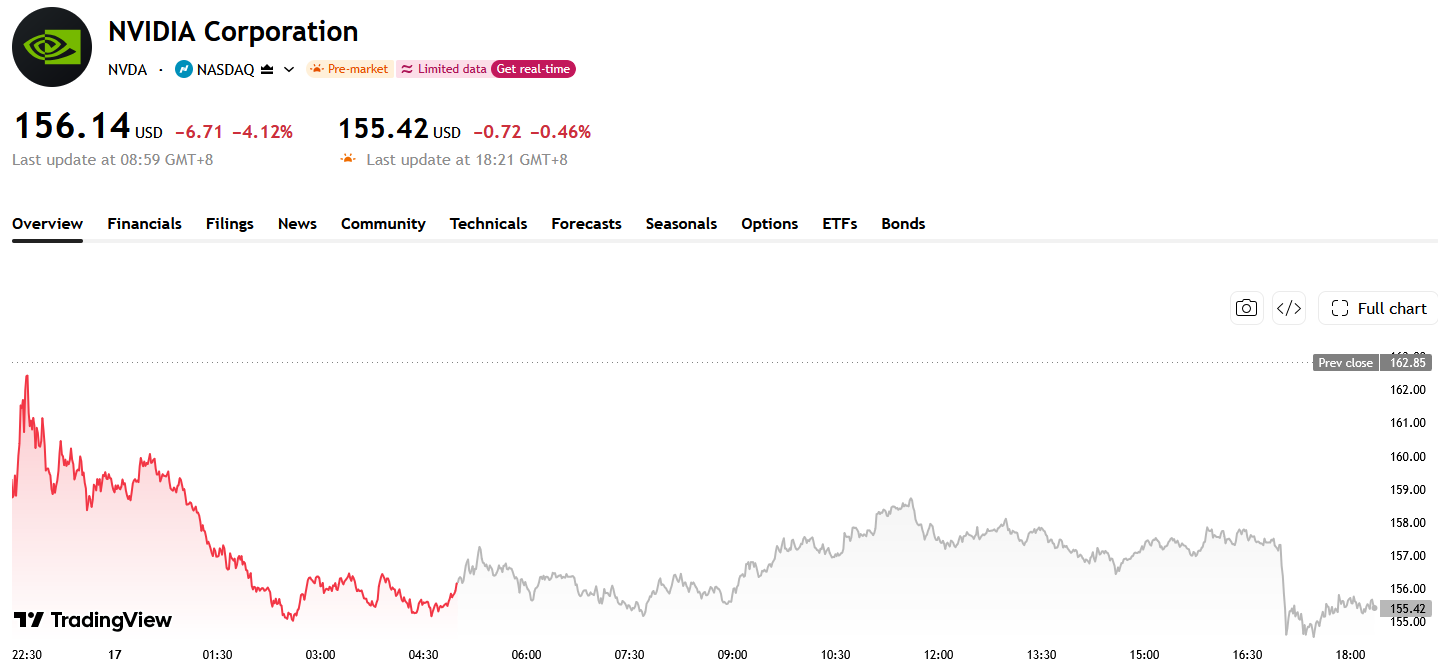
Source: TradingView
Morgan Stanley (MS) believes that the quarter's results have already been fully digested by the market, and what will truly drive the stock is whether interim CEO Colette Kress can reassure investors and customers, as well as whether management is willing to provide growth guidance for the next fiscal year. The bank expects Nvidia's third-quarter revenue to be approximately $108.1 billion, slightly below the market expectation of $108.9 billion, with adjusted earnings per share projected at $2.47, largely in line with Wall Street consensus.
Morgan Stanley stated that channel checks show Nvidia's business remains strong. Although some data center projects in Southeast Asia have slowed, existing supply still cannot fully meet customer demand, while the ramp-up of the Rubin platform and the continued expansion of capital expenditures by cloud service providers keep supporting the company's fundamentals. However, the sudden departure of Jensen Huang and policy risks facing the China business have significantly increased the uncertainty of medium- and long-term forecasts.
Based on these risks, Morgan Stanley lowered its price target for Nvidia from $300 to $267 while maintaining an Overweight rating. The bank believes that the management change is a major setback, but it has not yet undermined Nvidia's leading edge in artificial intelligence accelerators, networking equipment, and the software ecosystem. Based on current share prices, the $267 price target still implies substantial potential upside.
Meanwhile, the issue of Chinese enterprises remotely accessing high-end U.S. GPUs through overseas data centers is becoming a new regulatory focus. According to reports, Nvidia recently warned customers that pending U.S. legislation targeting remote computing access could expose the company and relevant data center operators to legal action. Nvidia will also currently not continue selling chips to customers that lease more than 50% of their GPU computing capacity to Chinese enterprises, in an effort to mitigate the risk of products being used to circumvent export controls. Reuters noted that it has not independently verified the report, and Nvidia did not immediately respond to a request for comment.
This restriction does not target the direct import of GPUs, but rather Chinese companies leasing computing power through data centers in locations such as Singapore and Malaysia. The U.S. Congress is advancing the Remote Access Security Act, which seeks to grant the Department of Commerce broader authority to place cloud computing services under regulations similar to those governing physical chip exports. Nvidia had previously warned that if the legislation takes effect, it could have a material impact on the company's business.
The U.S. Department of Commerce has also issued an interim rule requiring export licenses for shipping or transferring certain advanced semiconductors to Singapore, Malaysia, Thailand, Indonesia, and Brazil, while requiring overseas data centers to tighten end-user screening.
If the U.S. further expands controls over cloud computing access, data center operators' customer mix, service contracts, and compute leasing businesses could all be affected, potentially narrowing Nvidia's addressable customer base as well.
Recommended Articles


