


Sandisk Is Splitting Its Stock 8-for-1. Here’s the Number I’d Check Before Buying.
Key Points
Sandisk announced an 8-for-1 forward stock split with adjusted trading expected Nov. 20.
The split multiplies shares and divides the per-share price without creating business value.
A strong current margin does not prove whether the company can sustain it through a cycle.
- 10 stocks we like better than Sandisk ›
A stock split always generates buzz. So, when Sandisk (NASDAQ:SNDK) recently announced an 8-for-1 stock split, investors cheered.
Yet while stock splits can make headlines, investors may want to focus on another figure -- its gross margin -- rather than its new, lower stock price. Here's why.
Missed AI’s "Act 1"? Act 2 Could Be 15x Bigger. Most investors think they missed the AI boat because they didn't buy Nvidia in 2005. But according to our analysts, we’re only at the end of "Act 1"—the R&D phase. "Act 2" is the global rollout. Continue »

Image source: The Motley Fool.
Eight slices do not make a bigger pizza
First, let's talk about stock splits. While they may seem exotic, they don't actually change anything fundamental about the business. The best analogy is culinary: If you take a whole, uncut pizza and cut it into eight slices, you've done nothing to change how much food you have. You've simply divided it up.
Stock splits work the same way. Fundamentals, like revenue, net income, and free cash flow, do not change when a company splits its shares. When Sandisk shares split on Nov. 20, no one receives anything for free; they will simply see what they already own split according to the 8-for-1 principle.
For example, say you own 10 shares of Sandisk today. As of Nov. 13, each share trades for around $858, for a total market value of $8,580. After the split, someone who owned 10 shares will own 80 shares, and each share will drop to $107.25 (assuming the price stays steady between now and then). The total market value of 80 shares at $107.25 per share? $8,580, the same as before.
Granted, the price of Sandisk shares will fluctuate between now and Nov. 20, but the principle remains the same. The market value of shares going into Nov. 20 will still equal the market value after the split; the only thing that will change is the share price.
Gross margin shows what is left after making the product
Rather than focusing on the stock split, I think investors should take a closer look at Sandisk's gross margins. Gross margin is the profit remaining after deducting the cost of making a product.
Imagine Sandisk sells a memory chip for $100. If it took $15 to physically assemble the product, its gross margin on that product would be 85%. Bear in mind that the company doesn't get to keep the full $85 – it still has administrative and research costs, not to mention taxes.
However, gross margins are useful because they strip away these costs, allowing investors to see how profitable a business is without them. Sandisk's gross margins exploded since 2024, increasing from near 10% to around 85%.
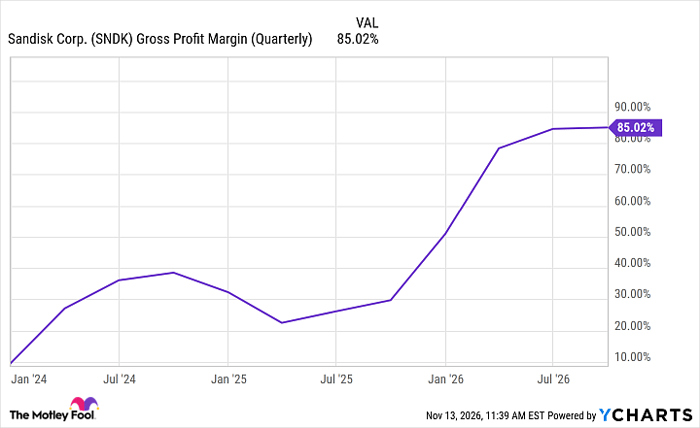
SNDK Gross Profit Margin (Quarterly) data by YCharts
However, the big question is whether the company can maintain these incredible margins, or whether those margins will come crashing down.
Memory pricing matters
For Sandisk, its gross margins are driven more by the price customers are willing to pay than by the input costs for its products. Therefore, it may be helpful to think of Sandisk's business like a hotel. The same rooms are far more profitable at $400 per night than at $150 per night, with many of the hotel's costs remaining steady.
Similarly, the supply-and-demand dynamics of the memory market have an enormous effect on Sandisk's gross margins. If memory demand were to pull back, perhaps as a result of slowing AI infrastructure investment, Sandisk's gross margins could tumble. On the other hand, if the company's long-term memory contracts prove durable, Sandisk's gross margins may remain resilient.
Any buying decision should survive the split date
Stock splits alone do not make a stock an attractive investment. The split changes the unit size; profits determine the investment's appeal.
As a result, Sandisk must maintain its impressive gross margins in future quarters in order to justify its appeal. The stock already trades at a price-to-sales (P/S) ratio of 4.6. That's down significantly from its peak of over 25 in June, but it remains far above its 2025 average multiple of around 1.7.
The market has already priced a major step into Sandisk's profitability. If that fall doesn't materialize, the stock could be primed for a move higher. That's why I'm intrigued by Sandisk's gross margins, not its upcoming stock split.
Should you buy stock in Sandisk right now?
Before you buy stock in Sandisk, consider this:
The Motley Fool Stock Advisor analyst team just identified what they believe are the 10 best stocks for investors to buy now… and Sandisk wasn’t one of them. The 10 stocks that made the cut could produce monster returns in the coming years.
Consider when Netflix made this list on December 17, 2004... if you invested $1,000 at the time of our recommendation, you’d have $335,171!* Or when Nvidia made this list on April 15, 2005... if you invested $1,000 at the time of our recommendation, you’d have $1,000,640!*
Now, it’s worth noting Stock Advisor’s total average return is 823% — a market-crushing outperformance compared to 208% for the S&P 500. Don't miss the latest top 10 list, available with Stock Advisor, and join an investing community built by individual investors for individual investors.
See the 10 stocks »
*Stock Advisor returns as of November 16, 2026.
Jake Lerch has no position in any of the stocks mentioned. The Motley Fool has no position in any of the stocks mentioned. The Motley Fool has a disclosure policy.
Recommended Articles


