


Down 60% in 2026, Is SoundHound Stock a Buy With Sustained Profitability Around the Corner?
Key Points
SoundHound stock has been crushed as it works to integrate a large acquisition and shift revenue models.
The stock is starting to look like an interesting speculative rebound candidate.
- 10 stocks we like better than SoundHound AI ›
SoundHound AI (NASDAQ:SOUN) shares have been decimated this year after the company decided to acquire troubled LivePerson, with the deal being completed in September. While LivePerson's market cap was small, the company carried significant debt, which SoundHound AI quickly retired through an equity raise. With that now behind the company and management targeting sustained profitability in the second half of next year, now could be the time to buy this beaten-down AI stock.
Cost-saving and model shift
Following the completion of its acquisition of LivePerson, SoundHound AI announced that it is transitioning its revenue model. It will reduce its reliance on licensing deals and shift its focus to a recurring-revenue, hosted-solution model. This will be led by its new voice-native agentic AI orchestration platform, OASYS.
Missed AI’s "Act 1"? Act 2 Could Be 15x Bigger. Most investors think they missed the AI boat because they didn't buy Nvidia in 2005. But according to our analysts, we’re only at the end of "Act 1"—the R&D phase. "Act 2" is the global rollout. Continue »
The company said its OASYS platform is the merging of technology from six pioneering companies that create a leading voice, language intelligence, and agentic AI orchestration solution. The platform is AI model-agnostic and can layer over humans to handle as much work through AI as possible. Meanwhile, it's partnered with outsourcers, resellers, and cloud marketplaces with established relationships, enabling it to reach thousands of new enterprise customers.
SoundHound AI, meanwhile, is already working to upsell the large customer base it acquired with LivePerson. It has reached out to LivePerson's 90 largest enterprise customers, which account for over $100 million in annual recurring revenue (ARR), and says the response has been "overwhelmingly positive." It said its acquisition has removed LivePerson customers' main sticking points, which were questions about the company's financial health and the lack of an enterprise-grade voice and agent AI solution.
Overall, for Q3, SoundHound AI's revenue jumped 48.5% to $62.4 million, fueled by strong product demand and $14 million in revenue from LivePerson. That was below the $65.8 million analyst consensus, as revenue was affected by the transition in the revenue model.
The company is still not yet profitable. Its adjusted EPS came in at a $0.05 loss compared to $0.03 loss in the year-ago period. Adjusted earnings before interest, taxes, depreciation, and amortization (EBITDA), meanwhile, was a loss of $20.7 million versus a loss of $14.5 million a year ago.
Its gross margin fell 850 basis points year over year to 34.1%, while its adjusted gross margin sank 900 basis points to 50.3%. However, SoundHound AI is optimistic about future gross margin expansion, as it deliberately chooses not to renew acquired negative-gross-margin contracts worth around $15 million and de-emphasizes low-growth lines of business. Meanwhile, the company has identified $120 million in annual cost savings following the LivePerson deal, which led it to forecast sustained adjusted EBITDA profitability starting in the second half of 2027.
With the LivePerson deal closed, the company now expects to hit full-year 2026 revenue of between $250 million and $260 million. For 2027, it projected revenue of between $350 million and $400 million, which compared to a prior forecast for revenue of at least $350 million.

Is the stock a buy?
SoundHound AI's stock has struggled mightily over the past couple of years, and the LivePerson acquisition, the roll-off of acquired negative-gross-margin contracts, and the shift to a recurring revenue business model make things a bit messy going forward. In that mess, though, it looks like there is a good opportunity for SoundHound AI to use LivePerson's customer base to become a premier player in the customer service and call center space with its OASYS platform.
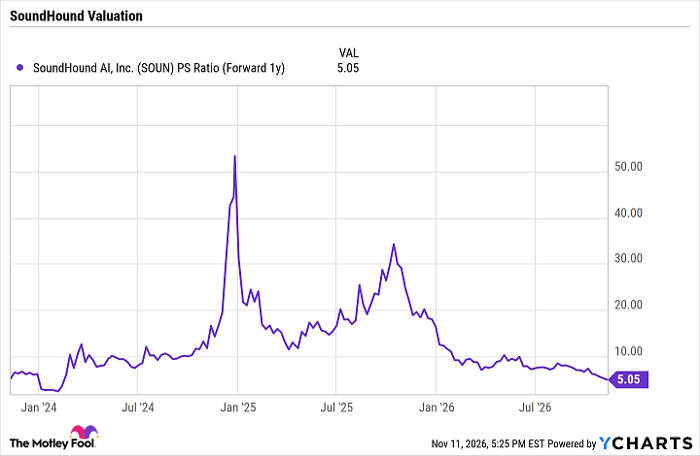
SOUN PS Ratio (Forward 1y) data by YCharts
The stock's valuation has come down significantly, and it now trades at a forward price-to-sales (P/S) ratio of 5 times 2027 analyst estimates. Now, the company will have to execute and improve its gross margin and profitability to justify that multiple, but the stock is starting to get interesting as a rebound candidate for next year. As such, I'd be willing to take a flier on this speculative growth stock down at these levels.
Should you buy stock in SoundHound AI right now?
Before you buy stock in SoundHound AI, consider this:
The Motley Fool Stock Advisor analyst team just identified what they believe are the 10 best stocks for investors to buy now… and SoundHound AI wasn’t one of them. The 10 stocks that made the cut could produce monster returns in the coming years.
Consider when Netflix made this list on December 17, 2004... if you invested $1,000 at the time of our recommendation, you’d have $335,171!* Or when Nvidia made this list on April 15, 2005... if you invested $1,000 at the time of our recommendation, you’d have $1,000,640!*
Now, it’s worth noting Stock Advisor’s total average return is 823% — a market-crushing outperformance compared to 208% for the S&P 500. Don't miss the latest top 10 list, available with Stock Advisor, and join an investing community built by individual investors for individual investors.
See the 10 stocks »
*Stock Advisor returns as of November 15, 2026.
Geoffrey Seiler has no position in any of the stocks mentioned. The Motley Fool has positions in and recommends SoundHound AI. The Motley Fool has a disclosure policy.
Recommended Articles


