


1 Magnificent Cybersecurity Stock That Might be a Better Value Than CrowdStrike and Palo Alto Networks
Key Points
Artificial intelligence (AI) is creating entirely new internal and external cyber risks for modern enterprises.
Tenable offers a comprehensive portfolio of exposure management products, which proactively identify vulnerabilities so enterprises can fix them before they are exploited.
Tenable stock has doubled so far this year, but it's still cheaper than its peers in the cybersecurity industry.
- Motley Fool Issues Rare "Total Conviction" Buy Alert ›
Artificial intelligence (AI) is creating significant cyber risks. Not only are hackers using it to stage sophisticated attacks, but businesses deploying chatbots and agents are also placing their valuable data at risk.
Cybersecurity is now a top priority for most organizations, so the best vendors are experiencing a surge in demand. As a result, Tenable (NASDAQ: TENB) stock has rocketed higher by 106% so far in 2026 (as of the market close on Oct. 28), crushing the S&P 500, which is up by just 13%.
Missed AI’s "Act 1"? Act 2 Could Be 15x Bigger. Most investors think they missed the AI boat because they didn't buy Nvidia in 2005. But according to our analysts, we’re only at the end of "Act 1"—the R&D phase. "Act 2" is the global rollout. Continue »
Tenable specializes in exposure management, a proactive form of enterprise cybersecurity that uncovers vulnerabilities in corporate networks before malicious actors can take advantage of them. Despite its blistering gain this year, Tenable is still one of the cheapest stocks in the cybersecurity industry, so here's why it could be a solid long-term buy.

Image source: Getty Images.
Securing the AI boom with exposure management
Tenable owns the Nessus platform, which constantly scans operating systems, networks, and devices for weak points, so managers can fix them before they are exploited. It's the cybersecurity industry's most widely deployed and most accurate tool for identifying vulnerabilities, but it's not enough to completely protect modern enterprises in the AI era, so Tenable offers an expanding portfolio of advanced products.
The Tenable One platform aggregates these products to deliver the industry's most comprehensive exposure management solution. It's powered by the Hexa AI agentic engine, which orchestrates a fleet of AI agents that constantly run scans, build risk dashboards, and schedule remediation, even while human security teams are offline. It generates an understanding of how each corporate asset interacts, so it has the contextual knowledge required to identify vulnerabilities.
During the third quarter of 2026 (ended Sept. 30), Tenable introduced the Tenable One Adversary View, which uses Anthropic's Claude Mythos AI models to simulate the perspective of an attacker. In other words, this tool allows security teams to look at their digital environment through the eyes of a hacker, which is an entirely new way to surface potential vulnerabilities.
Tenable One also includes a tool called AI Exposure, which minimizes potential vulnerabilities by keeping track of the sensitive assets every internal AI application can access. Further, it monitors how employees are using those applications, so it can uncover instances of prompt injection, a technique hackers use to trick chatbots and agents into handing over sensitive data by disguising malicious requests as legitimate instructions.
Tenable has over 40,000 enterprise customers. At the end of the third quarter, 5,000 of them had adopted the Tenable One platform, up by a whopping 67% from the year-ago period. This suggests more organizations are opting for comprehensive all-in-one solutions to achieve the appropriate level of security.
Revenue growth just accelerated
Tenable generated $276.4 million in revenue during the third quarter, topping management's forecasted range of $270 million to $273 million. It was a 9.5% increase from the year-ago period, marking an acceleration from the 8.6% growth the company delivered in the second quarter three months earlier.
Tenable could be growing its revenue even faster, but it's carefully managing costs to improve its bottom line. Its total operating expenses increased by just 5.2% during the third quarter, and since revenue grew faster, its generally accepted accounting principles (GAAP) net income increased by a whopping 400% to $11.3 million.
After excluding one-off and non-cash expenses like stock-based compensation, Tenable delivered an even bigger adjusted (non-GAAP) net income of $72.9 million, up 41.8% year over year. Consistent profits will result in a more sustainable business over the long term, giving management the ability to strategically invest in growth when appropriate.
Tenable stock looks like a bargain compared to its peers
Tenable stock is trading at a price-to-sales (P/S) ratio of 5.5, so it's cheaper than the technology-heavy Nasdaq-100 index which has a P/S ratio of 6.7. It's also much cheaper than each of its peers in the cybersecurity space, CrowdStrike, Palo Alto Networks, Zscaler, and SentinelOne, which trade at P/S ratios of between 7.8 and 50.8.
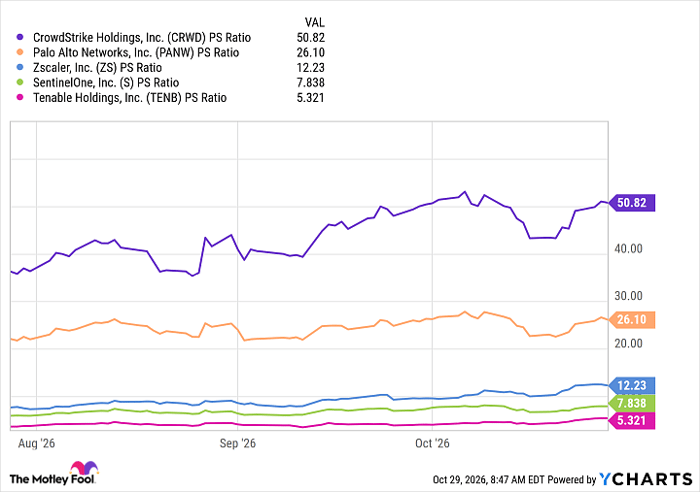
CRWD PS Ratio data by YCharts
Each of those companies generates more revenue than Tenable and is growing at a faster pace, so they deserve premium valuations. However, I think the substantial gap between Tenable's P/S ratio and CrowdStrike's P/S ratio is difficult to justify, particularly given the recent momentum in Tenable One adoption.
I'm not suggesting Tenable's P/S ratio will ever rise to above 50, but I think there is room for upside. Therefore, this stock could be a great buy for investors who want exposure to the cybersecurity industry at an attractive price as AI transforms the threat landscape.
Should you buy stock in Tenable right now?
Before you buy stock in Tenable, consider this:
The Motley Fool Stock Advisor analyst team just identified what they believe are the 10 best stocks for investors to buy now… and Tenable wasn’t one of them. The 10 stocks that made the cut could produce monster returns in the coming years.
Consider when Netflix made this list on December 17, 2004... if you invested $1,000 at the time of our recommendation, you’d have $334,793!* Or when Nvidia made this list on April 15, 2005... if you invested $1,000 at the time of our recommendation, you’d have $1,257,420!*
Now, it’s worth noting Stock Advisor’s total average return is 874% — a market-crushing outperformance compared to 209% for the S&P 500. Don't miss the latest top 10 list, available with Stock Advisor, and join an investing community built by individual investors for individual investors.
See the 10 stocks »
*Stock Advisor returns as of November 1, 2026.
Anthony Di Pizio has no position in any of the stocks mentioned. The Motley Fool has positions in and recommends CrowdStrike and Zscaler. The Motley Fool recommends Palo Alto Networks. The Motley Fool has a disclosure policy.
Recommended Articles


