


Betting on Archer Aviation or Joby Aviation Being the Tesla of eVTOLs? They Could End Up More Like Lucid.
Key Points
There are still huge questions about whether Archer and Joby can scale effectively.
Lucid's history of significant operating losses and stock dilution could be a warning sign for investors in Archer and Joby.
- Motley Fool Issues Rare "Total Conviction" Buy Alert ›
Archer Aviation (NYSE: ACHR) and Joby Aviation (NYSE: JOBY) are the highest-profile players in the U.S. electric vertical take-off and landing (eVTOL) market. Each company's future in the commercial eVTOL space hinges on scaling production and harnessing efficiencies that lead to margin improvements.
While economies-of-scale benefits from much higher vehicle production numbers and adoption in flight services could eventually pave the way to profitability, the chances of either company achieving profitability in the consumer market over the next five years look very low. I actually think there are good reasons to doubt whether Joby or Archer will achieve positive gross margin in the consumer category by the end of 2030.
Missed Nvidia in 2009? This Rare Signal Is Flashing Again. In 2009, a "Double Down" signal flashed for a little-known chipmaker called Nvidia. For the first time in years, that same "Total Conviction" signal is flashing for a company 1/100th the size of Nvidia. Continue »

Image source: Getty Images.
As an example of the challenges that come with scaling toward profitability in the broader electric vehicle market, I think the trajectory of Lucid (NASDAQ: LCID) is instructive. Lucid is a manufacturer of luxury electric cars and SUVs, not eVTOL aircraft -- but its business provides data that may be useful in modeling the outlook for Archer and Joby.
Lucid's struggles present a warning to Archer and Joby investors
Lucid is an upstart player in the EV market that has struggled to scale effectively despite its vehicles generally being highly regarded.
- The company's vehicle production increased 24% year over year to 4,774 vehicles in this year's second quarter; deliveries increased 19% year over year to 3,953 vehicles; and revenue increased 56% year over year to roughly $405 million.
- The performance brought the company's sales across the first half of the year to $687.8 million -- up from roughly $494.5 million in the prior-year period.
- On the other hand, Lucid's cost of goods sold rose from $995.3 million to $1.43 billion in the first half, partially due to supply chain challenges.
- The business posted a gross margin of -112.6% in this year's first half -- worsening from its gross margin of -101.3% in the prior-year period.
Again, the comparison between Lucid's business and Joby and Archer isn't an exact one -- but it is instructive when it comes to potential challenges inherent to relying on economies of scale to drive suitable margin expansion. Despite producing and delivering thousands of vehicles a quarter, Lucid has never even gotten close to posting positive gross margins.
What's the production outlook like for Joby and Archer?
Joby has said that it expects to reach production output of four aircraft per month in 2027, and it has a long-term target of producing 500 annually. Meanwhile, Archer Aviation says that it expects to produce 650 aircraft per year by 2030 -- but its most recent detailed update came in 2025 and said it only had three in the final assembly stage. Archer has since stopped providing production updates.
Joby and Archer are currently producing a very small number of aircraft, and neither company has Federal Aviation Authority (FAA) type certification for their flagship commercial eVTOL aircraft -- so it probably makes little sense to lock in production scaling at this point. There's a significant risk that each company's production levels in 2030 will be below the levels needed to generate substantial gross profits -- or any gross profits at all.
What Lucid's challenges could tell us about scaling in the eVTOL market
Archer and Joby look poised to have different mixes in unit sales and ride-service revenues. Meanwhile, Lucid generates all of its revenue from one-off vehicle sales essentially.
Compared to the revenue Lucid generates from a single vehicle sale, Archer and Joby will almost certainly be able to generate far more revenue either from one-off sales of an eVTOL aircraft or from operating it on a service-based model. On the other hand, the production costs for either one of their eVTOL aircraft will also be far above what it costs Lucid to make a vehicle.
- Electric cars and SUVs are largely known commodities in terms of design, manufacturing, and production scaling at this point.
- By comparison, both Archer and Joby's flagship eVTOL aircraft have yet to receive the FAA type certification required for commercial operations -- and some big questions remain about each design.
- Joby appears to have a lead over Archer in getting its eVTOL aircraft on track for potential FAA certification, but its commercialization outlook also appears highly uncertain.
The bull case for Archer and Joby in commercial eVTOLs essentially hinges on their ability to accomplish something similar to what Tesla did in the electric vehicle market. Tesla shifted to positive gross margins with the launch of the Model S in 2012 and finally recorded its first year of positive net income in 2020.
Tesla's ability to achieve positive gross margins with the Model S was partially driven by its use of existing or lightly customized automobile components. By comparison, both Archer and Joby will be far more reliant on proprietary parts, which entail higher manufacturing costs. Tesla also had the benefit of launching its vehicles into an already well-established auto market and of being a first mover in a category with substantial demand.
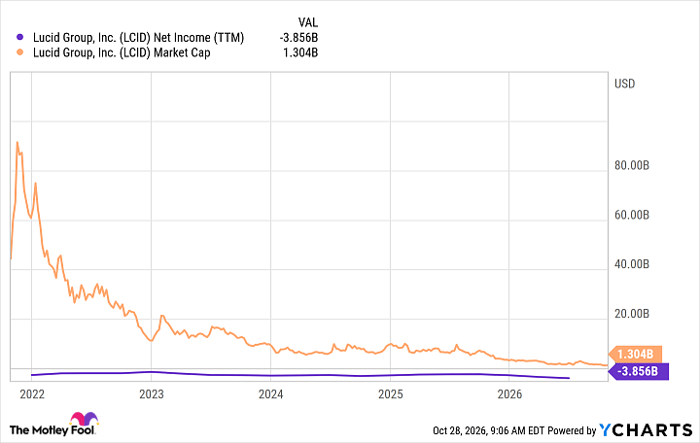
LCID Net Income (TTM) data by YCharts
Given the challenges and uncertainties surrounding the launch and scaling of commercial eVTOL operations, there's a substantial risk that Archer and Joby wind up performing more like Lucid than Tesla. Lucid shareholders have been hit by massive stock dilution as the company has sold new stock to raise funds amid huge operating losses.
A similar dynamic could play out for Archer and Joby investors even if both businesses eventually get the all-clear from the FAA. Notably, both companies have recently been making pushes into the defense space through acquisitions. The diversification initiatives look like smart moves, but the pivots may also underscore just how shaky the outlook is for profitable commercial eVTOL scaling right now.
Should you buy stock in Archer Aviation right now?
Before you buy stock in Archer Aviation, consider this:
The Motley Fool Stock Advisor analyst team just identified what they believe are the 10 best stocks for investors to buy now… and Archer Aviation wasn’t one of them. The 10 stocks that made the cut could produce monster returns in the coming years.
Consider when Netflix made this list on December 17, 2004... if you invested $1,000 at the time of our recommendation, you’d have $334,631!* Or when Nvidia made this list on April 15, 2005... if you invested $1,000 at the time of our recommendation, you’d have $1,312,844!*
Now, it’s worth noting Stock Advisor’s total average return is 893% — a market-crushing outperformance compared to 213% for the S&P 500. Don't miss the latest top 10 list, available with Stock Advisor, and join an investing community built by individual investors for individual investors.
See the 10 stocks »
*Stock Advisor returns as of October 31, 2026.
Keith Noonan has no position in any of the stocks mentioned. The Motley Fool has positions in and recommends Tesla. The Motley Fool has a disclosure policy.
Recommended Articles


