


These 2 Nearly 100% Historically Accurate Market Signals Are Conflicting. Here's What Investors Should Do.
Key Points
A CAPE ratio exceeding 38 has signaled past market crashes.
The market, however, is entering one of its historically strongest periods, during which stocks have risen 95% of the time since 1938.
- Motley Fool Issues Rare "Total Conviction" Buy Alert ›
Two of the stock market's most accurate historical signals -- one bearish and one bullish -- are currently butting heads. The conflicting signs have left many investors confused about what to do, but the answer is actually very simple: Remain invested, dollar-cost average into index exchange-traded funds (ETFs) such as the Vanguard S&P 500 ETF (NYSEMKT: VOO), and avoid trying to time the market.
However, before I explain this strategy, let's look at the two conflicting market signals that have been nearly 100% accurate in the past.
Missed Nvidia in 2009? This Rare Signal Is Flashing Again. In 2009, a "Double Down" signal flashed for a little-known chipmaker called Nvidia. For the first time in years, that same "Total Conviction" signal is flashing for a company 1/100th the size of Nvidia. Continue »
The bearish signal
The cyclically adjusted price-to-earnings (CAPE) ratio has climbed above 30 only five times before, and each time saw the stock market subsequently crash. The valuation metric was created by Yale economist Robert Shiller as a way to remove boom-and-bust cycles when valuing the S&P 500 index (SNPINDEX: ^GSPC). It uses the S&P 500's 10-year inflation-adjusted earnings per share. While the metric was designed to predict subsequent 10-year S&P 500 returns, every time it has traded at extreme levels, the market has crashed soon after.
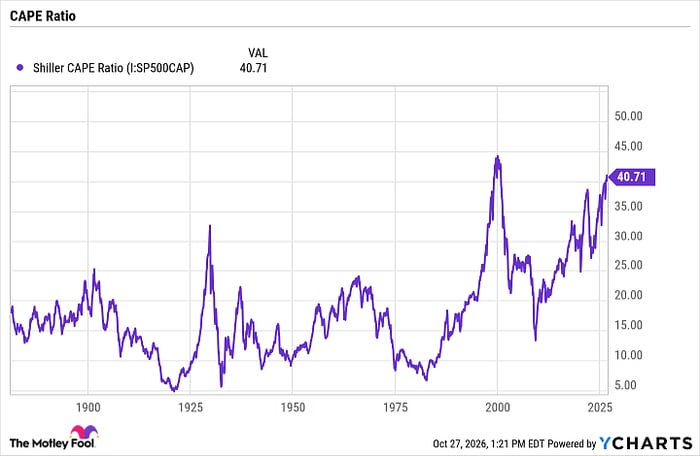
Shiller CAPE Ratio data by YCharts
The first time the CAPE ratio climbed above 30 was before the Great Depression, and that didn't end well. Its highest level was during the dot-com bubble, and it eventually peaked above 44. That was subsequently followed by the internet bubble bursting and the stock market plunging.
The second time the CAPE exceeded 38 was in November 2021, right before the 2022 bear market. In both instances, the tech sector and Nasdaq index led the market lower. It also climbed above 30 before the COVID-19 crash and in 2017-2018 before a big pullback at the end of 2018.
The CAPE ratio is once again above 38, sitting right around 40. If history repeats itself, it could lead to another bear market. Notably, this can take time to play out. For example, the CAPE first exceeded 30 during the dot-com bubble in 1997, but the market didn't crash until 2000, when it was much higher.
Image source: Getty Images.
The bullish indicator
While the CAPE ratio signals a potential bear market on the horizon, the market is entering one of its historically strongest periods. Since 1938, the market has risen in the following 12 months after midterm elections 95% of the time. And since 1950, the S&P 500 has generated an average annual return of 14.5% from November to November following midterm elections.
In fact, we are right at the start of what are historically two of the best quarters to own stocks. During the fourth quarter of midterm election years, the S&P 500 has risen in 84% of quarters since 1950, generating an average quarterly return of 6.6%. The first quarter of the following year is even stronger, with the S&P 500 up nearly 95% of the time with a 7.4% average quarterly return. The second quarter also tends to go well, with the S&P 500 producing gains 74% of the time with an average quarterly return of 5%.
If history holds, the stock market should have another strong 12 months of gains ahead of it.
What investors should do
Trying to time the market is nearly impossible and can lead to significant underperformance. Legendary investor Peter Lynch famously noted that more money has been lost trying to predict market downturns than in bear markets themselves.
Meanwhile, even if an investor can correctly predict a market pullback, they must also accurately guess when to get back into the market. Studies have found that if investors had missed the 10 best days in the market over the past 30 years, their returns would have been cut more than in half. Meanwhile, 76% of these top-performing days happened during bear markets or the first two months of a new bull market.
Ultimately, time in the market will beat market timing over the long run. Dollar-cost averaging into index ETFs, such as the Vanguard S&P 500 or Invesco QQQ Trust (NASDAQ: QQQ), which tracks the Nasdaq-100 Index, has been a proven way to build wealth over time. So while it may be fun or frightening to try to predict where the market is headed, it's best not to become too concerned about it. The market has always bounced back, and you have more to lose by incorrectly predicting a bear market.
Should you buy stock in S&P 500 Index right now?
Before you buy stock in S&P 500 Index, consider this:
The Motley Fool Stock Advisor analyst team just identified what they believe are the 10 best stocks for investors to buy now… and S&P 500 Index wasn’t one of them. The 10 stocks that made the cut could produce monster returns in the coming years.
Consider when Netflix made this list on December 17, 2004... if you invested $1,000 at the time of our recommendation, you’d have $334,308!* Or when Nvidia made this list on April 15, 2005... if you invested $1,000 at the time of our recommendation, you’d have $1,323,413!*
Now, it’s worth noting Stock Advisor’s total average return is 897% — a market-crushing outperformance compared to 213% for the S&P 500. Don't miss the latest top 10 list, available with Stock Advisor, and join an investing community built by individual investors for individual investors.
See the 10 stocks »
*Stock Advisor returns as of October 30, 2026.
Geoffrey Seiler has positions in Invesco QQQ Trust and Vanguard S&P 500 ETF. The Motley Fool has positions in and recommends Vanguard S&P 500 ETF. The Motley Fool has a disclosure policy.
Recommended Articles


