


Just 3 "Magnificent Seven" Stocks Remain Founder-Led. Should Investors Bet on Elon Musk, Mark Zuckerberg, or Jensen Huang for the Long Term?
Key Points
Nvidia's Jensen Huang got his start working as an engineer at Advanced Micro Devices.
Mark Zuckerberg has shown that he's not afraid to take chances.
Elon Musk turned Tesla around -- but also burned some bridges.
- 10 stocks we like better than Nvidia ›
The group of stocks that have been dubbed the "Magnificent Seven" has a huge impact on the overall performance of the stock market. It was 2023 when Bank of America analyst Michael Hartnett first pinned that phrase on tech sector giants Nvidia (NASDAQ: NVDA), Amazon, Apple, Alphabet, Meta Platforms (NASDAQ: META), Microsoft, and Tesla (NASDAQ: TSLA), and since then, they have grown to a combined market cap of $22 trillion. Collectively, they make up nearly one-third of the value of the S&P 500.
But what many investors may be overlooking is that the leadership of these companies has changed. Titans such as Jeff Bezos and Bill Gates have moved on. In fact, only three of these companies currently have founders who are actively guiding their direction -- Jensen Huang at Nvidia, Mark Zuckerberg at Meta Platforms, and Elon Musk at Tesla.
Where to invest $1,000 right now? Our analyst team just revealed what they believe are the 10 best stocks to buy right now, when you join Stock Advisor. See the stocks »
These three have very different visions for their companies, with unique strengths and risks. But is there one who is the best investment for the long term?
I think the answer is clear.
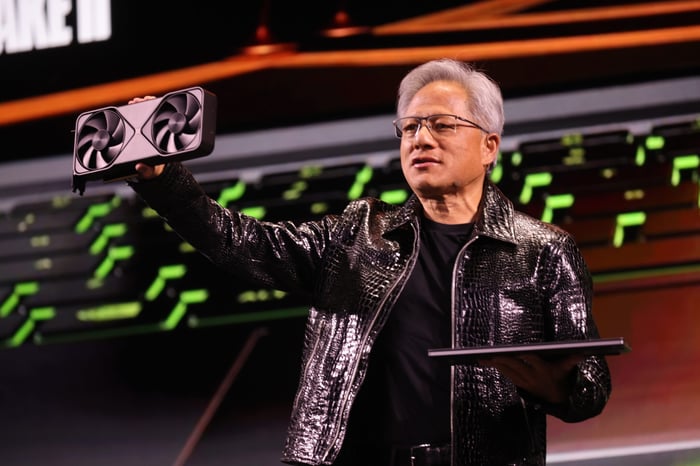
Nvidia CEO Jensen Huang. Image source: Nvidia.
Nvidia's Jensen Huang: Strategic focus
Huang is an electrical engineer who began his career as a microprocessor designer at Advanced Micro Devices. By 1993, he and two others founded Nvidia to design graphics chips for video games, and Huang became CEO.
The company's graphics processing units (GPUs) were great for gaming, but Nvidia really started gaining steam when it developed the parallel computing platform known as CUDA, which allowed developers to write and execute code that allowed GPUs to be used for other purposes. Researchers later discovered that GPUs were ideal for handling the heavy parallel processing needs of deep learning.
Today, Nvidia's GPUs are considered the gold standard for training and running AI programs. Nvidia's most recent quarter showed $81.61 billion in revenue, with $75.2 billion of that coming from data center sales.
Meta's Mark Zuckerberg: Making huge bets
Zuckerberg famously founded Facebook, now known as Meta Platforms, at age 19 while a student at Harvard University. The site was originally designed to help students match up the names and faces of their fellow students, but it has since grown to a mammoth social media/artificial intelligence company that operates Facebook, Instagram, WhatsApp, Messenger, and Threads. The company's apps are used by an average of 3.56 billion people per day.
Zuckerberg isn't afraid to take chances. In 2021, he led the company's rebrand from Facebook to Meta Platforms as he shifted its focus toward building a digital metaverse and virtual reality technology. Meta Platforms spent $80 billion on its metaverse aspirations, but Zuckerberg's vision never paid off.
"Sometimes, we knock it out of the park," Samantha Ryan, vice president of content at Meta's Reality Labs division, wrote in a blog post. "Other times, we get things wrong."
Now, Meta has shifted its attention to artificial intelligence, investing heavily in data centers and computing capacity, which up until now, it has used entirely for its own needs. However, Bloomberg reports that it is preparing to get into the cloud infrastructure business and lease capacity to external customers, and it's in the process of building a massive 5-gigawatt data center campus in Louisiana.
Tesla's Elon Musk: Big ambition, big risk
First things first -- let's acknowledge that Musk is recognized as a founder of Tesla, but he wasn't there at the beginning. The electric vehicle company was founded in 2003 by two engineers; Musk joined a year later, investing $6.5 million and becoming chairman of the board. A legal settlement later saw him recognized as one of its five founders.
Musk successfully turned Tesla around, thanks in part to his vision, personality, and work -- he famously slept on the factory floor for months in 2017 and 2018 as Tesla brought its Model 3 into production.
Today, Tesla's core business remains electric vehicles (EVs), but it's also deeply involved in artificial intelligence. The company is developing full self-driving (FSD) technology, hoping to gain widespread regulatory approval for autonomous vehicles to operate. And it's developing its Optimus humanoid robots, which Musk hopes will be used for general labor, manufacturing, and household chores.
But Musk's ambition and force of will can work against him as well. He got heavily involved in politics and took a short-lived post running President Donald Trump's now-defunct Department of Government Efficiency (DOGE). But that work hurt Tesla's brand, and Musk says he now regrets his involvement.
"I think instead of doing DOGE, I would have basically worked on my companies," he said in December.
The verdict
Undoubtedly, all three of these founder CEOs have been wildly successful. But if I had to choose just one to bet on for continued success over the long term, my money would be on Huang. Nvidia has the widest competitive moat with its GPUs. Meta Platforms, meanwhile, is investing heavily just to have the opportunity to potentially compete with a host of established cloud computing providers, and Tesla's Optimus robots and unsupervised FSD technology remain highly speculative long-term bets.
For those reasons, I'm picking Nvidia.
Should you buy stock in Nvidia right now?
Before you buy stock in Nvidia, consider this:
The Motley Fool Stock Advisor analyst team just identified what they believe are the 10 best stocks for investors to buy now… and Nvidia wasn’t one of them. The 10 stocks that made the cut could produce monster returns in the coming years.
Consider when Netflix made this list on December 17, 2004... if you invested $1,000 at the time of our recommendation, you’d have $377,990!* Or when Nvidia made this list on April 15, 2005... if you invested $1,000 at the time of our recommendation, you’d have $1,269,518!*
Now, it’s worth noting Stock Advisor’s total average return is 896% — a market-crushing outperformance compared to 206% for the S&P 500. Don't miss the latest top 10 list, available with Stock Advisor, and join an investing community built by individual investors for individual investors.
See the 10 stocks »
*Stock Advisor returns as of July 27, 2026.
Patrick Sanders has positions in Nvidia. The Motley Fool has positions in and recommends Advanced Micro Devices, Alphabet, Amazon, Apple, Meta Platforms, Microsoft, Nvidia, and Tesla. The Motley Fool has a disclosure policy.
Recommended Articles


