


If I Were Starting Over With $500 to Invest, I'd Begin by Building a Portfolio Around This Unstoppable Stock
Key Points
Past performance is no guarantee of future results. But it is a pretty good indication of what the future likely holds.
One particular company is so integral to the worldwide web that many people -- even some companies -- view it and the internet as one and the same.
More than a decade’s worth of hyper-reliable revenue growth confirms this organization is unstoppable.
- 10 stocks we like better than Alphabet ›
Like most investors, I stepped into the stock market rather cautiously, doing my best to follow Warren Buffett's primary rule: "Don't lose money."
Three decades later, I now realize I didn't fully appreciate the nuances of this tip. Namely, I conflated temporary setbacks with locking in losses. Oh, I knew the difference between realized and unrealized. It's just that, mentally, I convinced myself that some pullbacks never stop. Big mistake. Most do. This mindset kept me out of some stocks that would have ended up being very big winners.
Where to invest $1,000 right now? Our analyst team just revealed what they believe are the 10 best stocks to buy right now, when you join Stock Advisor. See the stocks »
I can't go back in time and do things over. I can, however, help others learn from my mistakes and tell them the very first stock I would have bought and held back then if I had known then what I know now. That's Google parent Alphabet (NASDAQ: GOOGL) (NASDAQ: GOOG).

Image source: Getty Images.
Alphabet has been unstoppable
OK, Google wasn't around when I first started investing. It wouldn't exist until 1998, and it didn't go public until 2004. If I were just starting out or starting over again today, however, it would be the foundational position in my portfolio.
That surprises a few people. It's a volatile technology stock, after all, and hot tech stocks come and go, replaced by the next great ones.
Except, that's clearly not been the case here. Over the past 28 years, Alphabet's Google has become the primary gatekeeper of the World Wide Web. Over 90% of the planet's web search queries are made using Google, according to numbers from Statcounter, while Google's operating system Android is installed on nearly 70% of the world's mobile devices. Gmail remains the most-used free email service with (company-reported) 3 billion users, and within the United States, YouTube garners more total watch-time than Netflix and all of Disney's streaming services combined. And the use of all of these platforms is a self-enforcing habit that would be tough to break now. Alphabet simply needs to optimize how it monetizes all of this traffic.
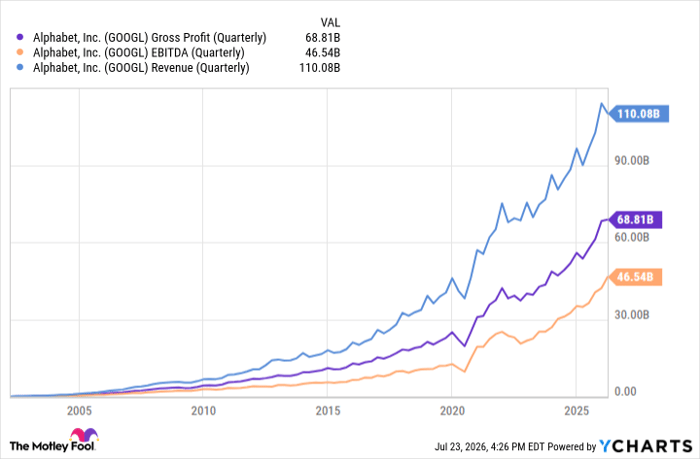
And it's gotten very good at doing exactly that. Except for the second quarter of 2020, when the COVID-19 pandemic was rattling the world, not one quarter since 2012 has seen this company fail to produce year-over-year revenue growth. Profit growth has been almost as reliable.
Data by YCharts.
Q2 results reaction was just another predictable pullback
Sure, the stock's down following Wednesday evening's release of its second-quarter results. Investors are worried about the additional money it's planning to spend on artificial intelligence for the remainder of 2026. Alphabet was budgeting between $180 billion and $190 billion in capital expenditures this year, but has upped this forecast to a range of $195 billion to $205 billion.
This is one of those temporary -- and even predictable -- setbacks I was talking about, though. Just take a step back and look at the bigger picture. Alphabet is one of the few companies getting a clear, sizable return on its AI investments. Last quarter's cloud computing business grew by more than 80%, more than tripling this segment's operating income.
More than anything, however, it's just difficult to envision a time when Google isn't symbiotically synonymous with the World Wide Web itself. And the internet certainly isn't going away anytime soon.
Should you buy stock in Alphabet right now?
Before you buy stock in Alphabet, consider this:
The Motley Fool Stock Advisor analyst team just identified what they believe are the 10 best stocks for investors to buy now… and Alphabet wasn’t one of them. The 10 stocks that made the cut could produce monster returns in the coming years.
Consider when Netflix made this list on December 17, 2004... if you invested $1,000 at the time of our recommendation, you’d have $377,990!* Or when Nvidia made this list on April 15, 2005... if you invested $1,000 at the time of our recommendation, you’d have $1,269,518!*
Now, it’s worth noting Stock Advisor’s total average return is 896% — a market-crushing outperformance compared to 206% for the S&P 500. Don't miss the latest top 10 list, available with Stock Advisor, and join an investing community built by individual investors for individual investors.
See the 10 stocks »
*Stock Advisor returns as of July 26, 2026.
James Brumley has positions in Alphabet. The Motley Fool has positions in and recommends Alphabet, Netflix, and Walt Disney. The Motley Fool has a disclosure policy.
Recommended Articles


