


Wall Street Thinks Teva Can Soar Over 60%. Here's Why Analysts Are Right.
Key Points
Teva's business is shifting away from generic drugs toward branded drugs.
Operating margins could soar through next year, boosting earnings potential.
The stock has plenty of upside, justifying Wall Street's optimistic price targets.
- 10 stocks we like better than Teva Pharmaceutical Industries ›
Companies must evolve to stay relevant in the pharmaceutical industry. Teva Pharmaceutical Industries (NYSE: TEVA) is in the midst of its own transformation, from making generic drugs and biosimilars to novel drugs that are beginning to deliver growth and profits that are catching Wall Street's eye.
Every single Wall Street analyst polled by CNN Business currently has a buy rating on the pharmaceutical stock. Based on 12-month price targets, Teva could have anywhere from 28% to 60% upside from its current price, according to the analysts.
Where to invest $1,000 right now? Our analyst team just revealed what they believe are the 10 best stocks to buy right now, when you join Stock Advisor. See the stocks »
It seems like a bold call, considering the broader stock market has left the stock in the dust. Teva is down 40% over the past decade. But sometimes, these comeback stories produce the biggest returns. Here's why Wall Street analysts are right to be bullish about the stock right now.

Image source: Getty Images.
Teva is pivoting from generics to boost growth
For a while, Teva had specialized in generics and biosimilars. Generic drugs are often simple formulations that typically sell at low margins. CEO Richard Francis took over in January 2023. He has helped guide the company further into developing novel drugs. This is a riskier path because drug development is expensive and many drugs fail to reach the market. However, a successful drug enjoys years of patent protection and can generate millions, even billions, of high-margin dollars in sales.
Revenue from generic drugs and biosimilars was $612 million in the first quarter of 2026, down 28% from a year ago on weaker generic sales. Generics and biosimilars accounted for 40% of Teva's total sales in Q1, and management expects biosimilars to continue growing and drive this group as generics become a smaller part of the business.
But branded drugs are moving the needle in the right direction. Teva's top-selling drug, Austedo, grew 41% to $559 million. Austedo is a treatment for tardive dyskinesia, a condition that causes involuntary facial movements. Management anticipates Austedo hitting $2.4 billion to $2.55 billion in sales for the full year, up from $2.26 billion in 2025.
Nearly all of Teva's other branded products are much smaller right now, but are growing at double-digit rates.
| Name | Sales in Q1 2026 | Year-Over-Year Growth in Q1 2026 |
|---|---|---|
| Ajovy | $87 million | 64% |
| Copaxone | $62 million | 16% |
| Uzedy | $63 million | 62% |
Source: Table created by author. Data from Teva Pharmaceutical Industries Q1 2026 earnings.
Becoming a better business for the long term
Revenue growth might not jump off the page right away. Despite the impressive growth in these branded sales, Teva expects total revenue to fall from $17.3 billion in 2025 to $16.4 billion to $16.8 billion this year. The key difference here is that these are higher-quality dollars. Management is guiding for 30% operating margins in 2027 as branded sales continue to grow, up from only 12.5% last year.
Teva's biosimilars portfolio is gaining momentum, with sales expected to reach $800 million in 2027, more than offsetting lower generic sales. Additionally, Teva is bolstering its pipeline through acquisition. It recently bought Emalex Biosciences for $700 million, adding ecopipam, a developmental treatment for Tourette's syndrome in children, to its portfolio. Teva filed a New Drug Application with the U.S. Food & Drug Administration for ecopipam last month, following positive data from its Phase 3 clinical trial.
Teva's price targets are attainable
At roughly $31 per share, Teva is trading at 14 times Wall Street's 2026 earnings estimates, and only 10 times 2027 estimates. The leap in earnings from this year to next is likely due to the expectation of those 30% operating margins, as reiterated by management on the company's Q1 earnings call.
That's a pretty inexpensive valuation for a company that suddenly has a lot going for it. Assuming ecopipam hits the market and branded and biosimilar sales continue to grow, Teva should be able to sustain solid earnings growth beyond next year. The low valuation leaves tons of room for that to translate to tangible investment returns.
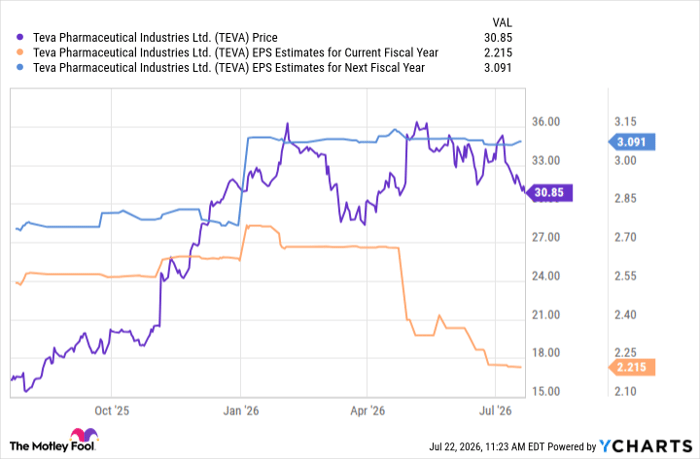
TEVA data by YCharts. EPS = earnings per share.
If Teva delivers results that boost the market's sentiment toward the stock, even trading at just 15 times 2027 earnings estimates puts the share price above Wall Street's median price target of $40. So, these targets are certainly possible if Teva's business continues to perform well.
Should you buy stock in Teva Pharmaceutical Industries right now?
Before you buy stock in Teva Pharmaceutical Industries, consider this:
The Motley Fool Stock Advisor analyst team just identified what they believe are the 10 best stocks for investors to buy now… and Teva Pharmaceutical Industries wasn’t one of them. The 10 stocks that made the cut could produce monster returns in the coming years.
Consider when Netflix made this list on December 17, 2004... if you invested $1,000 at the time of our recommendation, you’d have $377,990!* Or when Nvidia made this list on April 15, 2005... if you invested $1,000 at the time of our recommendation, you’d have $1,269,518!*
Now, it’s worth noting Stock Advisor’s total average return is 896% — a market-crushing outperformance compared to 206% for the S&P 500. Don't miss the latest top 10 list, available with Stock Advisor, and join an investing community built by individual investors for individual investors.
See the 10 stocks »
*Stock Advisor returns as of July 26, 2026.
Justin Pope has no position in any of the stocks mentioned. The Motley Fool has no position in any of the stocks mentioned. The Motley Fool has a disclosure policy.
Recommended Articles


